


Facebook | X | Instagram | YouTube | LinkedIn | Threads | TikTok
Every few months someone sends me a statistic about church shootings. Sometimes it is accurate. Often it is not. The numbers get recycled, sources get dropped, and security teams end up training against a threat picture that does not reflect reality.
This database exists to fix that. Christian Warrior Training has compiled 30 verified active shooter and deadly force incidents at houses of worship in the United States from 1999 to 2026. Every entry is sourced. Every weapon caliber, service phase, casualty count, and motive category has been checked against primary reporting. Where data was not publicly confirmed, it is listed as unconfirmed rather than estimated.
About This Database
The primary scope of this database is Christian churches and Christian ministry facilities. It also includes LDS meetinghouses, Unitarian Universalist congregations, and Jewish synagogues. This is not a theological statement. It is a tactical one.
The LDS Church and the UU Church are included because their members gather in similar ways, at similar times, for similar purposes to Christian congregations, and because attacks on their facilities follow the same patterns of pre-incident indicators, service phase vulnerabilities, and security responses documented throughout the rest of this database. Every tactical lesson from the Grand Blanc LDS attack applies directly to your Sunday morning service. The Knoxville UU attack teaches the same parking lot dispersal lessons as Burnette Chapel Nashville.
Synagogues are included for the same reason, and because the Michigan worship-site cluster of 2025-2026 cannot be understood without Temple Israel.
One additional observation worth making before we get into the data. Christian congregations account for 77% of the incidents in this database. That reflects both the volume of attacks and the sheer number of Christian churches in America. There are approximately 355,000 Christian congregations in the United States compared to roughly 3,700 synagogues. On a per-congregation basis, synagogues face a significantly higher rate of targeted attack. Both communities are under real threat with different threat profiles.
What rarely gets discussed is the steady drumbeat of violence against Christian congregations that receives almost no national coverage. Pittsburgh gets weeks of headlines. Sutherland Springs fades in days. Burnette Chapel barely registers nationally at all. Your congregation is not less of a target because fewer people are talking about it.
Finding 1: The Dominant Weapon Is the Handgun
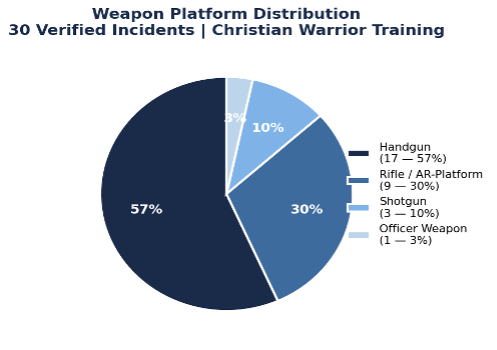
Handguns account for 57% of all incidents in this database, 17 of 30. The 9mm is the single most common caliber, followed by .45 ACP, .40 S&W, and .22-caliber pistols.
Rifles account for 30% of incidents, 9 of 30, and produced the two highest casualty events in the database. Sutherland Springs in 2017, 26 killed and 22 wounded, was a Ruger AR-556 in 5.56mm with 15 thirty-round magazines. Tree of Life Pittsburgh in 2018, 11 killed and 6 wounded, the deadliest synagogue attack in American history, was an AR-15 style rifle combined with three handguns. When a rifle comes through your door, the body count potential is in a different category from a handgun.

Shotguns appeared in 3 incidents. Both the Knoxville 2008 and White Settlement 2019 shotguns were 12-gauge, sawed-off, and concealed under clothing. The White Settlement attack is instructive and critical at the same time. Jack Wilson made an exceptional shot, six seconds, from over 45 feet, to stop Keith Kinnunen. That shot is worth studying. What is also worth studying is how Kinnunen got to the point of making that shot necessary. He entered the building in a wig and a long overcoat concealing a sawed-off shotgun. He was observed by the security team inside, who began tracking him. They did not stop him at the door. He reached the pew, stood up, and killed two deacons before Wilson responded. One man’s marksmanship does not redeem a perimeter that failed. The lesson from West Freeway is not to have a Jack Wilson on your team. It is to build a perimeter that stops Kinnunen before he reaches the pew.
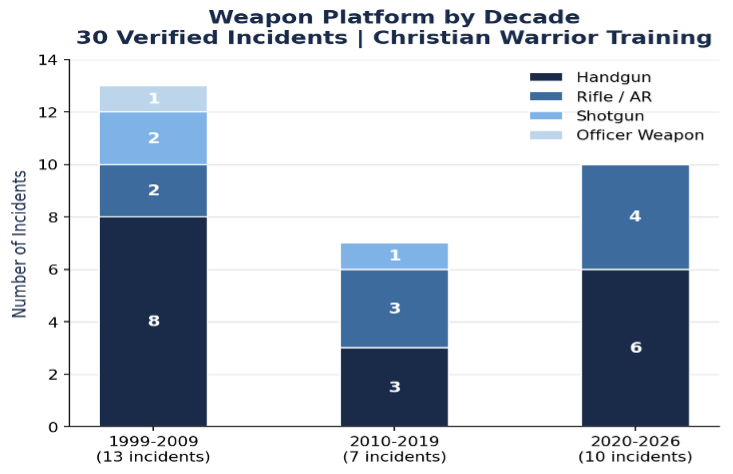
The rifle percentage is increasing. In 1999-2009, rifles were 2 of 13 incidents, about 15%. In 2020-2026, rifles are 4 of 10, 40%. The handgun remains the dominant platform, but any security team that is not training for a rifle threat is training for yesterday’s problem.

Finding 2: Transition Moments Are When Your Guard Is Down
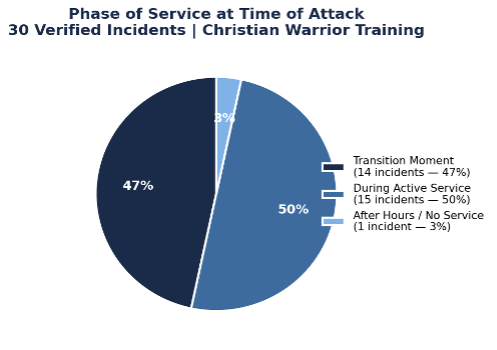
47% of incidents in this database struck during a transition moment. When you apply the full definition of what a transition is, that number tells the real story.
A transition moment is any period of ritual shift, movement, or reduced collective attention within or around the service. It includes the obvious ones: post-service parking lot dispersal, the pre-service foyer, between services, post-service fellowship meals. It also includes moments most security teams do not think about as transitions because they happen inside the sanctuary while the service is technically underway.
Communion distribution is a transition. When deacons move to the front, every eye follows the elements. The congregation is not watching the doors. Keith Kinnunen knew this. He rose from his pew at West Freeway the moment that window opened.
The closing prayer of a Bible study is a transition. Dylann Roof sat with the Wednesday evening group at Emanuel AME for a full hour. He waited until they stood, closed their eyes, and bowed their heads. He chose that moment deliberately.
A children’s musical is a transition in attention. Jim Adkisson entered Tennessee Valley UU during a performance of Annie Jr. with over 200 people in the sanctuary. Every eye was on the children on the stage. His first shot was mistaken for a sound effect. That is not a coincidence. That is a man who understood where the congregation’s attention would be.
The pre-service foyer is a transition. Scott Roeder killed Dr. George Tiller at Reformation Lutheran in Wichita while Tiller was serving as a greeter before service began. The post-service luncheon at Geneva Presbyterian in Laguna Woods was a transition. The hallway at Lakewood Church between services was a transition. The parking lot of an LDS meetinghouse during a funeral in Salt Lake City was a transition.
Thirteen of the 30 incidents in this database occurred at one of these windows. Your security posture should not track the order of service. It should be consistent from the moment the parking lot opens until the last car leaves, with specific attention on every moment your congregation is moving, gathering, or engaged in a ritual that directs their attention away from the doors.

Finding 3: Anti-Religious Hate Is the Leading Motive Category
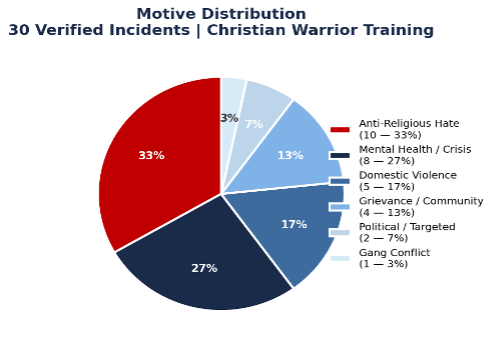
Anti-religious hate is the largest single motive category at 33%, 10 of 30 incidents. This category is broader and more varied than the racial hate framing that dominates the national conversation, and it is worth understanding precisely because the threat profile is different from every other category in this database.
Anti-religious hate attacks are directed at congregations because of who they are as a gathered community of faith. The specific form of that hatred varies. Larry Ashbrook at Wedgwood Baptist in 1999 hated Christians. Matthew Murray at New Life Church in 2007 hated Christianity, having grown up in a deeply religious household and turned that experience into contempt. Jim Adkisson at Knoxville UU in 2008 hated liberals and targeted that congregation for its beliefs. Dylann Roof at Charleston in 2015 was a racial hate crime targeting a historically Black congregation. Emanuel Samson at Burnette Chapel in 2017 targeted that congregation in racial revenge for Charleston. David Wenwei Chou at Laguna Woods in 2022 targeted a Taiwanese congregation. Thomas Sanford at Grand Blanc LDS in 2025 hated Latter-day Saints specifically. Robert Bowers at Pittsburgh in 2018 hated Jews. John Earnest at Poway in 2019 hated Jews. Ayman Ghazali at Temple Israel in 2026 targeted Jews.
These are not the same motive. But they share a structure: the attacker selected the target because of its identity as a gathered community before God. That is what makes this category distinct from domestic violence, where the church is simply the location of someone the attacker knows, or mental health crisis, where the congregation itself may be secondary to the attacker’s internal state.
For your security team, anti-religious hate attacks tend to be operationally deliberate. Roof sat with the group for an hour doing surveillance. Murray attacked two locations the same day. Sanford brought a vehicle, a rifle, and a gasoline accelerant. Ghazali loaded a truck with commercial fireworks and gasoline, sat in the parking lot for over two hours, and called his ex-wife before driving through the entrance. These are not impulsive acts. They are planned. The pre-incident window is longer, the observable indicators are different from a mental health crisis, and the operational preparation tends to be more sophisticated.
A Word on Mental Health and Spiritual Warfare
Mental health is the second-largest motive category at 27%, 8 of 30 incidents. The behavioral indicators that researchers and law enforcement label as mental health warning signs are real and observable. Withdrawal from normal life, escalating agitation, expressions of hopelessness or grievance, dramatic behavioral changes in the days or weeks before an attack.
But if the Bible is true, and it is, then the clinical framework does not have the full picture. Scripture documents demonic activity that produces observable behavioral disturbance in people. Mark 5, Luke 8, Matthew 8. Paul writes about spiritual warfare as a present operating reality, not a historical artifact. What the clinical world calls a mental health crisis may in some cases have a spiritual root that no diagnostic manual can identify.
Both frameworks are observing the same behavior. A man who is in a documented mental health crisis, withdrawing from relationships, expressing grandiose or paranoid beliefs, deteriorating in the weeks before an attack, needs to be reported and intervened with regardless of whether you understand what is driving that behavior as a neurological condition or as spiritual oppression. The reporting pathway is the same. The urgency is the same. The outcome of failing to act is the same.
Finding 4: Domestic Violence Runs Through One in Six Attacks
The Secret Service National Threat Assessment Center published a case study in April 2025 using Sutherland Springs as its primary subject. Their conclusion: the attack was the endpoint of years of documented domestic violence, not a sudden break or an ideological act. The attacker had a history of violence against his wives, against children, against animals. He should not have legally owned a single firearm. He owned several because a military records failure allowed him to pass background checks he should have failed. The Secret Service reported that 41% of all mass attackers have at least one documented incident of domestic violence in their backgrounds.
Five of the 30 incidents in this database follow the domestic violence pattern directly. Greater Oak Baptist Hopkinsville 2001, an estranged husband targeted his wife during the altar call. Ministry of Jesus Christ Baton Rouge 2006, an estranged husband shot four in-laws at the church and then killed his wife at a separate location. First Baptist Sutherland Springs 2017, the church was targeted because his wife’s family attended. Richmond Road Baptist Lexington 2025, a man with prior domestic violence charges drove 16 miles to the church after shooting a state trooper.
Your congregation almost certainly has people in it right now who are in or leaving dangerous relationships. Building a culture where that is visible, and where there is a clear pathway to report a threat and get help, is not only pastoral work. It is security work.
Finding 5: Most Attacks Happen Inside the Building
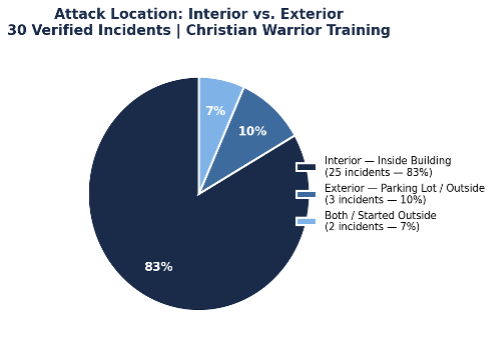
83% of incidents in this database, 25 of 30, occurred primarily inside the building. Three occurred primarily outside, including the Salt Lake City LDS funeral parking lot shooting. Two began outside and moved inside.
The parking lot matters enormously. White Settlement, New Life Colorado Springs, Burnette Chapel Nashville, CrossPointe Wayne, and Salt Lake City all demonstrate what the exterior threat looks like. But when the attack begins, the data says it will most likely begin inside your sanctuary. Your team needs to be positioned, trained, and armed to respond there.
Finding 6: Armed Security Determines the Outcome
This is documented across multiple incidents in this database, not inferred.
New Life Church, Colorado Springs, 2007. Armed volunteer Jeanne Assam stopped Matthew Murray in the foyer before he reached the sanctuary. Two killed in the parking lot. Zero inside the building.
Burnette Chapel, Nashville, 2017. Unarmed usher Robert Engle was pistol-whipped but retrieved his own firearm and held Emanuel Samson at gunpoint. One killed in the parking lot. The attack was contained.
West Freeway Church of Christ, White Settlement, 2019. Jack Wilson, a former reserve deputy and firearms instructor, stopped Keith Kinnunen six seconds after he opened fire. Two killed. Zero additional casualties. Wilson had been training that security team for 18 months before the attack.
CrossPointe Community Church, Wayne, Michigan, 2025. A church deacon struck the attacker with his truck in the parking lot. Armed security killed him outside. Zero congregation fatalities. Approximately 150 people inside.
Chabad of Poway, California, 2019. John Earnest’s rifle jammed after his first magazine. Congregants rushed him and he fled. One killed, three wounded. The congregation’s physical response to the malfunction saved lives.
Congregation Beth Israel, Colleyville, Texas, 2022. Rabbi Charlie Cytron-Walker threw a chair at the hostage-taker and led three congregants to safety through the door. He had completed four security training courses from the FBI, ADL, Colleyville PD, and Secure Community Network before that day. Training saved him. Not a firearm. Training.
Now look at the incidents where no equivalent response was available. Charleston 2015: 9 killed. Sutherland Springs 2017: 26 killed, 22 wounded. Tree of Life Pittsburgh 2018: 11 killed, 6 wounded. Grand Blanc LDS 2025: 4 killed, building destroyed.
The difference is not luck. The difference is preparation.
State Distribution
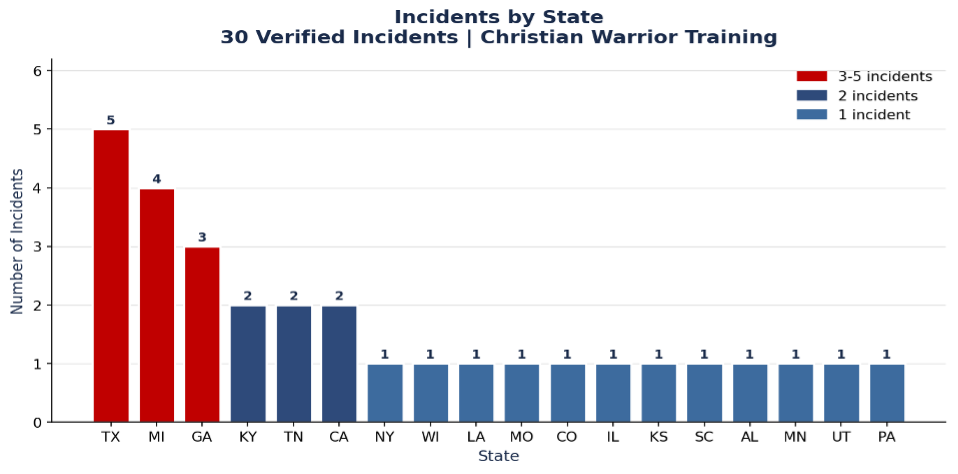
Texas leads the database with 5 incidents across the study period. Michigan follows with 4, including three worship-site attacks in a nine-month window that has no parallel in the American record. Georgia has 3. The full Michigan Threat Intelligence Bulletin covering the 2025-2026 cluster, the suspect profiles, and tactical recommendations for congregations in the region is available free at ChristianWarriorTraining.com.
Southern states remain concentrated in this database, consistent with national research on worship-site violence. But the data now spans 18 states from Pennsylvania to California, from Utah to Minnesota. No region is exempt.
What Your Security Team Should Take From This
The probability that any given congregation faces an active shooter event in any given year is low. But probability is not the right framework. When the event happens, it happens to real people in a real sanctuary. The question is not whether it is likely. The question is whether you are ready.
Ready looks like a trained, armed security team that covers the interior and the parking lot, maintains full posture through every transition window, and has positioned someone in the lot during every arrival and departure period. A perimeter that catches the man in the wig and the overcoat before he reaches the door. A congregation that knows how to report a threat. A pastor who understands that the man in spiritual distress he has been counseling may need a security contact as well as a pastoral one. A culture where domestic violence is visible and where someone in a dangerous relationship has a pathway to safety before that relationship produces a security event for the whole church.
Ready looks like Rabbi Cytron-Walker, who went through four security trainings and knew exactly what to do when a man with a gun sat down in his synagogue. Ready looks like Jack Wilson, who started training 18 months before he needed it.
Nehemiah organized his people so that half worked and half stood guard. Both were ministry. Both were necessary. Neither group stopped.
That is still the model.
Sources: U.S. Secret Service National Threat Assessment Center (2025 Sutherland Springs Case Study), Violence Prevention Project, Faith Based Security Network, Lifeway Research, FBI field office public statements, CNN, ABC News, NBC News, Detroit News, CBS News, Salt Lake Tribune, Gephardt Daily, Wikipedia incident articles. Data confidence: High for all high-profile incidents. Moderate for mid-tier incidents where caliber data remains publicly unconfirmed.


