


What Happened
On June 14, thousands gathered on the South Lawn of the White House for the UFC Freedom 250 event, a fight card tied to the nation’s 250th anniversary celebrations. By the time the crowd took their seats, the plan to kill many of them was already broken up.
Federal authorities learned of the threat on June 10, four days before the event, after a relative of one of the suspects contacted law enforcement, worried that a family member was talking about doing something in Washington. That single thread led investigators into an informal network communicating over the Signal app. The FBI, working with the Secret Service, the Department of Justice, and state and local partners, ran a multi-state operation that put five people in custody. Officials say roughly twenty-three individuals were identified as part of the network.

According to officials cited by CBS News, NBC News, and others, the plan was built in stages. Explosive-laden drones would strike buildings near the venue to create mass panic. As the crowd fled in the direction the planners expected, a sniper team positioned along that path would open fire on people in the open. A second wave would then attempt to storm the White House gates. The first blast was never meant to be the main event. It was meant to move people. The killing was supposed to happen where the crowd was driven, not where the explosion went off.
That structure is the whole lesson, so hold onto it.
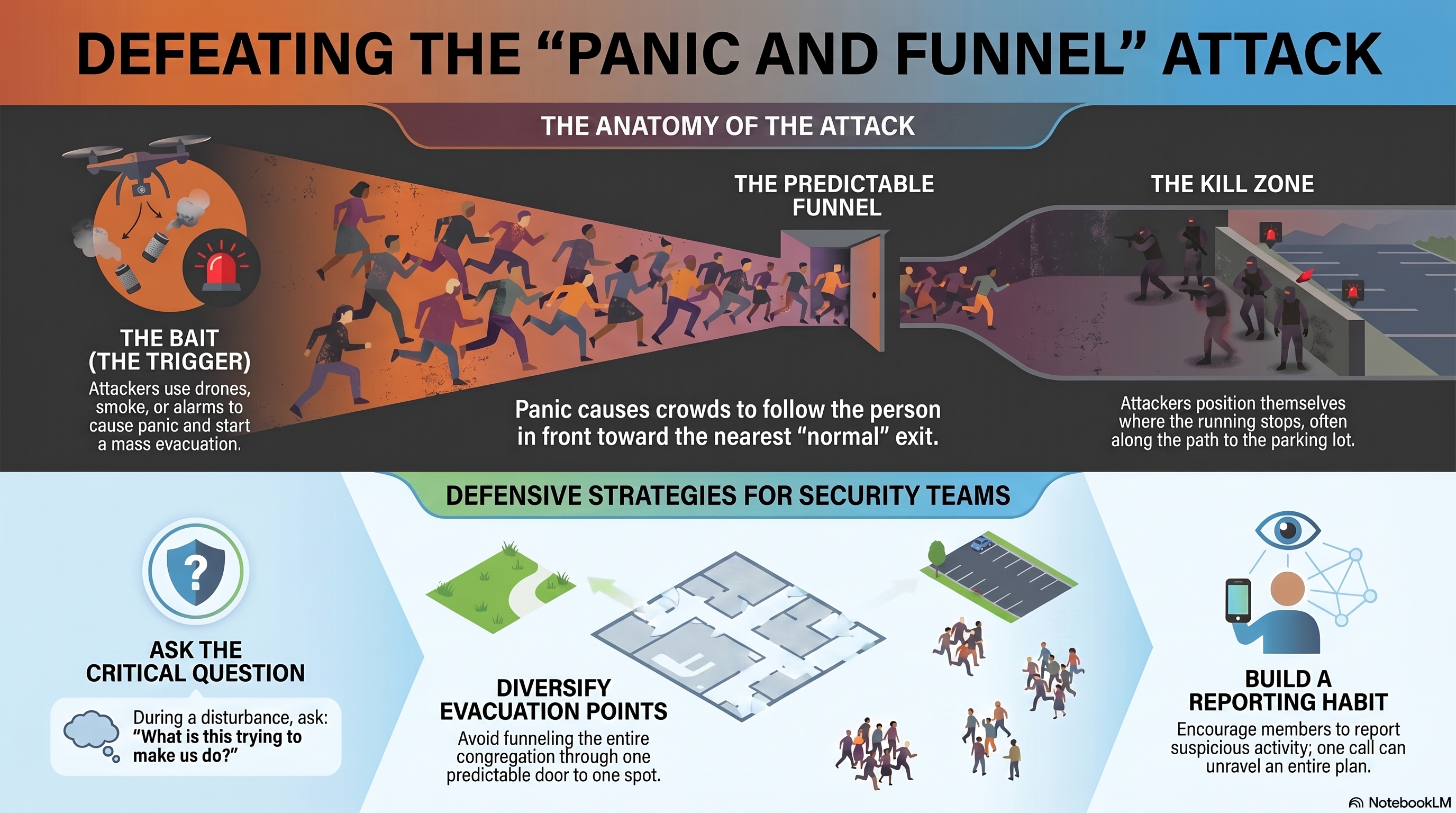
The First Bang Is Often the Bait
A trained attacker who wants a high body count does not rely on a single event. He builds a sequence. The opening act is designed to do one thing: take a calm, stationary crowd and turn it into a panicked, moving one. People who are running are not thinking. They follow the person in front of them, they head for the nearest visible exit, and they move as a herd toward whatever looks like safety. The attacker counts on that. The kill zone is not where the first noise comes from. It is where the running stops.
For a church security team, this changes how you read a disturbance. The fire alarm, the broken window, the commotion in the lobby, the smoke in the back hallway. Your instinct, and your congregation’s instinct, is to treat the first event as the emergency and move toward an exit. A capable adversary is hoping you do exactly that. The discipline you train into your team is to treat the first event as a question, not an answer. What is this trying to make us do, and where is it trying to send us. You do not have to be paralyzed by the question. You have to be aware that the obvious response is sometimes the planned one.
Your Evacuation Plan Can Become the Kill Zone
Most church evacuation plans are written for fire. Everyone moves to one or two doors, then to one designated muster point in the parking lot or on the lawn. That plan saves lives in a fire. It can cost lives in an attack designed around it. If your entire congregation funnels through one predictable door to one predictable gathering spot, you have built the attacker’s kill zone for him. He does not need to find your people. He knows where you will send them.
Build your egress thinking with more than one answer. Identify multiple exits and more than one muster location, and train your team to direct people away from a threat rather than toward a single fixed point. The parking lot is not a safe zone simply because it is outside. It is open ground, it is predictable, and it is exactly where a secondary attacker would wait. Assign someone to watch the lot and the approaches during dismissal, not just the sanctuary during service. The period when people are leaving, clustered and relaxed, is one of the most exposed moments of the day.

We Named This Yesterday, and Some of You Said It Was Obvious
Yesterday we published the 250th threat bulletin. In it we named this specific tactic: an initial event used to panic a crowd and funnel them into a prepared kill zone. The news broke the next morning.
Some of you replied that this was obvious. You are not wrong. To a trained eye, it is obvious. That is the problem. The tactics that get people killed are almost never sophisticated. They are simple, repeatable, and obvious to anyone who has studied how attacks actually unfold. They remain effective because the people standing in the kill zone do not see what the trained eye sees. They see a fight card and a summer evening. They feel safe in a crowd because the crowd feels normal, and normal feels safe. That gap, between what a security professional knows and what an ordinary person believes about their own safety, is where casualties happen.
So we will keep stating the obvious. Naming the obvious is the job. A pilot runs the same checklist on his ten-thousandth flight that he ran on his first, not because the items changed but because the cost of skipping one never changed. The day a threat stops being obvious to your team is the day you have stopped training. Say it again next week. Say it to the volunteer who rolls his eyes. Repetition is not condescension. It is how a team moves from knowing a thing to acting on it without being told.
The Plot Died Because Someone Said Something
Strip away the drones and the sniper team and look at how this actually ended. It did not end with a hardened perimeter or a quick-reacting officer. It ended four days early because a family member heard a relative talking and made a phone call. The most advanced layer of defense in this case was a worried person who refused to talk themselves out of what they were hearing.
That is the layer your church already has and most often wastes. The people inside your circle, your members, your volunteers, the parent who noticed someone photographing the children’s wing, hold information no camera will ever capture. Give them a clear, simple way to report what they see, and tell them plainly that you would rather chase a hundred nothings than miss the one call that matters. Most people who notice something stay quiet because they do not want to overreact or accuse someone wrongly. Your job is to make reporting easy and shame-free, so the next worried person picks up the phone instead of hoping they are imagining it.

Biblical Perspective
The plan against that crowd was old. The technology was new, but the logic, drive people into panic so you can cut them down, is at least three thousand years old. In Second Samuel, the counselor Ahithophel proposed exactly this to Absalom during his rebellion against David. His advice was to strike David’s company while they were weary and discouraged, throw the people into a panic so they would scatter and flee, and kill the king in the confusion. It was sound military thinking. It very likely would have worked. But Absalom listened instead to a rival counsel meant to delay him, and Scripture tells us why.
“And Absalom and all the men of Israel said, ‘The counsel of Hushai the Archite is better than the counsel of Ahithophel.’ For the LORD had ordained to defeat the good counsel of Ahithophel, so that the LORD might bring harm upon Absalom.” — 2 Samuel 17:14 · ESV
The expert plan was defeated. Not because David’s side was stronger or saw it coming, but because God ordained that the better counsel would not be followed. The deliverance came through ordinary means, a man giving advice, a warning carried in time, while God’s hand worked behind those means. That is worth sitting with. We train, we plan, we watch the parking lot, and behind all of it God is at work in ways we will never fully trace. The phone call from a worried relative is the kind of small, ordinary thing through which deliverance often arrives.
The second truth is what happened to the planners themselves. They built a network, coordinated over a messaging app, and that very coordination became the thread that exposed and caught them.
“The nations have sunk in the pit that they made; in the net that they hid, their own foot has been caught. The LORD has made himself known; he has executed judgment; the wicked are ensnared in the work of their own hands.” — Psalm 9:15–16 · ESV
The trap they engineered for others is the thing that caught them. The same effort that was meant to take lives pulled them into custody instead. We do not write this to gloat over men whose hearts were set on murder. We write it because it tells us something true about how God governs the world. Evil is not as in control as it imagines. The plan that looks unstoppable from the inside is, in God’s hands, already accounted for. That does not excuse us from vigilance. It frees us from despair while we stay vigilant.
Final Assessment
This was not a near miss for a church. It was a near miss for thousands of Americans at a national event, broken up by a tip and good police work. But the tactic is portable, and that is the reason we are writing about it. The same logic that drove this plan, panic the crowd, funnel them, and kill them where they stop, can be scaled down to a sanctuary, a parking lot, or a Sunday dismissal.
Take three things to your team this week. First, treat the first sign of trouble as a possible setup, not just an emergency to flee from. Second, look hard at your evacuation plan and ask whether it funnels your people into one predictable spot, then fix it. Third, build a reporting habit so the worried member in your congregation makes the call instead of staying quiet. None of this is complicated. It is obvious. We are going to keep saying it until every team acts on it.
The crowd in Washington went home safe because someone refused to ignore what they saw, and because a plan that looked airtight was defeated four days before it ran. Take the same posture into your church.
Join the Conversation
If this helped you think through your own egress plan, leave a comment and tell us how your team handles a secondary-attack scenario. Then forward this to your pastor or your team leader and walk through it together before Sunday.


