

My analyst notes are available to paid subscribers. Scroll to the bottom to read them.
Bottom Line Up Front (BLUF)
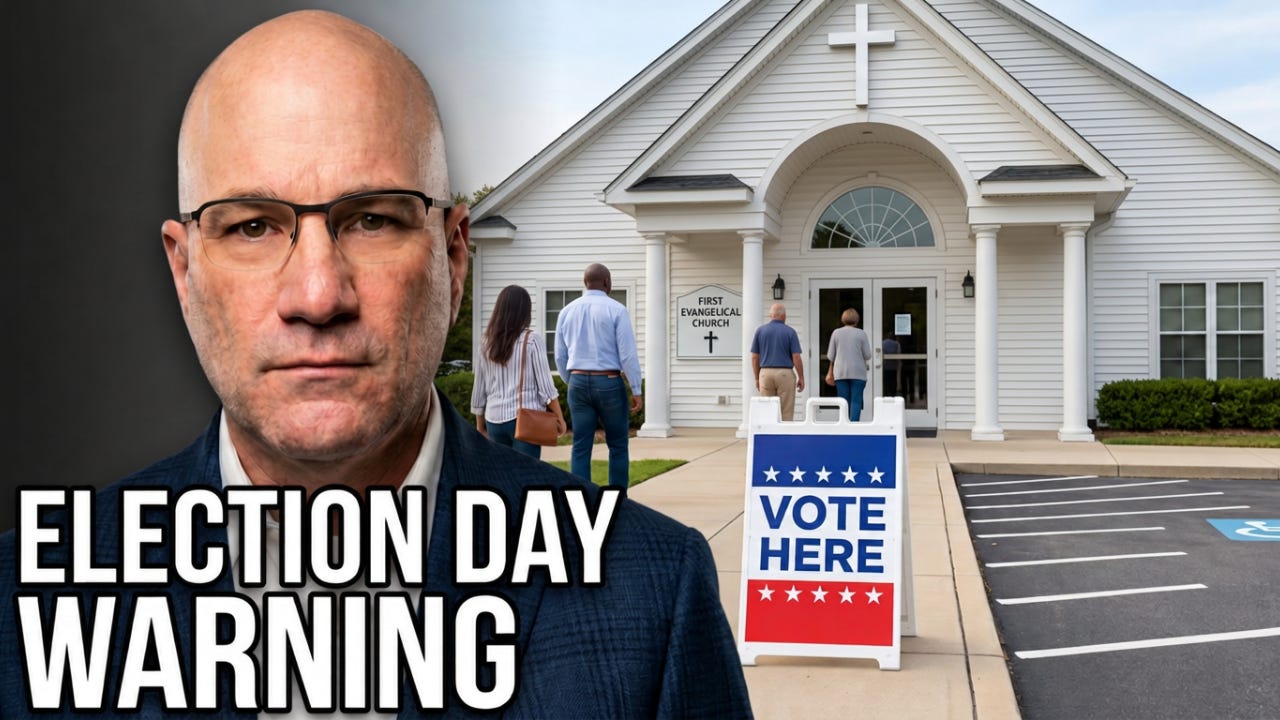
Election Day is Tuesday, November 3, and many churches across the country will open their buildings as polling places. There is no known specific threat against church polling places this year, but recent elections have produced an armed and belligerent voter inside a church polling room, disorderly conduct arrests, an explosive device detonated half a block from a church polling entrance, and hundreds of hoax bomb threats against polling sites. Teams at host churches should meet the election official running their site before Tuesday, staff the building and parking lot during voting hours, leave all contact with federal personnel to election officials and local police, and check whether their state restricts firearms at polling places.
Key Judgments
Highly Likely: Hoax bomb threats sent by email or phone will close some polling places for a short time on November 3, as they did in 2024 and 2025.
Likely: At least one church polling place in the country will have a belligerent voter or bystander who requires a police response.
Likely: Rumors and sightings of federal agents near polling places will spread on social media during Election Day and draw arguments or small protests at some sites.
Possible: Tension over results will carry into the days after the election, including Wednesday night services.
Unlikely: Immigration and Customs Enforcement (ICE) agents will be stationed at church polling places.
Unlikely: A planned attack will target a church because it is serving as a polling place.
Likely: Armed church team members in states with polling place weapons laws will violate those laws on November 3 unless their team leaders check the law first.
What Has Happened at Church Polling Places
On Election Day 2024, a man walked into the polling place at First Friends Meeting, a Quaker church in Indianapolis, wearing a campaign shirt and hat. Indiana law bars campaign clothing inside a polling place, so a poll worker told him to remove the hat and turn the shirt inside out. The man yelled and cursed, put his cap on the poll worker’s head, and pulled off his shirt to show two handguns and a knife in his waistband. The election official in charge of the site walked him to the front of the line, got him checked in, let him vote, and escorted him out. Two Indianapolis police officers arrived, questioned him on the church grounds, and released him. Voters left the line, some of them through the church kitchen, and turnout at the site dropped off for the rest of the day.
The Marion County Election Board held public hearings on the case and believed the evidence supported a charge under Indiana’s new poll worker protection law. A grand jury heard the case in May 2025 and did not return an indictment. First Friends then declined to serve as a polling site for the May 2026 primary, ending a practice of at least 20 years, and was still deciding whether to host in November.
The same day in Coventry, Rhode Island, police arrested Timothy Masse, 33, at the Maple Root Baptist Church polling place at about 10:15 a.m. Police said he confronted voters, campaign supporters, and election staff, yelled obscenities, and interfered with polling operations. He was charged with disorderly conduct. Police released body camera footage of the arrest.
On May 19, 2026, during the Pennsylvania primary, an explosive device thrown from a moving pickup truck detonated about half a block from the entrance of Salem United Church of Christ in Catasauqua, which was serving as the borough’s First District polling place. Nobody was hurt. Investigators found 17 more homemade explosive devices in the truck. A father, 56, and his son, 24, were charged with felonies including conspiracy to unlawfully possess or manufacture a weapon of mass destruction and conspiracy to risk a catastrophe, and a judge upheld the charges. The Lehigh County District Attorney says there is no evidence the device was aimed at the election or the church. Voting continued all day through an alternate entrance while the street outside was a crime scene.
Hoax threats have caused the most widespread disruption. On Election Day 2024, 32 of 177 polling places in Fulton County, Georgia, received bomb threats, and five were briefly evacuated. The Federal Bureau of Investigation (FBI) said many of the threats that day came from Russian email domains. The Brennan Center for Justice counted at least 227 bomb threats against voting locations in the 2024 election. In November 2025, emailed bomb threats closed polling places in seven New Jersey counties, and some voters were sent to other locations. A juvenile was arrested in connection with the threat against a school polling place in North Brunswick.

The Current Threat Environment
In mid-October, the FBI and the U.S. Postal Inspection Service began investigating more than 100 suspicious letters mailed to election officials and congressional offices. Election offices in Louisiana and Oklahoma were evacuated after staff opened envelopes containing white powder, and states from Idaho to Florida reported letters that were either received or intercepted. Preliminary tests in several states found no hazardous material. The FBI has asked anyone with information about threats against election workers or polling locations to contact a local FBI field office.
No reporting reviewed for this brief identifies a specific threat against churches serving as polling places. The concern for host churches comes from the political climate and the record above: angry individuals, campaign disputes that spill into the voting line, hoax threats, and confrontations over who is watching the polls.
Federal Agents and Monitors at the Polls
Federal law bars troops and armed federal agents from places where an election is held. On February 25, 2026, Heather Honey, a Department of Homeland Security (DHS) official, told state election officials there would be no ICE presence at polling locations this election. A DHS statement after that call said ICE is not planning operations targeting polling locations, but that a person who posed an active public safety threat to a polling location could be arrested in a targeted enforcement action. Homeland Security Secretary Markwayne Mullin has said agents would be at a polling place only if there is a threat to that polling place or they are serving a warrant on someone they have been tracking.
The Department of Justice (DOJ) Civil Rights Division plans to send about 1,000 personnel to polling places, up from 714 in 2024 and roughly 289 in 2022. In an October court filing, a government official stated that FBI and ICE employees will not serve as monitors, that the monitors will include Drug Enforcement Administration (DEA) personnel, and that monitors are prohibited from carrying guns and limited to observing and taking notes. The National Association for the Advancement of Colored People (NAACP) has sued for records on the program. Political parties and advocacy groups will also have poll watchers at many sites, and several religious groups have trained volunteer “poll chaplains” who wear vests and badges outside polling places, including training on how to respond if ICE agents are spotted.
On Tuesday, a host church may have unarmed DOJ monitors, party poll watchers, advocacy volunteers, local police, and campaign workers on its property at the same time. Some voters are upset by immigration enforcement and others support it, and either reaction can start an argument in the parking lot. A voter who sees a federal identification card on a DOJ monitor may assume the person is ICE and post about it. Election officials check credentials and decide who belongs at the polls, and local police enforce their decisions.
Weapons Laws Change on Election Day
The last issue is state weapons law. When the church becomes a polling place, laws written for polling places apply to the building and, in many states, to the ground around it. The National Conference of State Legislatures (NCSL) counts 22 states plus the District of Columbia with explicit prohibitions or restrictions on guns and other weapons at polling places: Arizona, California, Colorado, Delaware, Florida, Georgia, Hawaii, Louisiana, Maryland, Massachusetts, Michigan, Mississippi, Missouri, Nebraska, New Jersey, New Mexico, New York, Ohio, South Carolina, Texas, Vermont, and Virginia. Some of these laws are complete bans, and others apply only to certain people or only to open or concealed carry. Other trackers also list Connecticut and Washington.
The distances and exemptions vary from state to state. Georgia prohibits weapons within 150 feet of a polling place. Massachusetts prohibits firearms within 150 feet of a polling site on Election Day and during early voting. Michigan prohibits firearms in a polling place or within 100 feet of any entrance to the building while the polls are open, and it exempts a person licensed to carry a concealed pistol who is carrying concealed. Virginia prohibits knowingly carrying a firearm within 100 feet of any building used as a polling place, with exceptions that include law enforcement officers and licensed armed security officers. New Mexico prohibits firearms within 100 feet of a polling place and exempts concealed carry license holders. Missouri’s limit is 25 feet. Texas prohibits firearms on the premises of a polling place on Election Day and during early voting. Vermont prohibits firearms at a polling place and on the walks leading to the building. Delaware prohibits firearms at polling places outright. Mississippi and Nebraska bar concealed handguns in polling places, and Arizona bars entering a polling place on Election Day carrying a deadly weapon.
At most churches, a line drawn 100 or 150 feet from the polling entrance covers the main doors, the lobby, and much of the parking lot. In those states, a team member carrying anywhere inside that line during voting hours may be breaking the law without ever entering the voting room. Law enforcement exemptions generally cover officers and do not extend to church volunteers. Laws that ban guns on school grounds or in government buildings also still apply where those buildings serve as polling places.
Idaho and most of the remaining states have no polling place weapons statute on NCSL’s list. Nevada’s governor vetoed a polling place gun ban in 2025 for the second time. Teams in those states still need to confirm the rules with their county election office, because local practice, other state laws, and the church’s own carry policy still apply.
Before Tuesday, call your county election office or county attorney and ask three things: whether your state restricts firearms at or near a polling place, how the distance is measured, and who is exempt. Then decide which team members carry during voting hours and where they post. If your state bars carry near the polling entrance, keep armed team members outside that distance or have them store their firearms where state law allows, and plan on calling 911 for anything in the polling area.

👉 Get the self-defense legal protection I carry with Right to Bear, 10% off for life with code CWT
What Your Team Does on Election Day
Meet the election official in charge of your site before Tuesday. The title varies by state (inspector, judge, or chief judge). Get that person’s name and cell phone number. Agree that election officials control the voting room and your team controls the rest of the building and the parking lot. Ask what their plan is for a bomb threat and which door voters will use if the main entrance closes.
Call your county election office for the state rules. Ask about firearms at and near the polling place as described in the weapons section above, the distance from the entrance where campaigning is prohibited, and who is permitted inside the voting room. Your team cannot remove a voter, poll watcher, or monitor from the voting room. The election official decides, and police remove the person.
Separate the church from the polling area. Lock interior doors to offices, children’s areas, and the sanctuary. If a preschool or another ministry runs that day, give it a separate entrance and put a team member on that door.
Post team members at the polling entrance and in the parking lot during voting hours. Team members wear team identification and no campaign clothing or buttons, and they do not discuss candidates or issues on duty. Call police for anyone who threatens voters, blocks a doorway, or displays a weapon in a threatening way, and notify the election official at the same time.
Leave federal personnel to election officials and police. If someone identifies as a federal agent or monitor, do not block or question that person. Notify the election official and write down the time, the number of people, any agency markings, and vehicle descriptions and plates. If voters or protesters confront them, call local police.
Treat bomb threats and suspicious items as real until police clear them. Election officials decide what happens to the voting room. Your team moves church staff and visitors out of the rest of the building according to your evacuation plan. Do not touch or move a suspicious item.
Write an incident report the same day. Give a copy to the election official and to your pastor.
Brief the team for Wednesday. Results in close races may not be final on election night. Review your plan for Wednesday night services and any events through the weekend.

Threat Assessment
There is no specific threat against churches serving as polling places on November 3. The concern comes from the political climate, the recent incidents at church polling places, and the number of people with competing roles who will be on church property during voting hours.
The primary concern is a belligerent or armed individual inside the polling room or the voting line. The Indianapolis and Coventry cases show what that looks like, and the Indianapolis case shows that police may release the person and prosecutors may decline to charge. It is likely that at least one church polling place in the country will need police to deal with a person like this on Tuesday. The secondary concern is disruption from hoax bomb threats, which is highly likely somewhere in the country based on 2024 and 2025. These threats close polling rooms and put church buildings under police search, and a team that has already agreed on a plan with its election official will handle it faster.
Confrontations over federal personnel are likely in some places and will most likely start from rumors. Current DHS and DOJ statements make it unlikely that ICE agents will be stationed at church polling places, and DOJ monitors are barred from carrying guns. A planned attack against a church because it is a polling place is unlikely. Separately, the most likely legal problem for host churches is an armed team member violating a polling place weapons law. Checking state law before Tuesday prevents it. The Catasauqua case is a reminder that a dangerous person can still act near a polling site for reasons unrelated to the election. Team posture for Tuesday should be visible staffing at the entrance and parking lot, a working agreement with the election official, and police as the response for anyone who will not calm down.
What the Bible Says
If possible, so far as it depends on you, live peaceably with all. (Romans 12:18, English Standard Version (ESV))
Paul wrote this to believers in Rome who lived under a government many of them had good reason to distrust. He allowed that peace would not always be possible and told them to make sure the failure did not come from their side. On Election Day, a church opens its doors to every voter in the precinct, including people who will vote the opposite of most of the congregation and people who are angry at whoever is in power. The safety team’s part is to keep the building safe and orderly for all of them, and to keep from adding to anyone’s anger.
A soft answer turns away wrath, but a harsh word stirs up anger. (Proverbs 15:1, ESV)
Most of the incidents in this brief started with somebody’s temper. The poll worker in Indianapolis was following the law when he asked a voter to cover his campaign shirt, and the situation got worse in seconds. The election official who took over did not argue with the man. She moved him through the line and out the door, and nobody was hurt. Team members who stand at a polling entrance will hear political comments and insults. A calm answer and a call to the election official or police will resolve more of these situations than a debate about who is right.
In 1 Timothy 2:1-2, Paul tells Timothy to pray for kings and everyone in authority so that believers may lead a peaceful and quiet life. That instruction covers whoever wins on Tuesday and whoever loses. A church that hosts a polling place serves its neighbors, and a team that prays for the election officials, the police, and the voters before the doors open is doing what Paul told the church to do.
Final Thoughts
Leave a comment and tell us how your church handles Election Day if you host a polling place. Share this brief with your pastor and your team leader before Tuesday. Paid subscribers get the Analyst’s Notes for this brief below.
1 Corinthians 16:13: “Be watchful, stand firm in the faith, act like men, be strong.”
Remember your ABCs. Always be carrying.
Some links in this post are affiliate links. If you buy through them, Christian Warrior Training may earn a small commission at no extra cost to you, which helps support this work. I only recommend gear I trust and use.
For Paid Subscribers
✅ Analyst’s Notes on the incident record, source reliability, and what to watch after the polls close


