


What 198 Funeral Shootings Tell Church Safety Teams
You’re working the parking lot at your church on a Saturday afternoon. Your church doesn’t have a service today. A family from the neighborhood rented the building for a funeral, and the man being buried was shot and killed two weeks ago. The service ends, the family heads to the fellowship hall for the repast, and most of your team goes home because the funeral is over. Forty minutes later a car rolls slowly through the lot for the second time.
This year Christian Warrior Training (CWT) built a dataset of violence at funerals from police reports, prosecutor releases, court records, local news, the CWT Daily Church Crime Brief, and two exports from the Gun Violence Archive (GVA). We found 198 shootings and stabbings connected to funerals, wakes, burials, processions, and repasts in the United States between January 2010 and October 3, 2026. Those incidents killed 95 people and injured 396. They happened in 33 states and Washington, DC, with Illinois leading the list at 30.
That number is a floor. Local shootings with one or two people wounded rarely make national news, and police in suburban Chicago have said trouble with funeral processions coming out of the city happens almost weekly. We also have no count of the thousands of funerals where nothing happened, so this study can tell you what violence at funerals looks like. It cannot tell you the odds at any single funeral.
The Repast Accounted for the Most Deaths
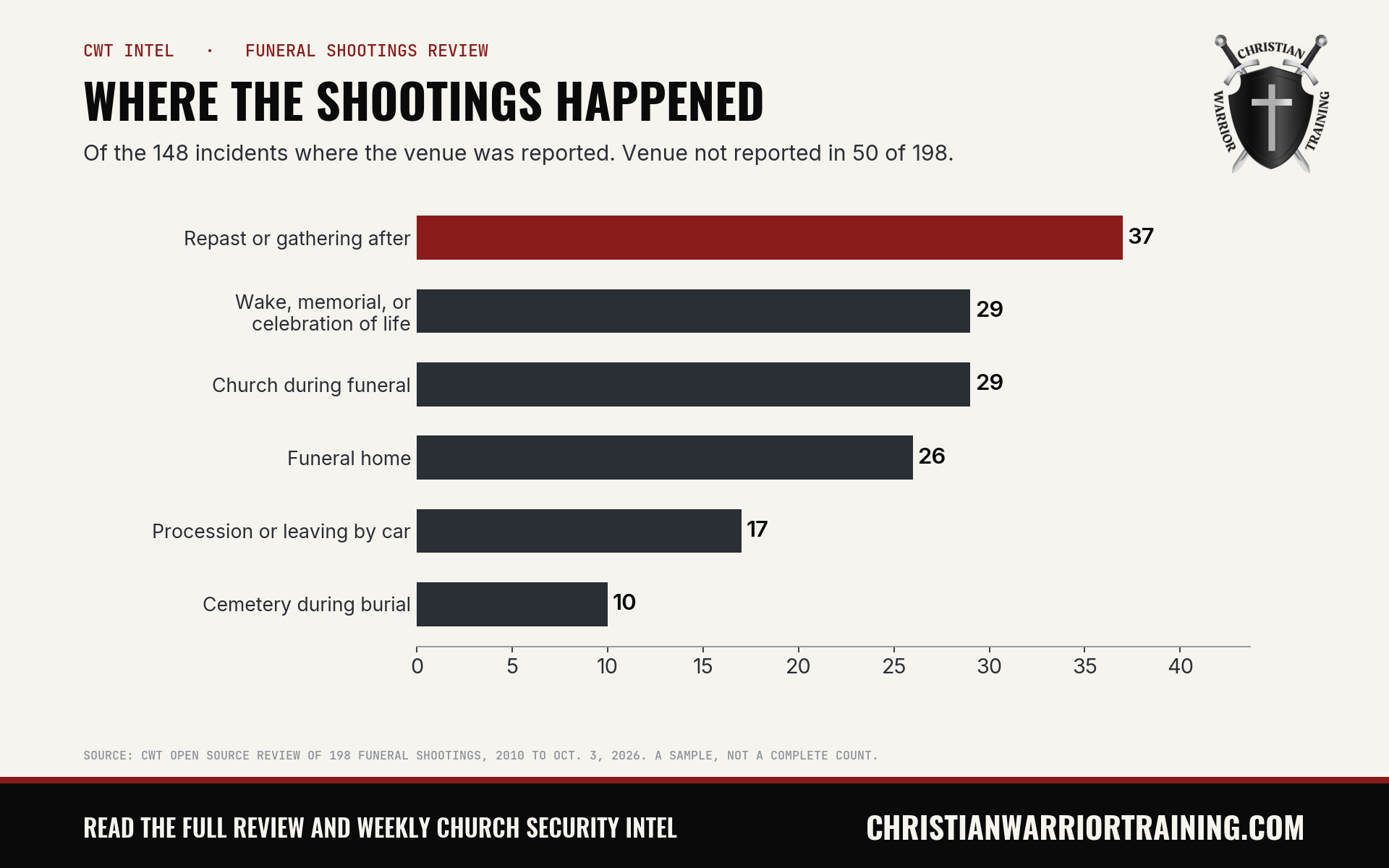
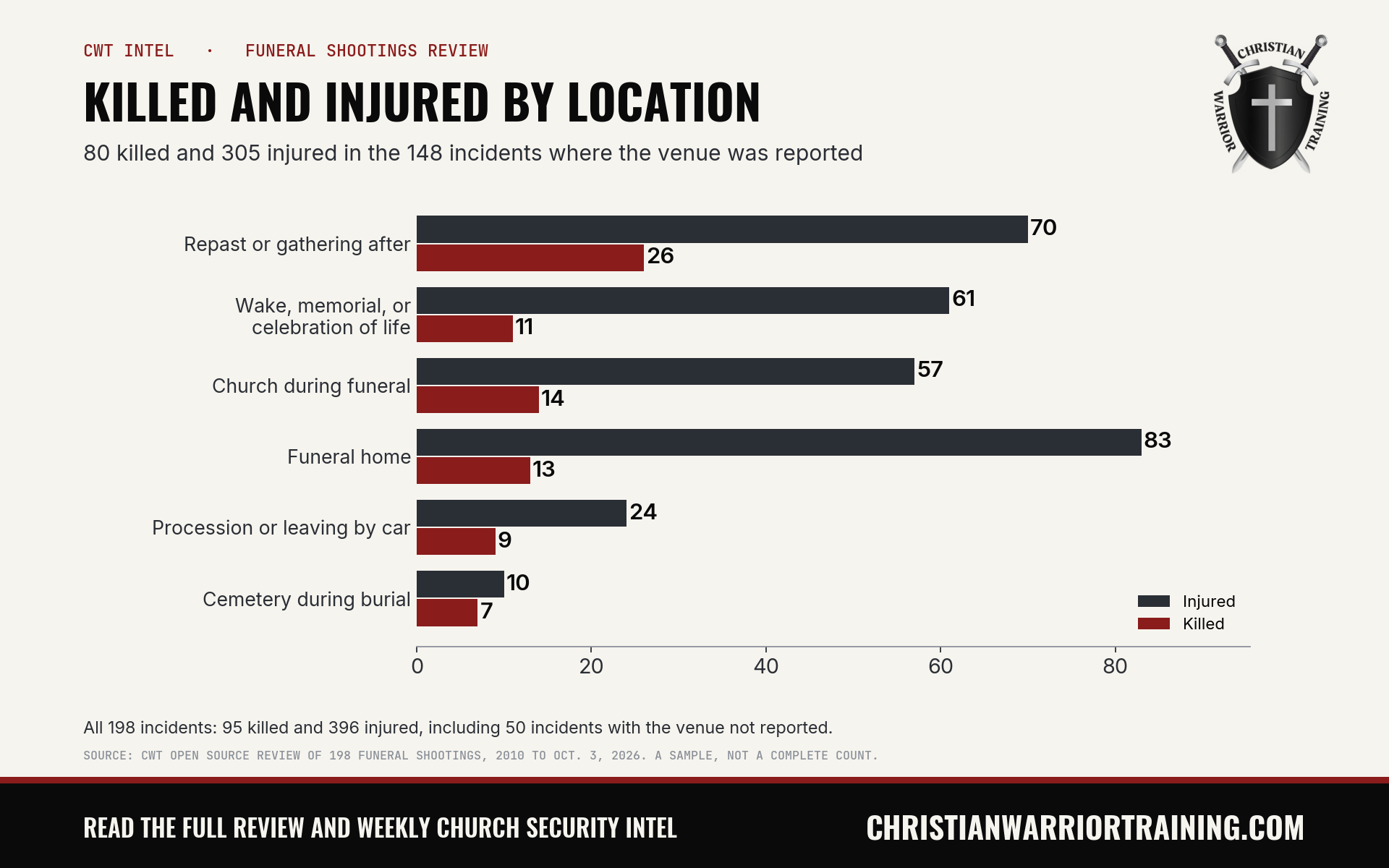
The repast is the meal or gathering held after a funeral. Some families spell it “repass,” and that spelling alone kept a lot of incidents out of our first round of searches. We counted 37 shootings at repasts and gatherings after the funeral, which killed 26 people and injured 70. No other part of the funeral produced more deaths in our sample.

👉 Get the self-defense legal protection I carry with Right to Bear, 10% off for life with code CWT
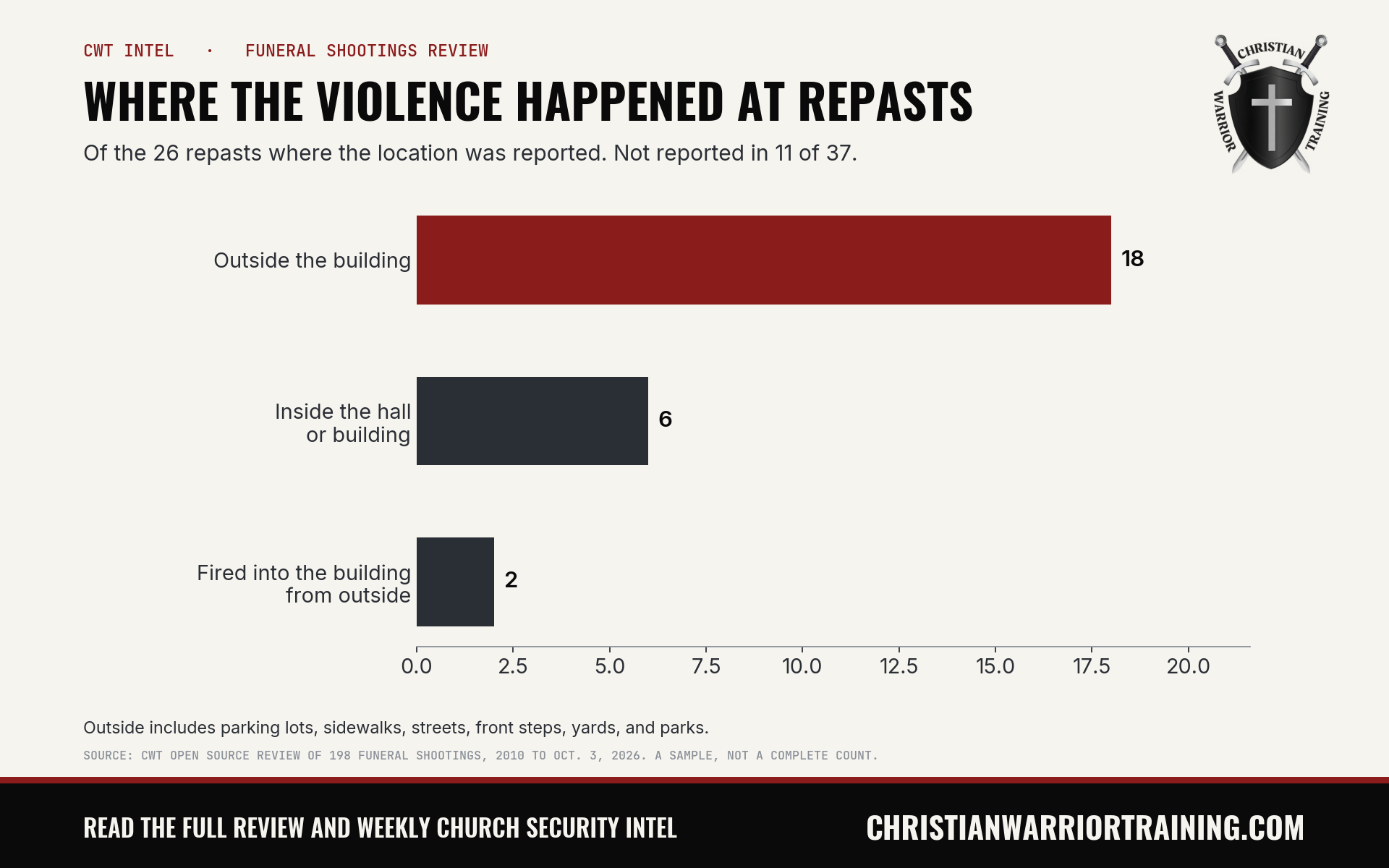
Of the 26 repast shootings where reporting identified the location, 18 happened outside the building, in parking lots, streets, front yards, front steps, and parks. Six happened inside the hall, and in two more a shooter fired into the building from outside. In St. Paul in February 2023, someone in a passing car fired into the Wellstone Center during a funeral reception for a 15-year-old stabbing victim and hit three teenagers.
Why is the repast so exposed? Because it often happens at a different location than the funeral, after the police and the safety team have gone home. It runs longer than the service, people come and go, and nobody is watching the door. In Houston this past August, an argument at a repast in a lounge parking lot ended with a man in his 20s dead and his mother wounded.
Who Was Being Buried
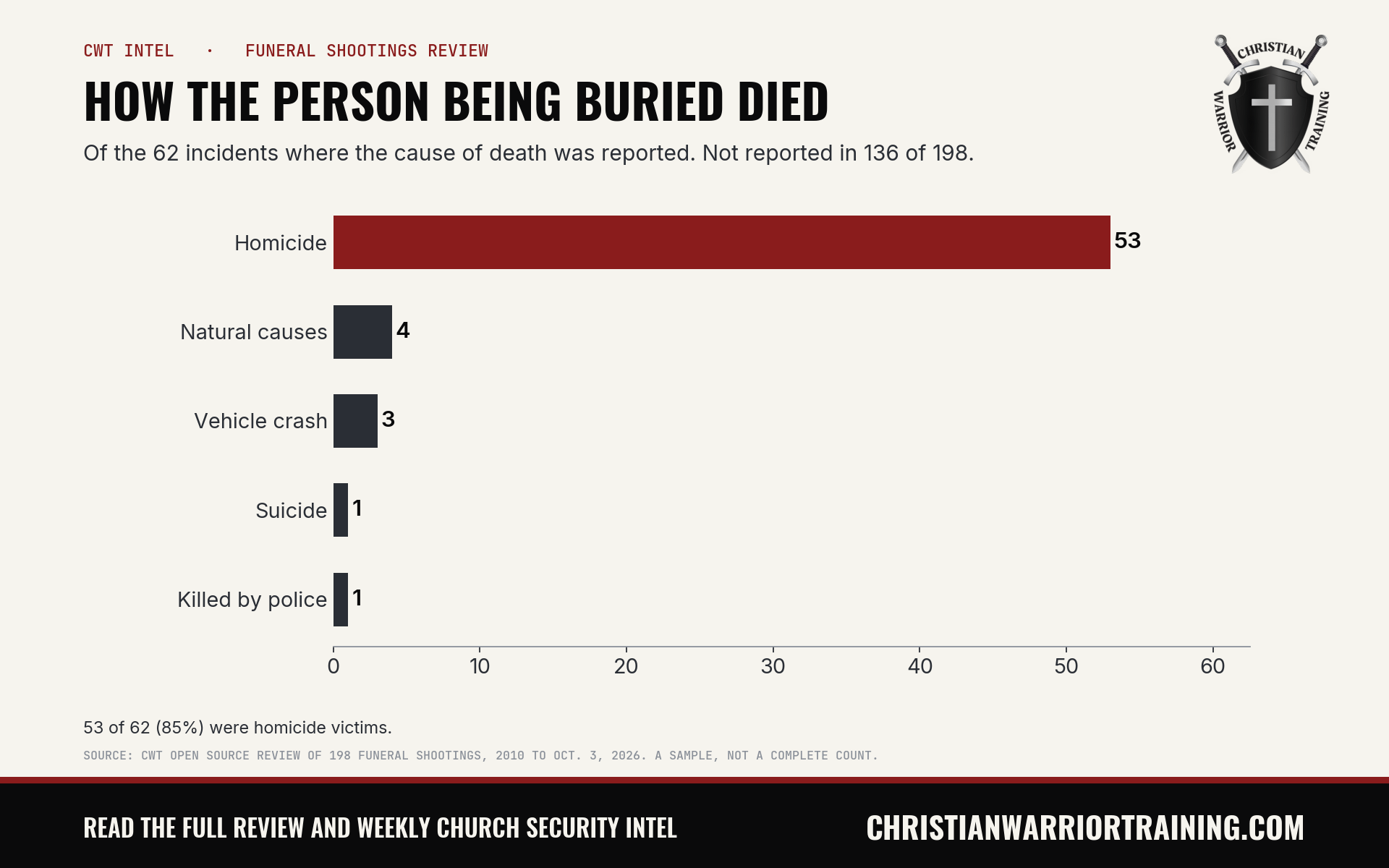
The cause of death of the person being buried was reported in 62 of the 198 incidents. In 53 of those 62, the person had been killed in a homicide, usually within one to three weeks of the funeral. The cause of death was not reported in most incidents, so that figure describes the documented cases only.
At funerals for homicide victims, the pattern changes. Where the reporting described how the shooting started, 22 began with a shooter arriving and opening fire, compared with 10 that started with an argument. That is more than two to one. A funeral for a recent homicide victim, especially when nobody has been arrested, puts the people involved in that conflict at a known place at a known time. In Pittsburgh in October 2022, prosecutors said two shooters watched Destiny of Faith Church for 20 to 30 minutes before they fired 23 rounds at mourners outside and wounded six. The man being buried had been killed two weeks earlier.
How the Violence Started
Across the whole dataset, where the start of the violence was reported, 59 incidents began with an argument or fight among people who were already there. Another 46 began when a shooter arrived and opened fire. Many of those arguments were between relatives. We documented fights over the obituary, child custody, money, a parking spot, and who was allowed to attend.
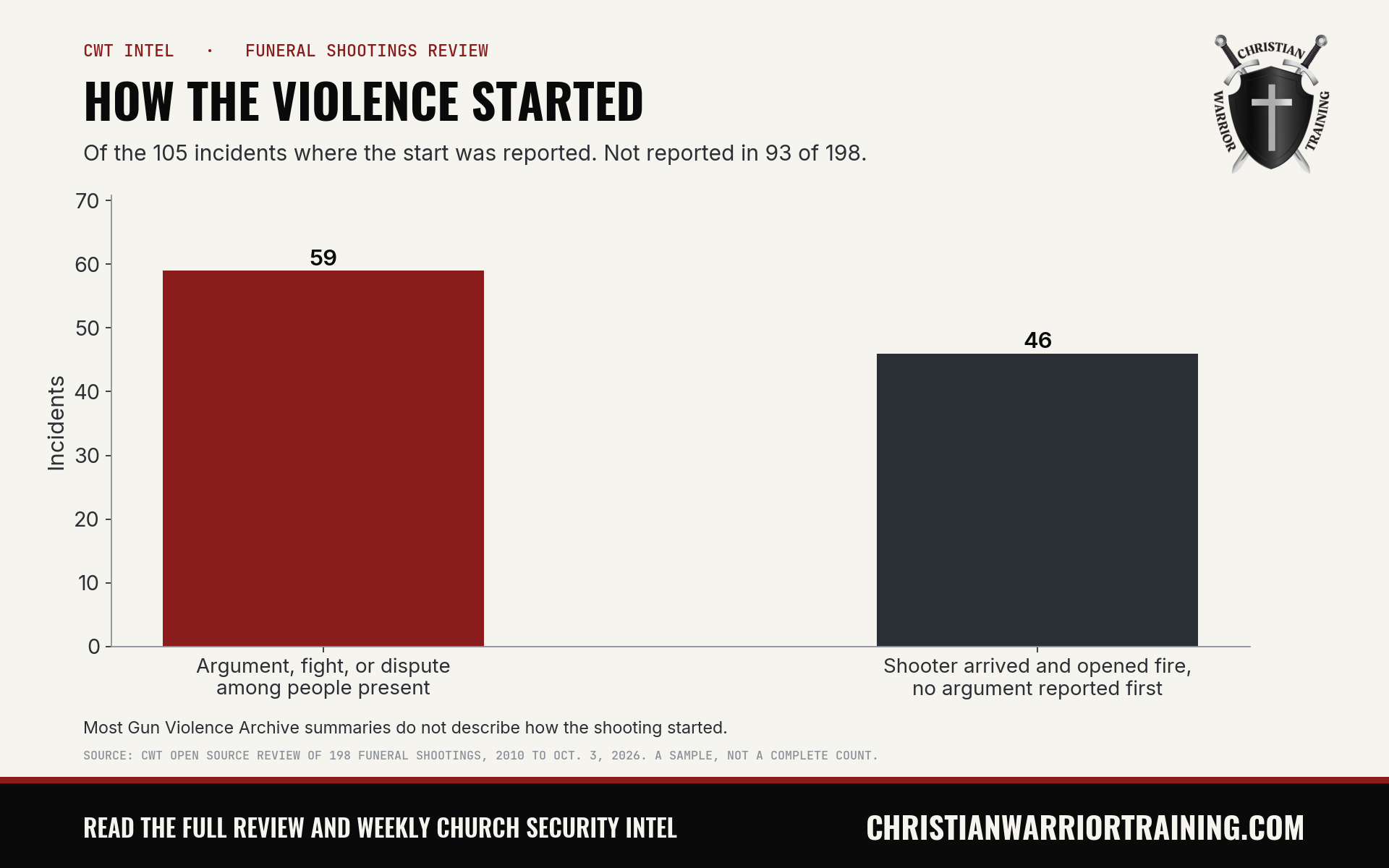
In Waukegan, Illinois, in January 2026, prosecutors said a man argued with another mourner over money, drove home, picked up a handgun, came back to the funeral home, and shot two people. In Ardmore, Pennsylvania, in 2020, a fight between two families at a post-funeral luncheon ended when a man who had been sitting at a table walked over and fired. Any of us who worked patrol has been to a family fight at a wedding or a holiday. A funeral puts the same people in the same room under more strain.
Police Presence and Security
Police were on scene or nearby before the shooting in 12 incidents. They were warned about the specific funeral in five. These are incidents where violence happened, so the data cannot tell us whether police presence prevented violence at other funerals. Officers on scene did cut the response time to seconds in several cases.

👉 Take the free Suspicious Vehicles online training
The individual cases are worth knowing. In Pittsburgh, police presence was requested for the funeral and never provided. In Kansas City in February 2026, the family hired off-duty officers because the man who killed the deceased had not been caught, and a shooter still fired into the church. In Chicago in July 2020, police had intelligence on a gang connection and posted two squad cars outside Rhodes Funeral Services, and a drive-by still wounded 15 people.
Only three incidents documented security or door control of any kind. In Riviera Beach, Florida, in 2020, the church posted armed security for the funeral, and the fight and shooting started after the team left. In Wichita, Kansas, in 2023, a man was refused entry to a church funeral and a shootout followed outside. In Jacksonville, Florida, in 2023, the host of a celebration of life hired armed security, and two shooters walked up and fired into the crowd anyway.
I have seen too much to call any of this a fluke. Most of these shootings happened in the parking lot, at the exit, or after the safety team’s shift was over. That is where we need to be.
What to Do Before Your Next Funeral
These steps come from the patterns above. They have not been tested against funerals where nothing happened, and they are what I would put in place for my own team.

Ask three questions at intake. Add these to the form for every family and every outside group renting your building: Did the deceased die by homicide or another violent act in the last 90 days? Is anyone in custody or wanted for the death? Has anyone received threats about this service? Treat a “yes” or “don’t know” on the first question as a high-risk funeral.
Call the police district 72 hours out. For a high-risk funeral, request a marked unit for arrival, the service, departure, and the repast. Write down the name of the person who took your request, and call again the morning of the service.
Cover the repast or hand it off in writing. If the repast is at your church, keep the team on post until the last guest leaves the property. If it is somewhere else, tell the family and the venue in writing that your team does not cover it, and give the police the address.
Put people outside. Post team members at the street frontage, the parking lot, and the main exit, each with a radio or phone and the job of calling 911 and moving people inside.
Watch the cars. Assign one person outside from 45 minutes before the service until the last car leaves to record the plates of vehicles that circle the block or park with people inside. Give that information to the officer on scene.
Put two people in the fellowship hall. Their job is to separate anyone who starts arguing and walk one party out a different door.
Track anyone you turn away. When you refuse someone entry, a second team member watches that person until they leave the property. If they go back to a car and stay in the lot, call the police.
Control the release. Keep mourners inside until the hearse and family cars are lined up, release them in groups, and do not let a crowd form on the sidewalk or front steps.
Stock bleeding control kits. Put them at the main entrance, the fellowship hall, and the parking lot, and train your ushers to use them.
The Biblical Lens
“Blessed are those who mourn, for they shall be comforted” (Matthew 5:4). A grieving family comes to the church because it is supposed to be the safest place they can bring their sorrow. Most of the violence in this study grew out of conflicts that walked in the door with the mourners or pulled up outside in a car. Comforting those who mourn includes standing in the parking lot so they can grieve.
The full study, with all 198 incidents, sources, and charts, is available at christianwarriortraining.com. Pull up your intake form this week and add those three questions before your next funeral.
Some links in this post are affiliate links. If you buy through them, Christian Warrior Training may earn a small commission at no extra cost to you, which helps support this work. I only recommend gear I trust and use.


