


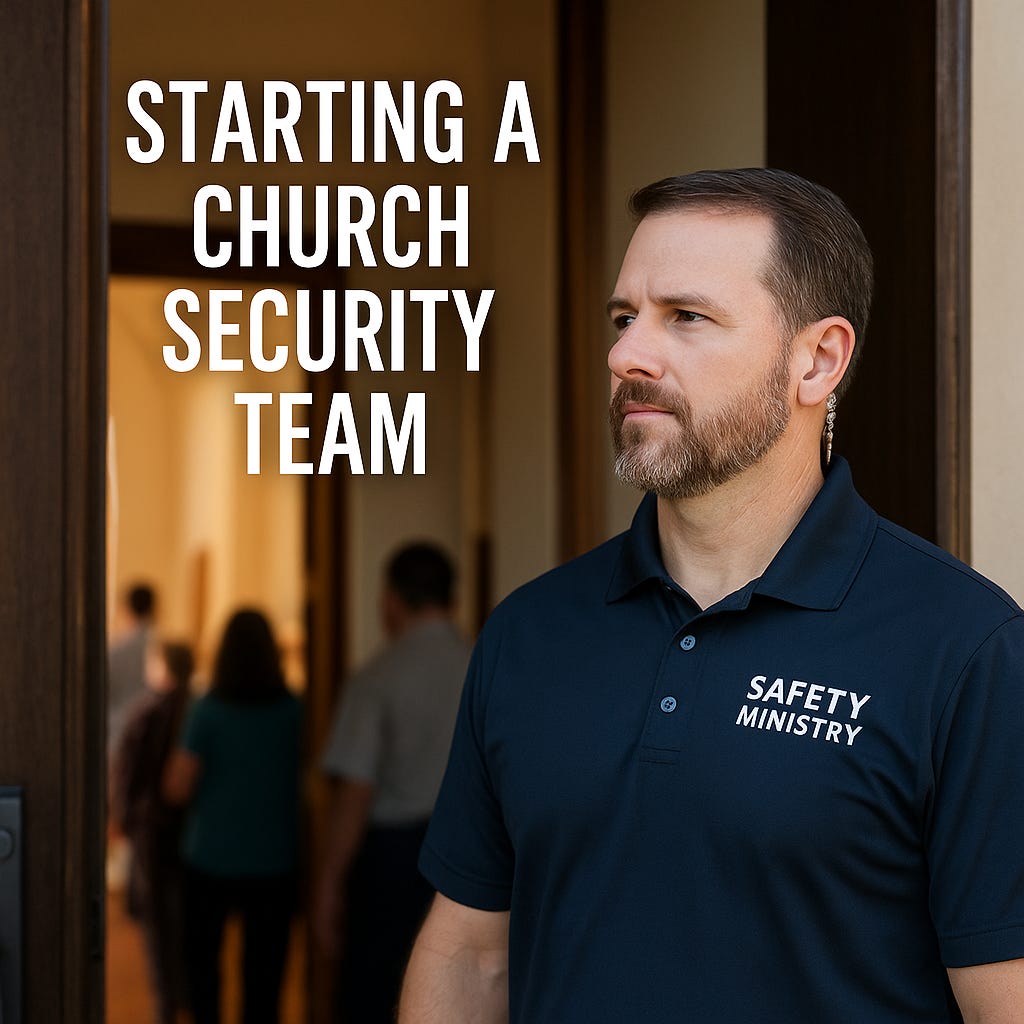
Building a church security team is about stewardship and preparation. You protect God’s people so they can worship freely and safely. Whether you’re starting from scratch or improving an existing team, this guide walks you through how to organize, train, and root the ministry in Scripture.
Disclaimer: This article is for educational purposes only. It does not provide legal advice. Always consult your attorney and church insurance provider before implementing new policies or procedures.
Step 1: Get Pastoral and Board Approval
Every ministry starts with support from church leadership. Present the purpose clearly: protect worship, protect people, and support ministry. Ask the pastor and board to authorize the team and appoint a pastoral sponsor or elder to oversee it. That gives you accountability and alignment with church leadership.
Step 2: Form a Core Planning Group
Build a small, trusted group to help you form the foundation. Include your pastoral sponsor, team leader, training lead, medical lead, administrative lead, and a representative from children’s ministry. Meet weekly until launch, then monthly. Keep everything organized in one place; policies, rosters, training logs, and incident forms.
Step 3: Consult Legal and Insurance Early
Before anyone takes a post or carries a radio, talk to your attorney and insurer. Review your firearms policy, use of force policy, volunteer coverage, privacy laws, and medical liability. Address trespassing and video surveillance laws. Clearing this early prevents problems later.

Step 4: Define the Mission, Scope, and Authority
Write a short mission statement that clearly defines the purpose.
Mission: Protect worship, protect people, and support ministry.
Scope: Regular services, special events, and approved off-site activities.
Authority: Who directs operations, who calls law enforcement or EMS, and who can stop or resume a service during an emergency.
Write this down and distribute it so everyone operates under the same understanding.
Step 5: Build the Spiritual Foundation
Before you write policies or issue gear, ground your team in Scripture. This is not a security detail—it’s a ministry of service, just like the worship or hospitality teams.
The best biblical example is found in Nehemiah and Ezra.
Nehemiah built the wall to protect God’s people.
Ezra built their faith inside that wall through teaching and worship.
That model still applies today. You protect on the outside so faith can grow on the inside.
Bible Study Plan
Primary Reading: Nehemiah 1–6 and Ezra 7–10
Supporting Scriptures:
1 Peter 5:2–3 — Shepherd the flock with care
Proverbs 27:12 — The prudent see danger and take refuge
Psalm 127:1 — Unless the Lord watches over the city, the guards stand watch in vain
Nehemiah 4:9 — “But we prayed to our God and posted a guard day and night”
Romans 13:4 — God’s servant for good, to restrain evil
Ephesians 6:10–18 — The armor of God
Hold a Bible study together before formal training. It sets the right tone and reminds everyone this is a calling, not just a volunteer job.

Step 6: Get Trained Through Christian Warrior Training
Once your team understands the ministry side, it’s time to train. Go to courses.christianwarriortraining.com and complete the courses that fit your church’s needs. All are free and written for church safety and medical teams.
Recommended Course Categories
Biblical leadership and mindset
Situational awareness and threat recognition
Pre-attack indicators and suspicious behavior
De-escalation and communication
Medical and trauma response
Use of force and legal considerations
Team coordination and communication
Even if your team already exists, take these courses together to align your standards.

Step 7: Write Policies and SOPs
Keep policies short and practical. They should cover:
Use of force and de-escalation
Firearms and less-lethal tools
Children’s safety
Medical operations
Radio and CCTV use
Incident reporting and After Action Reviews
Public and media communication
Train from these documents often so they become second nature.

Step 8: Structure the Ministry and Define Roles
A church security team is a ministry, so it needs leadership, accountability, and structure.
Ministerial Oversight
A minister or staff pastor must take overall charge of the safety ministry. This ensures spiritual guidance and alignment with church leadership.
Operational Roles
Ministry Pastor or Minister in Charge
Team Leader
Assistant Leader
Training Coordinator
Medical Coordinator
CCTV Operator or Dispatcher
Intelligence and Analysis Officer (gathers and shares credible threat information)
Armed Position Officer or Range Instructor
Armed Positions
Anyone assigned an armed role must qualify before serving. Use the Christian Warrior Training Firearm Qualification Course or an approved equivalent. Document all qualifications and keep a current roster.

Step 9: Screen and Select Team Members
Screening protects your church and the ministry’s integrity.
Background check
Interview with leadership
Testimony and references
Assessment of physical and emotional readiness
Look for people who are steady under pressure and willing to be coached.
Step 10: Onboarding and Mentorship
Don’t deploy anyone alone until they’re ready. Use the observe, assist, and lead model.
Observe a trained member
Assist under supervision
Lead while being evaluated
Keep sign-offs for each skill.
Step 11: Create a Training Rhythm
Train consistently. Four hours per month works well. Rotate between security and medical training.
Use real-world scenarios such as:
Disruptive individual in service
Domestic dispute in the lobby
Missing child
Medical emergency in worship
Track attendance and maintain records.
Step 12: Build Relationships with Law Enforcement and EMS
Connect with your local police and first responders. Invite them to walk the property and review entrances, exits, and AED locations. Build those relationships before you need them.
Step 13: Incident Reporting and After Action Reviews
Use a single form for all incidents. Complete an AAR after each significant event to capture lessons learned. Assign action items and track completion.

Step 14: Facility Safety and Risk Reduction
The goal of facility safety is to create a secure, welcoming environment for worship—not a fortress. Focus on improvements that protect people while keeping the atmosphere open and inviting.
Practical Steps
Improve lighting in parking lots and walkways
Clear sight lines by trimming landscaping
Upgrade locks and door hardware where needed
Keep exterior doors closed and monitored during services
Consider adding security film to entry glass for added protection
These actions show good stewardship and care for the congregation without creating a “bunker” image.
Step 15: Continuous Improvement
Review your policies quarterly. Run at least one full-scale exercise each year involving ushers, staff, and children’s ministry. After each incident, complete an AAR and update policies as needed. Growth is part of stewardship.
The Biblical Perspective
Nehemiah prayed and posted guards. Ezra restored worship within those walls. Preparation and faith work together. Proverbs 21:31 says, “The horse is made ready for the day of battle, but victory rests with the Lord.” Preparation is obedience. Trust is worship.
Conclusion
When done right, a church security team becomes a ministry that protects worship, supports faith, and serves the body of Christ.
Start with leadership support. Ground the team in Scripture. Train through Christian Warrior Training. Keep improving and stay humble.
Serve faithfully. Protect His people. And always remember who you’re doing it for.
In His Service,
Keith Graves
Great article, thank you!
Beautiful, I would love this emailed to share with my team.
Thanks KG!