

Threat Intelligence Briefing
Date: January 21, 2026
Subject: Organized Protest Disruptions of Church Worship Services
Focus Area: Minnesota with National Spillover Risk
Executive Summary
An organized group of anti ICE activists disrupted a Sunday worship service at Cities Church in St. Paul, Minnesota. The action involved a coordinated entry into the sanctuary during service, verbal disruption, and filming. While described by organizers as “nonviolent,” the act constituted deliberate interference with religious worship and created safety risks for congregants.
In the days following the incident, senior Minnesota state officials publicly validated the tactic. Minnesota State Representative Leigh Finke, a transgender activist legislator, publicly called for continued church disruptions as a form of political pressure. Minnesota Attorney General Keith Ellison appeared in an interview with Don Lemon endorsing the legitimacy of the disruption and minimizing potential legal consequences. Lemon himself participated in the protest.
Public endorsement by state level officials materially increases the likelihood of follow on actions. When government actors signal tolerance or approval of coercive protest activity targeting civilian religious institutions, activists interpret this as permission to escalate.
Based on current indicators, further church disruptions are likely over the next several weeks, particularly in Minnesota and other jurisdictions experiencing active anti ICE organizing.
Key Judgments
Additional church disruptions are likely in the near term.
The Cities Church incident demonstrated feasibility and generated national attention. Public praise from elected officials lowers perceived risk for participants.Churches will be targeted for symbolic pressure, not operational relevance.
Selection is driven by narrative value and accusations rather than verified institutional ties to immigration enforcement.Most actions will remain nominally nonviolent but carry elevated risk of physical confrontation.
Crowded worship environments, emotional congregants, children present, and confined spaces increase the probability of escalation even without intent to use force.Information operations are central to the tactic.
Live Streaming, rapid social media amplification, and post event narrative shaping are integral to these actions.
Situation Overview
Incident Summary
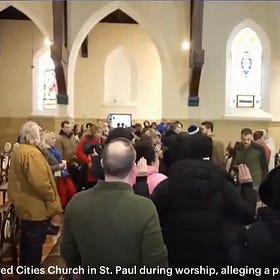
Activists entered a Sunday worship service and disrupted the service from inside the sanctuary.
Participants filmed the event and engaged congregants verbally.
Law enforcement response occurred after the group had already departed.
BREAKING: Protesters entered Cities Church in St. Paul during worship, alleging a pastor has ties to ICE
·
The intelligence we used to warn you about this earlier this week was due to paid subscribers! Your subscription is helping us monitor situations like this.

Political and Media Amplification
State Rep. Leigh Finke publicly characterized church disruptions as necessary and called for their continuation.
Minnesota Attorney General Keith Ellison appeared in an interview with Don Lemon and suggested the disruption did not violate the law.
However, disrupting religious worship is illegal under both Minnesota state law and federal law. Minnesota statutes prohibit intentional interference with lawful assemblies and religious services. Federal law similarly protects the free exercise of religion and criminalizes conspiracies or actions intended to intimidate or coerce individuals in the exercise of constitutional rights.
The public framing of this incident as legally permissible by a sitting Attorney General represents a material mischaracterization of the law. Such statements function as de facto authorization signals to activist networks and materially increase the likelihood of follow on violations, regardless of the actual legal exposure participants face.
Don Lemon, who conducted the interview, also participated in the protest itself and amplified the narrative through national media channels.
Broader Context
This incident did not occur in isolation. It followed a period of heightened anti ICE activism in Minnesota, with increasing acceptance of targeting non government institutions to apply pressure.
Importantly, Church security reporting in the week prior to this incident explicitly warned that churches could become protest targets as activists expand beyond traditional government sites. That assessment proved accurate.
This briefing notes that fact not to boast, but to reinforce the value of early warning and trend analysis. Churches that recognize emerging patterns can posture defensively before incidents occur.
Threat Assessment
Threat Actors
Decentralized anti ICE activist networks
Individuals motivated by ideological pressure campaigns rather than issue specific grievances against churches
Media aligned participants who amplify activity through livestreams and interviews
Tactics and Methods
Coordinated group entry during active worship
Chanting, verbal accusations, and filming
Attempts to provoke response from church leadership
Rapid online narrative framing following the event
Calls for repeat or expanded actions
Assessed Threat Level
Minnesota: Likely, Elevated
Other major metro areas: Possible, Moderate
Indicators and Warning Signs
Pre Incident
Online calls for “direct action” at churches
Naming of specific churches, pastors, or service times
Messaging framing churches as legitimate protest venues
Reconnaissance behavior during prior services
On Scene
Groups entering together rather than dispersing
Immediate filming before disruption begins
Positioning in aisles or near the front of the sanctuary
Likely Courses of Action
Repeat disruptions at the same church to normalize intrusion
Expansion to additional churches accused of ideological opposition
Shift to exterior confrontations if interior access is blocked
Narrative escalation portraying churches as political actors deserving pressure

Recommendations for Churches
Immediate
Establish a clear decision maker for disruptions
Train greeters and security to recognize coordinated entry
Post security outside of your church watching for protestors
Prevent sanctuary access when lawful and feasible
Secure children’s areas immediately during disturbances
Near Term
Coordinate expectations with local law enforcement in advance
Develop short, calm verbal scripts for leadership during incidents
Review camera coverage and evidence capture procedures
Communications
Do not respond emotionally or in real time to accusations
Verify facts before issuing any statement
Expect online pressure campaigns following incidents
Biblical Considerations
Scripture affirms both the freedom to worship God without interference and the responsibility of governing authorities to restrain disorder.
The Bible repeatedly condemns the disruption or profaning of worship. Jesus himself responded forcefully when the temple was intentionally disrupted, driving out those who turned a place of worship into a venue for coercion or spectacle. Worship is to be conducted in peace and order, not intimidation.
Romans 13 affirms that civil authorities are appointed by God to restrain wrongdoing and protect lawful assemblies. When authorities fail to uphold that responsibility, or publicly misrepresent the law in a way that enables intimidation, they abandon their God given role as ministers of order.
Acts 5 reminds believers that obedience to God takes precedence over obedience to men. Churches are therefore not obligated to yield their worship practices or surrender sacred space in response to political pressure campaigns.
Christians are instructed to pursue peace, but peace in Scripture is not achieved through coercion. Intimidation, even when labeled nonviolent, is incompatible with biblical justice and the free exercise of faith.
Analytic Note
This incident aligns with a broader shift toward targeting civilian religious spaces for political intimidation. The presence of state level validation changes the risk environment significantly. Churches should assume this tactic will continue and plan accordingly.
This briefing reflects observed trends and prior warning assessments. Churches that act on early indicators remain better positioned to protect congregants and preserve worship without disruption.
Stop being a pasifist soft target. Lock the doors with inside push bar exits. Start a security force of those armed with lethal weapons, and those armed with less lethal weapons I.E. impact and chemical weapons. Do not hesitate to forcefully oppose those entering to disrupt your service. They are jackals who only respect force. If they infiltrate quietly, have a cadre ready to physically escort them out, using the least amount of force necessary. No matter how you respond, they WILL SUE YOU. They think churches have deep pockets, and more importantly to them, you are interfering with their cosplaying "social justice warrior" fun. They rule by intimidation and threats of violence, but when confronted with a united force willing to use equal violence, they melt away.
Yes, less lethal.
Sharpen the pepper spray devices.
My first question is, where’s the security/safety team?