

BLUF
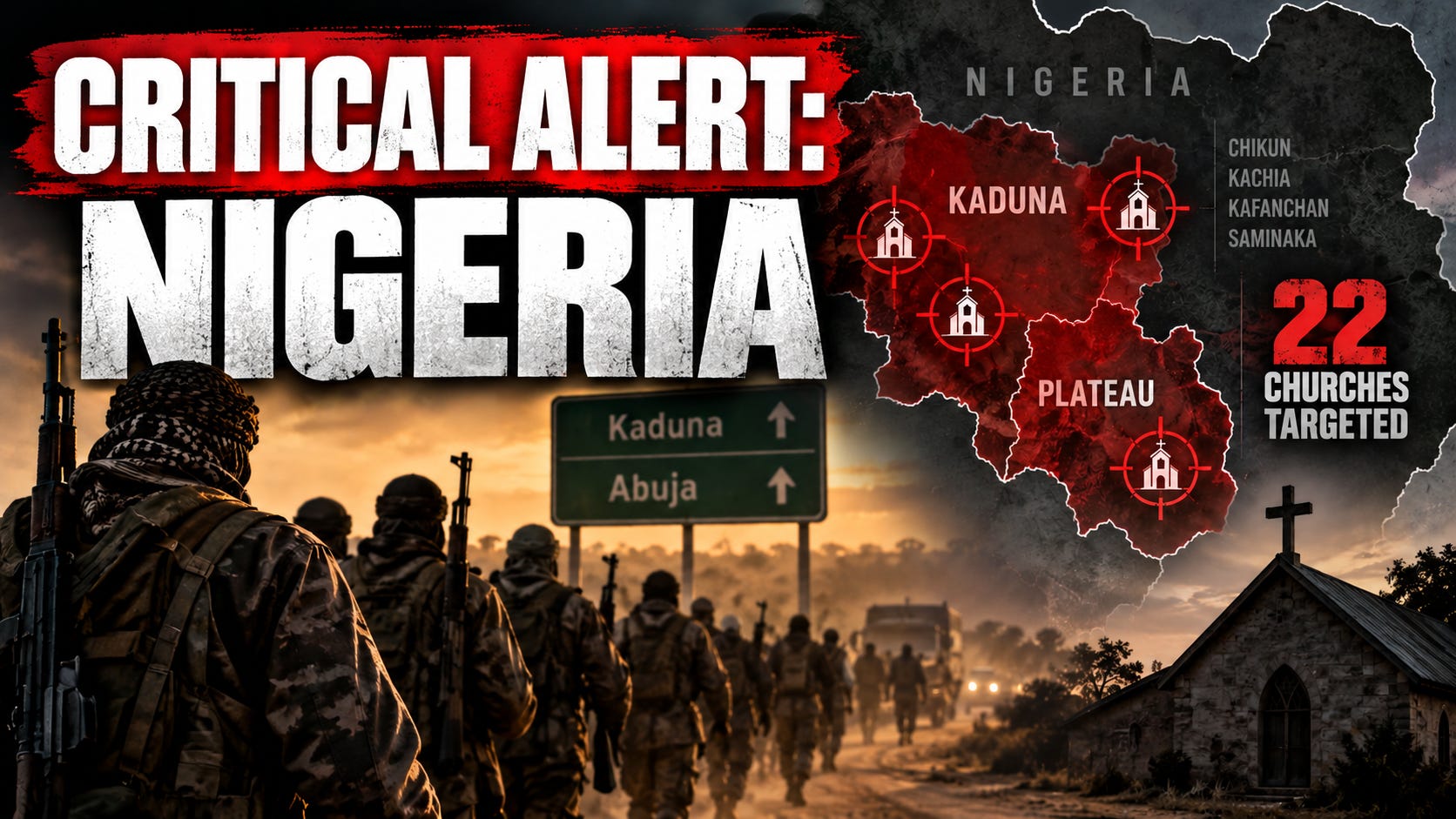
Truth Nigeria issued a CRITICAL threat warning on 28 August reporting hundreds of armed fighters moving toward the main expressway south of Kaduna city, along with source intelligence naming roughly 22 Catholic and Protestant churches as planned targets through 5 September. The sourcing cannot be independently verified. The documented incident record in those same areas this year is severe enough that the warning should be treated as actionable by anyone with people on the ground, and as a doctrine case by everyone else.
Key Judgments
Highly Likely: Armed attacks against Christian communities in Kaduna and Plateau States will continue at or above the current rate through the end of 2026, independent of what this specific warning window produced.
Likely: The armed movement reported on 28 August occurred, based on the volume of consistent movement reporting out of the Kaduna corridor this year.
Likely: Any attack inside the 29 August to 5 September window will be under-reported, denied, or confirmed late by Nigerian authorities, following the pattern of the January church abductions.
Possible: The church target list reflects actual attacker planning rather than a source’s assessment of which churches are most exposed.
Unlikely: This warning indicates any threat to congregations in the United States.
Terms and Geography
Kaduna and Plateau are neighboring states in central Nigeria, in the region where the Muslim north meets the Christian middle belt. Southern Kaduna is heavily Christian and has been the site of repeated mass attacks.
Fulani Ethnic Militia refers to armed groups drawn from the Fulani, a large herding people spread across West Africa. The Nigerian government formally designated these militias as terrorist organizations in December 2025. ISWAP is the Islamic State West Africa Province, the regional Islamic State affiliate. ECWA is the Evangelical Church Winning All, one of the largest Protestant denominations in northern Nigeria. CAN is the Christian Association of Nigeria, the national umbrella body for Nigerian churches.
What the Warning Reports
The alert contains two movement reports and one targeting report.
The first movement report is a sighting on 28 August of hundreds of armed Fulani militia moving from Sabon Gaya toward the Abuja-Kaduna Expressway, the main highway running south out of Kaduna city. The alert flags the Gonin Gora and Millennium City area on the southern approach to the city. Destination and intent were not established.
The second is earlier reporting of more than 50 armed fighters on more than 50 motorcycles moving south and east out of Katsina State, crossing Kaduna State and continuing toward Jos, the capital of Plateau State. They were reportedly reinforcing armed groups in Plateau after losses to Nigerian security operations.
The targeting report states that Fulani militia working with ISWAP and a group called Darussalam are planning attacks on churches in four areas of Southern Kaduna: Chikun, Kachia, the Kafanchan area, and the Saminaka corridor. The breakdown totals roughly 22 named Catholic and Protestant churches, with Kachia carrying the most at ten.
The alert does not identify a source, a collection method, or specific dates and times inside the window, and it assigns no confidence level of its own beyond the word CRITICAL.
Source Assessment
Truth Nigeria is edited by Douglas Burton, a former State Department official in Kirkuk, Iraq, who has covered Nigerian terrorism since 2019 and has written for Epoch Times, EWTN, and Business Insider. Its Kaduna reporter is Luka Binniyat, who also serves as spokesman for the Southern Kaduna Peoples Union.
Police arrested Binniyat on 4 November 2021 on a complaint from Kaduna’s commissioner for internal security, Samuel Aruwan, over a report criticizing the state government’s response to the killing of Christians. He was charged under Nigeria’s cybercrime law, denied bail, and held 84 days before a court released him in January 2022. The Committee to Protect Journalists, Reporters Without Borders, and the Media Foundation for West Africa all took up his case.
The outlet is advocacy journalism rather than wire reporting. Its donate link routes to a ministry called Equipping the Persecuted. Its security alert category holds 123 published warnings, and it does not publish follow-up posts stating whether a warned-of attack actually occurred.
Handle it the way you would handle a reliable confidential informant with good access and an agenda. The information has repeatedly proven accurate. The outlet also wants a specific outcome, which is Western attention on Nigeria. Both are true and neither cancels the other.
The clearest test case is the January church abductions. On 18 January 2026, gunmen struck three churches in the village of Kurmin Wali during Sunday services. The Kaduna State Police Command and the local government chairman said no kidnapping had occurred and accused the media of misleading the public. Rev. Joseph John Hayab, CAN chairman for Nigeria’s 19 northern states, put the count at 172 taken with nine escaping. The final figure reached 177. National police spokesman Benjamin Hundeyin confirmed the incident the following Tuesday. Absence of official confirmation in Kaduna carries almost no evidentiary weight.

Status of the Threat Window
The threat period ran 29 August to 5 September. As of 4 September, I found no open-source reporting of a mass-casualty attack on churches in any of the four named areas inside that window. Truth Nigeria has published no follow-up alert. It did publish a report of a pastor executed during an abduction on 2 September and a report on Kaduna State ignoring kidnapper raids near Rijana on 1 September.
Three explanations fit the available evidence and none can be excluded. The attack did not occur. The attack occurred and has not yet been reported, which is the documented default in Kaduna. Or the warning generated a security response that prevented it. A warning that changed behavior and a warning that was wrong produce the same visible result.
Application for U.S. Church Security Teams
Attackers in Kaduna struck during Sunday services and hit multiple churches in the same community at the same time. The January raid took three churches in Kurmin Wali at once and 177 worshippers with it. At Easter, attackers hit First ECWA Church and St. Augustine Catholic Church in the village of Ariko, killing at least seven and abducting others before Nigerian troops rescued 31. Ariko sits in Kachia, the area carrying the most named targets in the current warning. A service is the only time a community is stationary, concentrated, unarmed, and operating on a published schedule. That condition is identical in Idaho and in Kachia. Your service hours are your highest-risk hours.
In the Easter attack at Ariko, a local councilman said poor cell coverage may have contributed to the scale of the attack by delaying any response. Radios and phone trees are the mechanism by which a warning reaches the people who can act on it.
Southern Kaduna communities have functioning civilian early warning. Residents observe armed movement and report it. What fails is what happens after the report reaches an authority. When volunteers report suspicious activity and see no visible result, they stop reporting. Close that loop on every report your team submits.
Threat Assessment
The overall threat level for churches in the named areas of Kaduna and Plateau States is RED (critical). That assessment does not depend on the outcome of this particular warning window. It is highly likely that armed attacks on Christian communities and church services in these areas continue through the remainder of 2026. It is likely that the armed movement reported on 28 August occurred, and possible that the church target list reflects actual attacker planning rather than a source’s vulnerability assessment. The primary concern is a mass abduction or mass-casualty raid during a Sunday service, which is the demonstrated method in both the January and Easter church attacks. Violence in these two states this year has also included 40 people killed across two communities on Palm Sunday, a Catholic priest and ten others taken at 0320 hours in February, and at least 30 killed at Naridon village in July, eight of them children from a single family. The secondary concern is the reporting gap, since it is likely that any attack inside the window is denied or confirmed late, which strips the warning value away from other congregations in the same corridor.
For congregations in the United States, this warning does not change your threat level. Hold your existing posture based on local indicators. It should change your training emphasis. The 2026 Kaduna cases are documented proof that simultaneous multi-site attacks during service hours are an operational method rather than a tabletop exercise construct.
Biblical Lens
“And we prayed to our God and set a guard as a protection against them day and night.” (Nehemiah 4:9, ESV)
Nehemiah prayed and posted a guard. The churches in Chikun, Kachia, and Kafanchan are praying. Most have no lawful means to post a guard, because the state that designated these groups as terrorists nine months ago has not put men between them and the road. American congregations have both options available and should use both.
Leave a comment with how your team plans for simultaneous multi-site attacks during service hours, and pass this to your pastor and your team leader.
Heavenly Father, I ask you in the name of Jesus to hear the cries of your followers in Nigeria. They love you and they are all grateful for Your forgiveness of their sins, just like I'm grateful for Your forgiveness. PLEASE send physical protection for the Christian followers in Nigeria - please find a way to get firearms & training to our brothers & sisters. Nevertheless, not my will but Your will be done. Please deliver them from the Muslim followers of Satan who hates truth and light. In the name of Jesus I offer up this prayer.
Thank you. I will attempt to pass this along to A Million Women which is a prayer and fasting ministry associated with Lou Engle. The group just concluded a 7 day fast specifically for the churches and believers in Nigeria. I am sure they want to know this . Mr. Graves you and your ministry team are a greatly appreciated and I consider you a gift and a god-send to the Body of Christ.