


Facebook | X | Instagram | YouTube | LinkedIn | Threads | TikTok
BLUF
April 20 is a date with a documented history of mass violence in the United States and a measurable pattern of copycat threats clustered around its anniversary. There is no specific, credible threat against your congregation today. There is a well-established behavioral pattern that justifies raising your team’s situational awareness for today’s services and returning to normal posture tomorrow.
Key Judgments
Highly Likely: April 20 will continue to function as a motivating date for copycat-inspired actors in future years, given Columbine’s documented status as the most imitated mass attack in U.S. history.
Likely: Anniversary-related threats will emerge in online extremist spaces on or around this date each year. Law enforcement has observed this pattern repeatedly, including a foiled plot specifically timed to April 20, 2024.
Possible: A domestic extremist actor motivated by historical symbolism, whether tied to Columbine, the Oklahoma City bombing, or the Waco anniversary window, could select a soft public target during the April 19-20 calendar window.
Unlikely: Your congregation faces a targeted threat tied specifically to today’s date. The general risk environment is elevated above baseline, but there is no active intelligence pointing to a specific church threat.
Historical Record: What Happened on and Around April 20
The weight of this date begins with Columbine. On April 20, 1999, two students killed 13 people and wounded more than 20 others at Columbine High School in Littleton, Colorado, in what was at the time the deadliest school shooting in U.S. history. The attack was not spontaneous. The two shooters planned for roughly a year, constructed 99 improvised explosive devices, and intended the cafeteria bombing to be the centerpiece of a mass casualty event that would rival the Oklahoma City bombing. Most of those devices failed to detonate. The shooting that followed killed 13 and set off a chain of cultural and criminal contagion that continues today.
The Oklahoma City bombing preceded Columbine by four years. On April 19, 1995, Timothy McVeigh detonated a truck bomb outside the Alfred P. Murrah Federal Building, killing 168 people in the deadliest act of domestic terrorism in U.S. history. McVeigh chose the date deliberately, timing the attack to the second anniversary of the end of the Waco siege and the 220th anniversary of the Battles of Lexington and Concord. The use of a historical calendar as a motivating framework was not incidental, it was the entire point. That logic has been replicated by actors who have followed him.
These two events, occurring within 24 hours of each other on the calendar a generation apart, have given the April 19-20 window a symbolic weight that persistent extremist communities continue to activate.
The Columbine Effect: Documented Contagion
What happened after Columbine is not merely cultural. It is operational threat data. Researchers have documented more than 70 attacks and plots globally that were directly linked to the Columbine massacre through attacker writings, target selection, or explicitly stated inspiration. The phenomenon has a name in threat assessment literature: the Columbine effect.
The pattern does not respect time. Attacks inspired by Columbine have occurred across three decades. The December 2024 shooting at Abundant Life Christian School in Madison, Wisconsin was carried out by a 15-year-old who, according to investigators, idolized the Columbine shooters and mimicked their ideology and tactics. The August 2025 attack at Annunciation Catholic Church in Minneapolis, which killed two children during a school Mass and wounded 28 others, was carried out by someone investigators described as having a “deranged fascination with previous mass shootings,” including Columbine. The shooter’s weapons bore the names of past attackers, including the Columbine perpetrators.
The anniversary itself generates specific threat activity. In April 2024, four Pennsylvania teenagers were charged after law enforcement uncovered a specific plan to carry out an attack on April 20 in direct homage to the 25th anniversary of Columbine. Text messages between them included language about wanting “everything to go down like Columbine.” That plot was disrupted. Not every plot is.
Online Radicalization and the Current Threat Environment
The mechanism driving copycat risk has changed. Social media and encrypted platforms have created persistent communities that treat mass killers as objects of admiration, study their tactics in detail, and actively encourage imitation. Federal cyber tip line data shows a 300-plus percent increase between 2023 and 2024 in reports involving violent online groups of this type. Researchers tracking these communities have documented at least seven school shootings or disrupted plots in 2024 alone linked to individuals embedded in them.
Among the documented networks operating in this space are the Terrorgram Collective, a neo-fascist network that encourages violence aimed at societal collapse, and a subculture researchers call Saints Culture, which treats high-casualty attackers as heroic figures and frames imitation as the highest achievable act. These communities do not confine their targeting to schools. They encourage violence against any high-visibility soft target, and a filled church sanctuary fits that description.
The spring calendar window amplifies this. Actors embedded in these communities are aware of April 20. They discuss it. Some of them plan around it.
What This Means for Your Church Today
This brief is not a notification of a threat to your congregation. It is a notification of an elevated threat environment on a specific date, grounded in documented historical patterns rather than active intelligence.
Your team’s posture today should reflect that distinction. Heightened observation is appropriate. Normal protocols remain in effect, applied with sharper attention. Your team should pay particular attention to late arrivals during services, anyone whose behavior breaks the pattern of normal Sunday attendance, and anyone who is conducting what looks like pre-operational surveillance of your facility rather than participating in worship. Those behaviors are not unique to today, but today is a day to take them more seriously than usual.
The Annunciation Catholic Church shooting in August 2025 is the most recent data point for what happens when a church full of children is attacked without a prepared response. Two children died. Twenty-eight others were wounded. A prepared team is not a guarantee of survival, but an unprepared team in that environment is a near-guarantee of higher casualties.
Threat Assessment
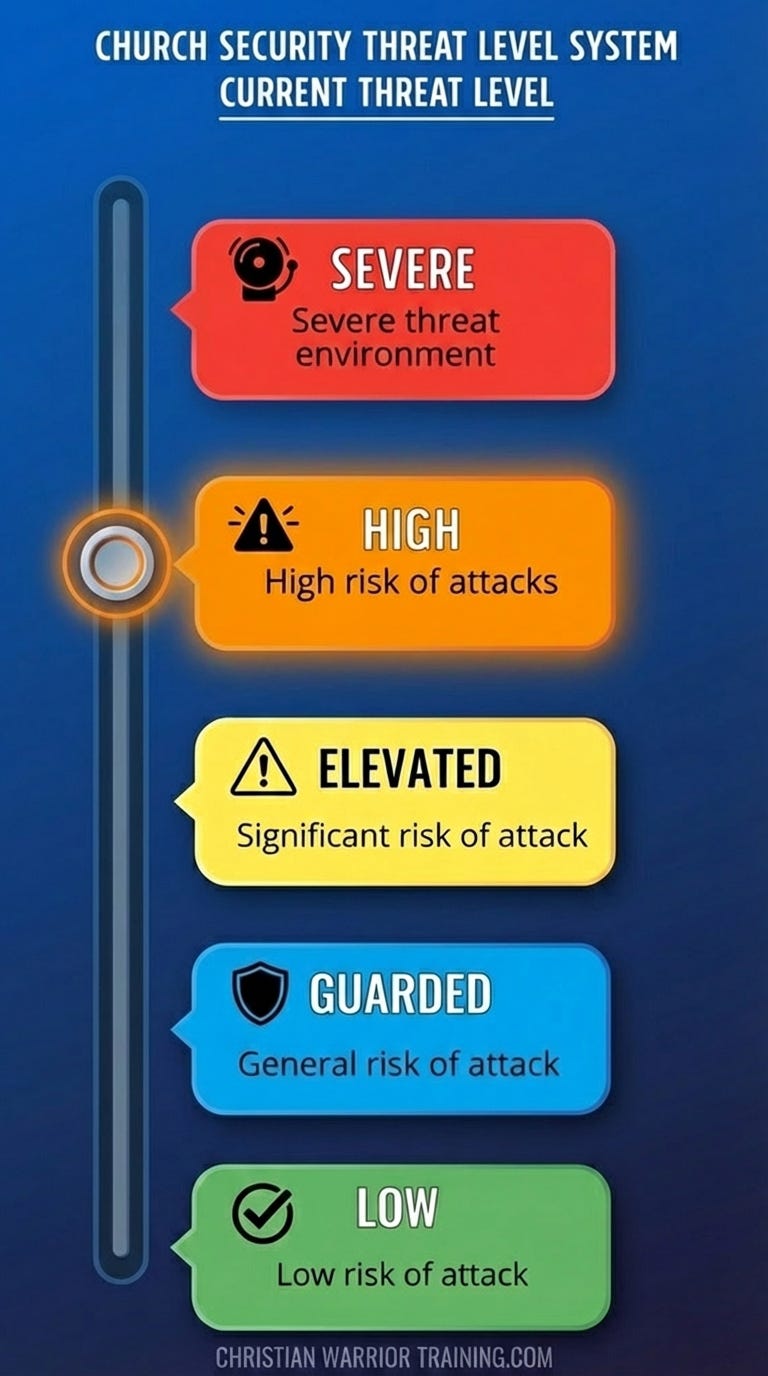
The overall threat level for churches and congregations on April 20, 2026 is assessed at ELEVATED (Orange), raised from the standing ELEVATED (Yellow) posture for today only.
This assessment is based on historical pattern and documented behavioral data, not active intelligence targeting any specific church or region. The Columbine anniversary generates measurable threat activity each year in online extremist communities. The Oklahoma City bombing anniversary occurred yesterday. These dates together form a recognized high-risk window in the domestic extremism calendar.
The primary concern is a copycat-motivated lone actor or small group operating without specific coordination, selecting a soft public target for symbolic or notoriety-driven reasons. Churches are not the primary historical target of Columbine-inspired attacks, but soft targets with high casualty potential have appeared in attacker writings and planning documents with enough frequency to warrant attention. The secondary concern is escalatory language or specific threats appearing in online spaces today and in the days that follow. If your team or congregation members encounter anything of that nature, report it immediately through your local law enforcement liaison and through CWT’s reporting platform at alert.christianwarriortraining.com.
Return to ELEVATED (Yellow) posture on April 21 unless new intelligence warrants otherwise.
Biblical Lens
“Set a guard, O Lord, over my mouth; keep watch over the door of my lips.” — Psalm 141:3
The men of Issachar understood the times. Part of that understanding is knowing when a day is not like other days, not out of fear, but out of discernment. April 20 is a day that requires more of your team, not because God is not in control, but because He has placed your team in a position of responsibility. You are the guard on the wall today. Stand alert, stay calm, and trust the Lord with what you cannot see.
Drop a comment below with your observations from today, and share this brief with your pastor or team leader. They need to understand what their team is standing guard against.
I heard also years ago like Darwin mentioned that this day is associated with Hitlers birthday. And also Nation pot day. Is there any truth to these comments?
And also don’t forget April 20 is Hitler’s birthday. I remember back when I was a kid. Somebody always pulled something that week of his birthday. I remember there was problems with skinheads on that week a lot and just random people honoring Hitler.