


📺 Watch the Full Video Briefing on YouTube
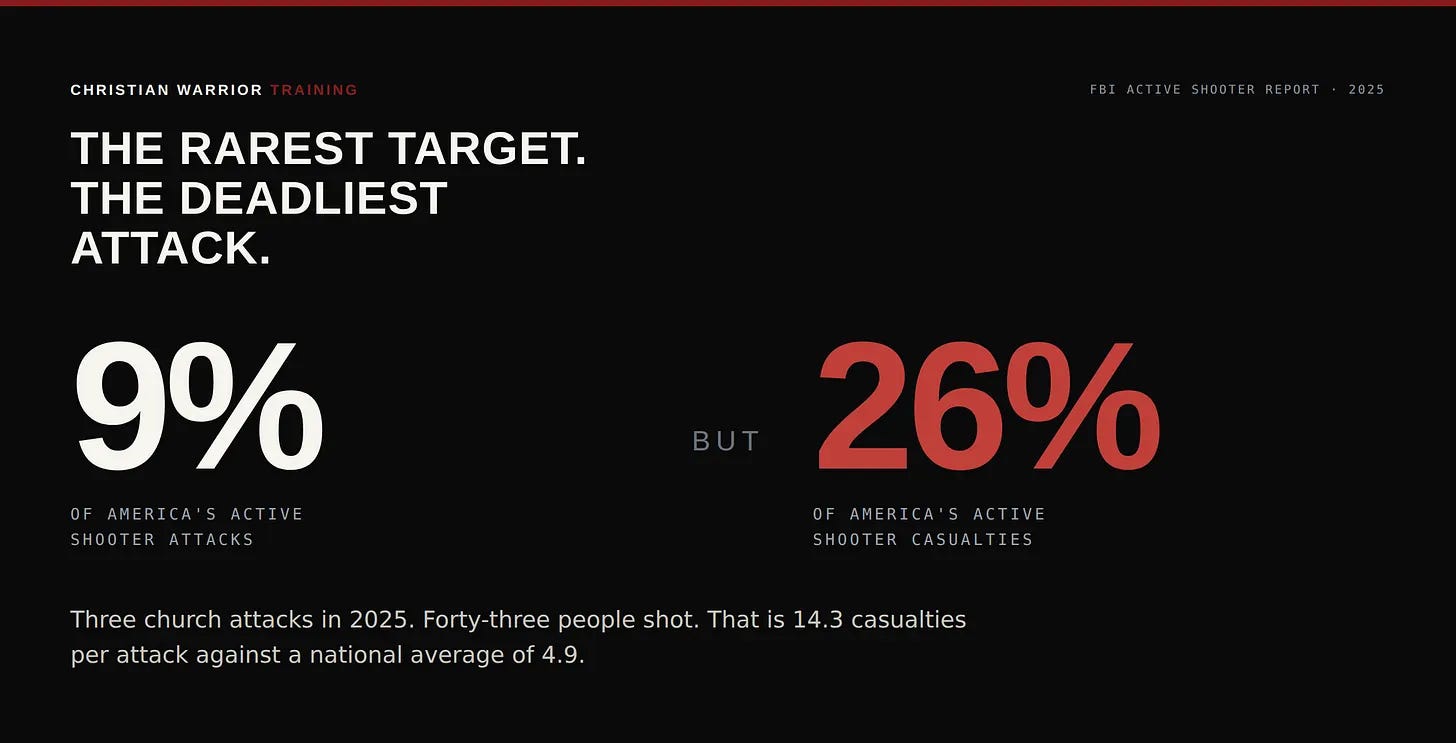

Churches were the least-attacked place in America last year and took twenty-six percent of the casualties. The FBI counted 34 active shooter attacks in 2025. Three of them happened at churches, which is nine percent of the total and the smallest share of any category in the report. Those three attacks put 43 of the 166 casualties in the country on the ground.
Picture your own building on a Sunday morning. Two hundred people in rows, seated, facing forward, most of them past sixty. The doors are propped because it is warm. Somebody’s grandkids are in the second row. A man walks across the lot with a rifle and starts shooting through the window glass from outside, and nobody inside sees him coming because everybody inside is looking at the pulpit. That is Minneapolis, August 27th. Thirty casualties in about two minutes.
I read all seventy-six pages of this report. There are about two pages in it about churches, because the report is written for cops, not for you. What follows is the part that reaches into your building.
Nine percent and twenty-six percent
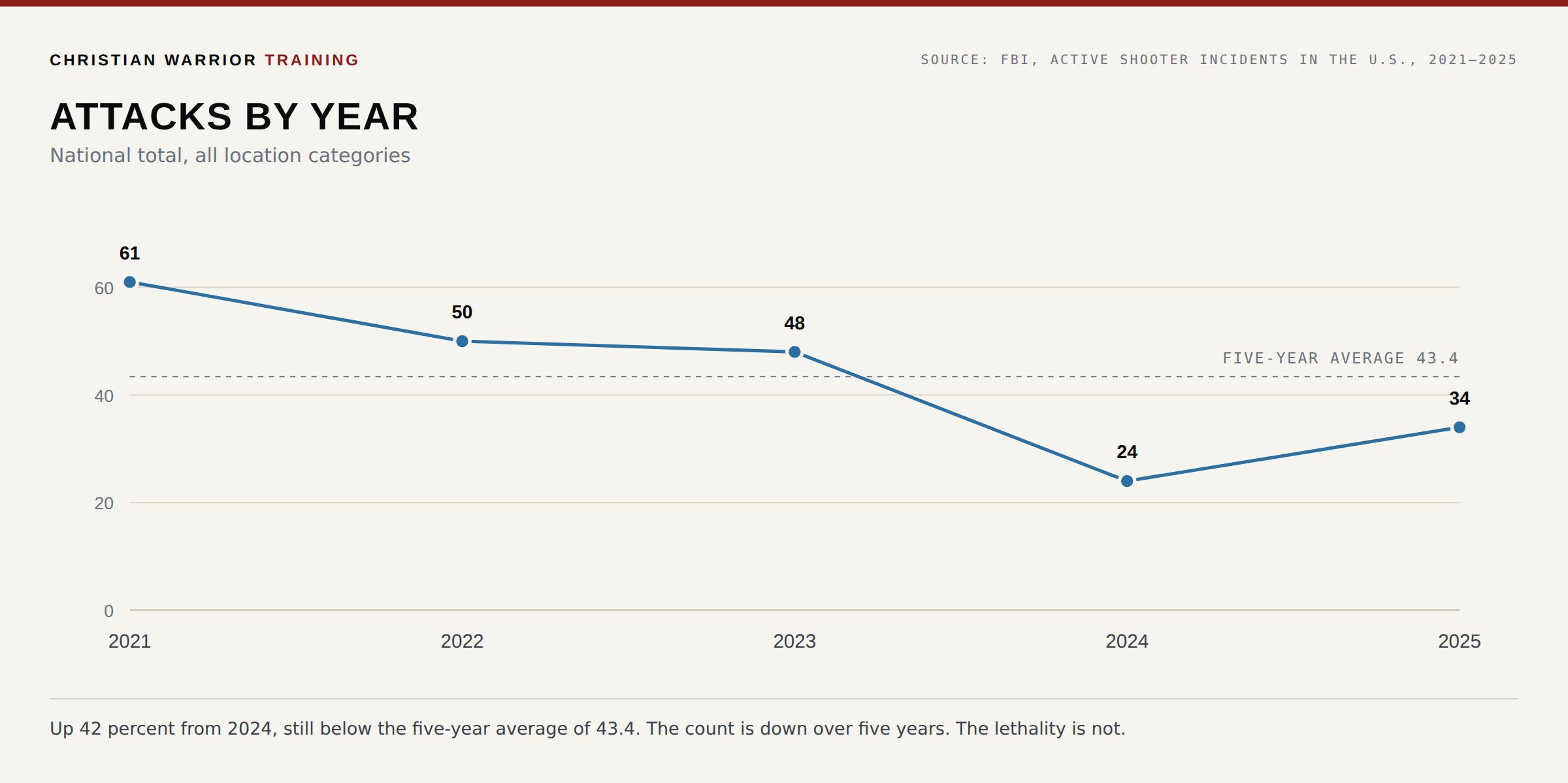
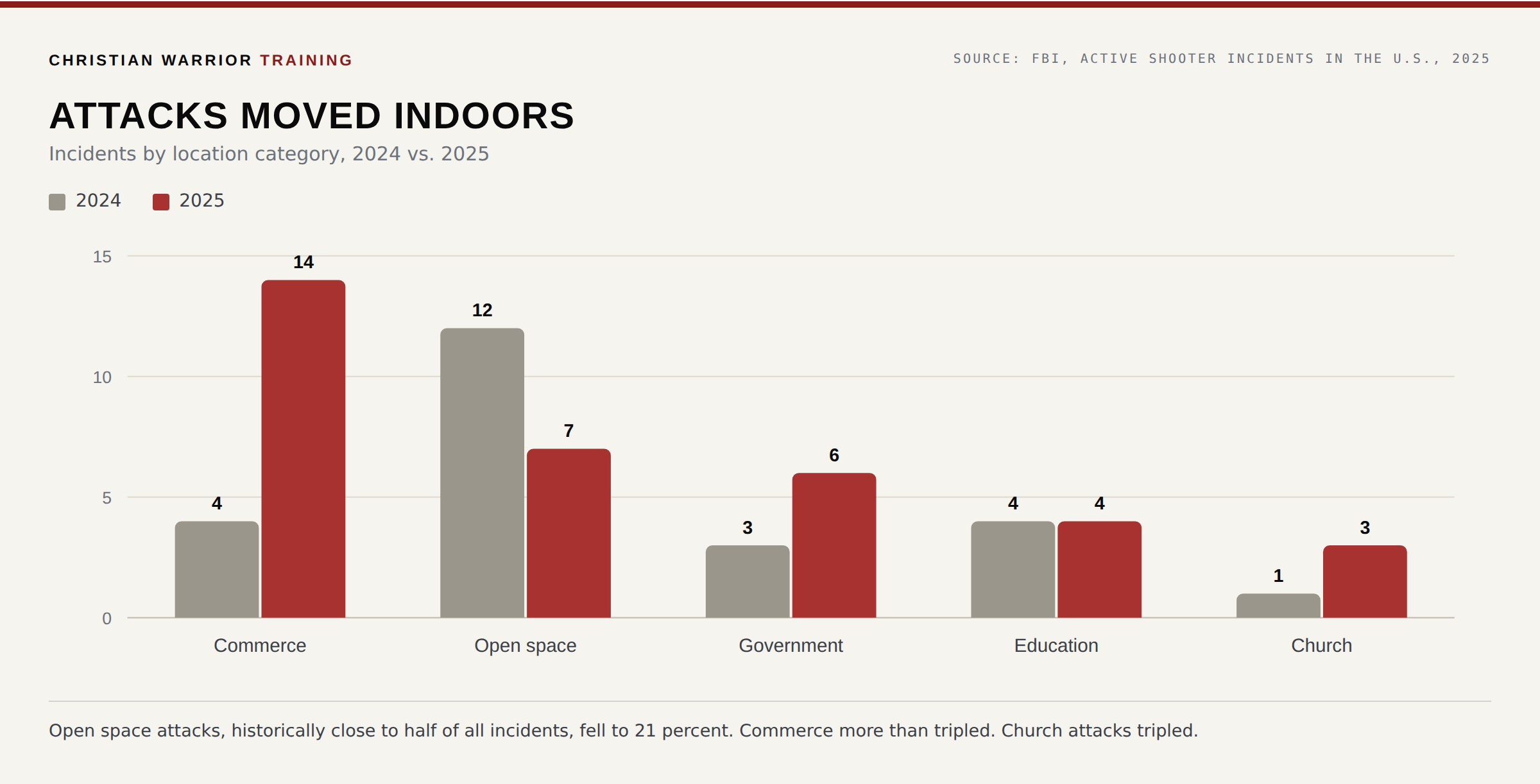
Commerce locations took the most attacks in 2025 with fourteen. Open spaces took seven, government buildings six, schools four, and churches three. Nationally the year was worse than the one before it by a wide margin. Attacks were up 42 percent from 24 to 34, casualties were up 57 percent from 106 to 166, and mass killings more than doubled from three to seven. Every shooter was male, every one of them worked alone, and their ages ran from 16 to 77.
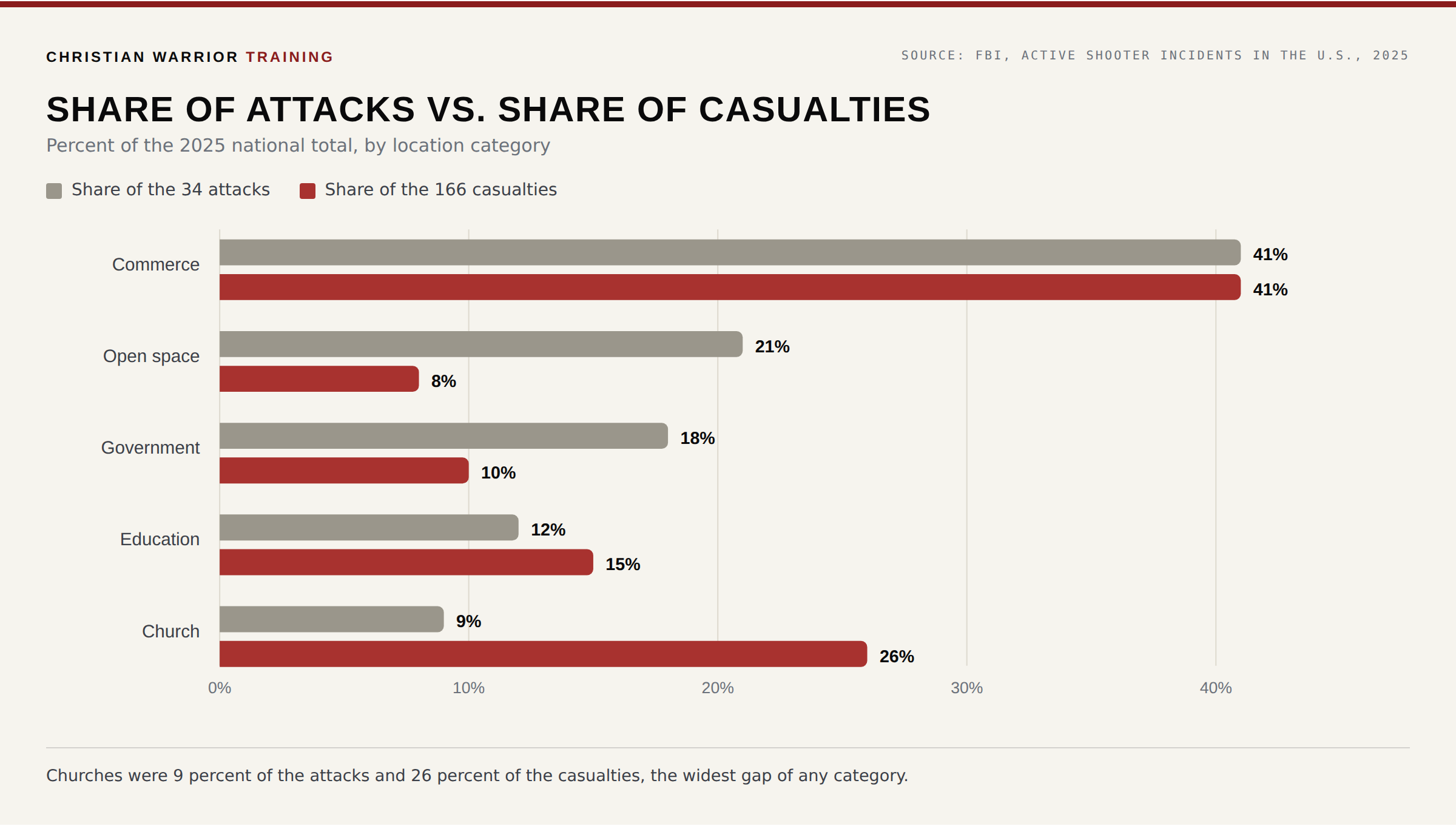
You will see people run the division on that and report 14.3 casualties per church attack against a national average of 4.9. I am not going to lean on that number and neither should you. Thirty of the 43 came from Minneapolis alone. One attack is carrying that average, and any statistic built on three events will do that.
Here is the honest version. The three attacks produced 1 casualty, 12 casualties, and 30 casualties. Take Minneapolis out of the math entirely and the other two still averaged 6.5, above the national 4.9. Widen the window to five years, where the sample is big enough to mean something, and the FBI counts seven church attacks and 54 casualties from 2021 through 2025. That is 7.7 per attack against 4.9 across every location. Only schools ran higher.
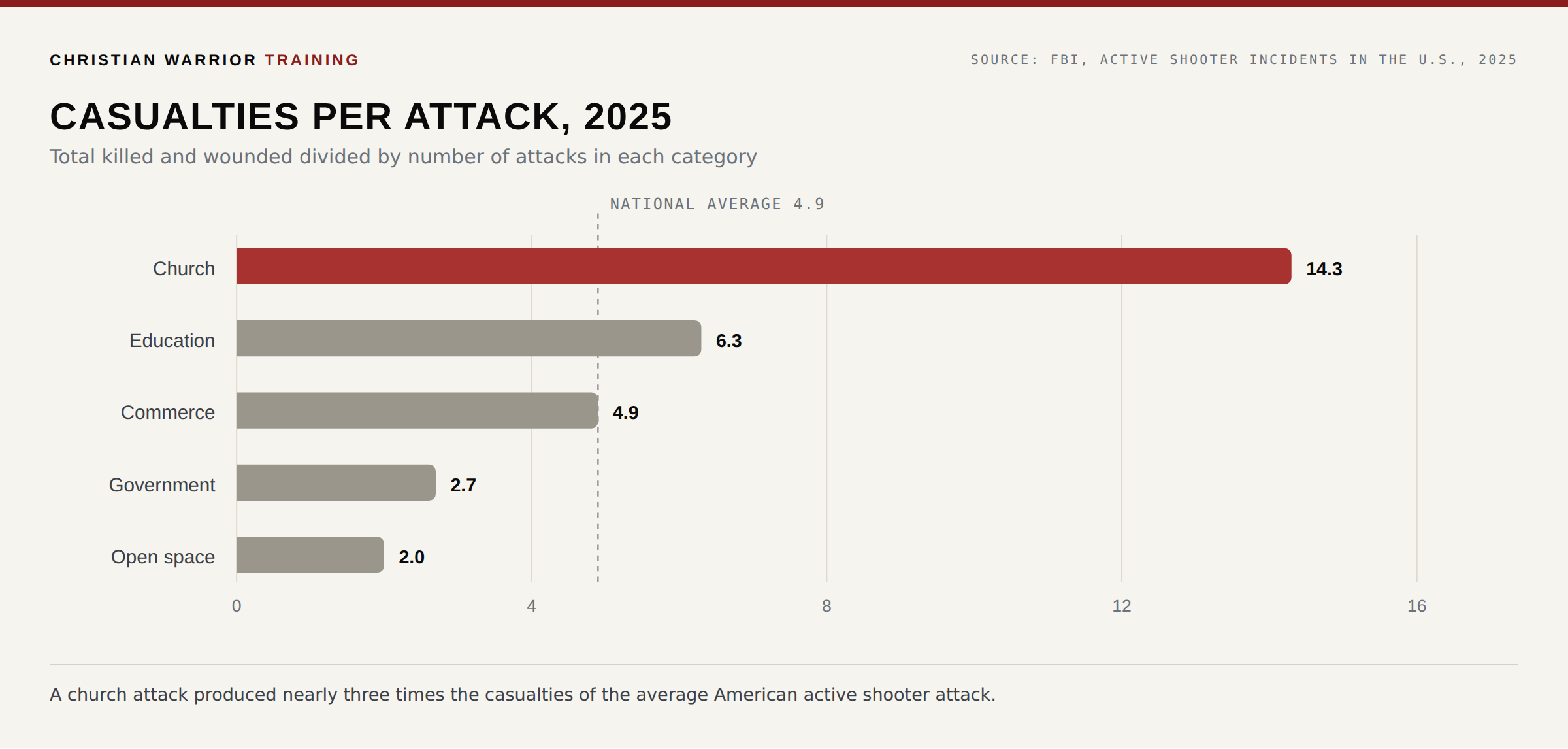
Why does a church run high year after year? Density. A man shooting in a parking lot is shooting at people who are spread out, moving, and dropping behind cars. A man shooting into a sanctuary during a service is shooting into rows of people who are sitting down, packed shoulder to shoulder, facing the other way. Every round he fires has somebody in front of it. That will not change, which is why churches and schools sit at the top of that chart year after year while the attack counts stay low.
Three attacks, read side by side
The FBI writes these summaries in about four sentences each. Put the three next to each other and they teach a great deal more than any one of them does alone.
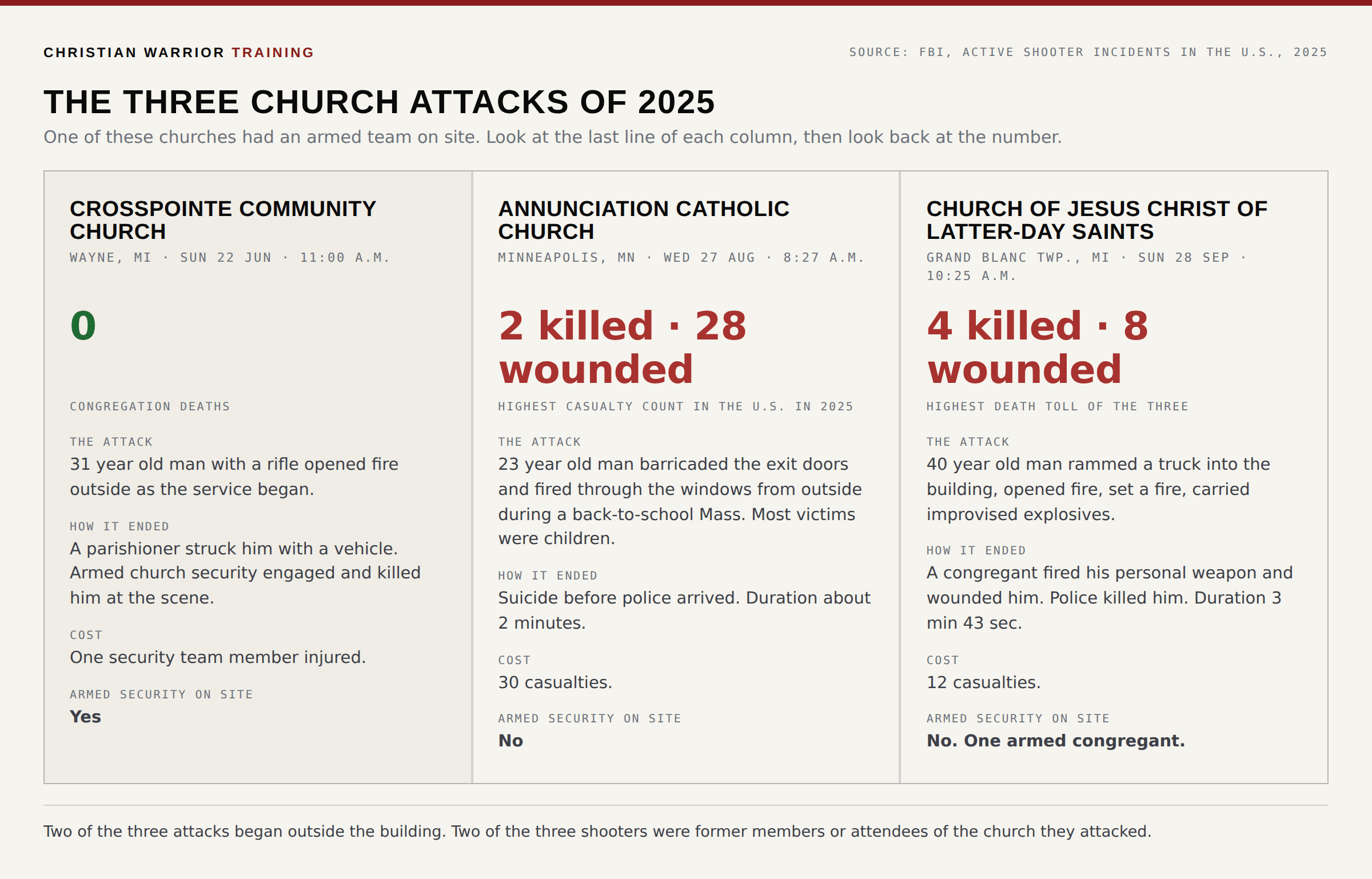
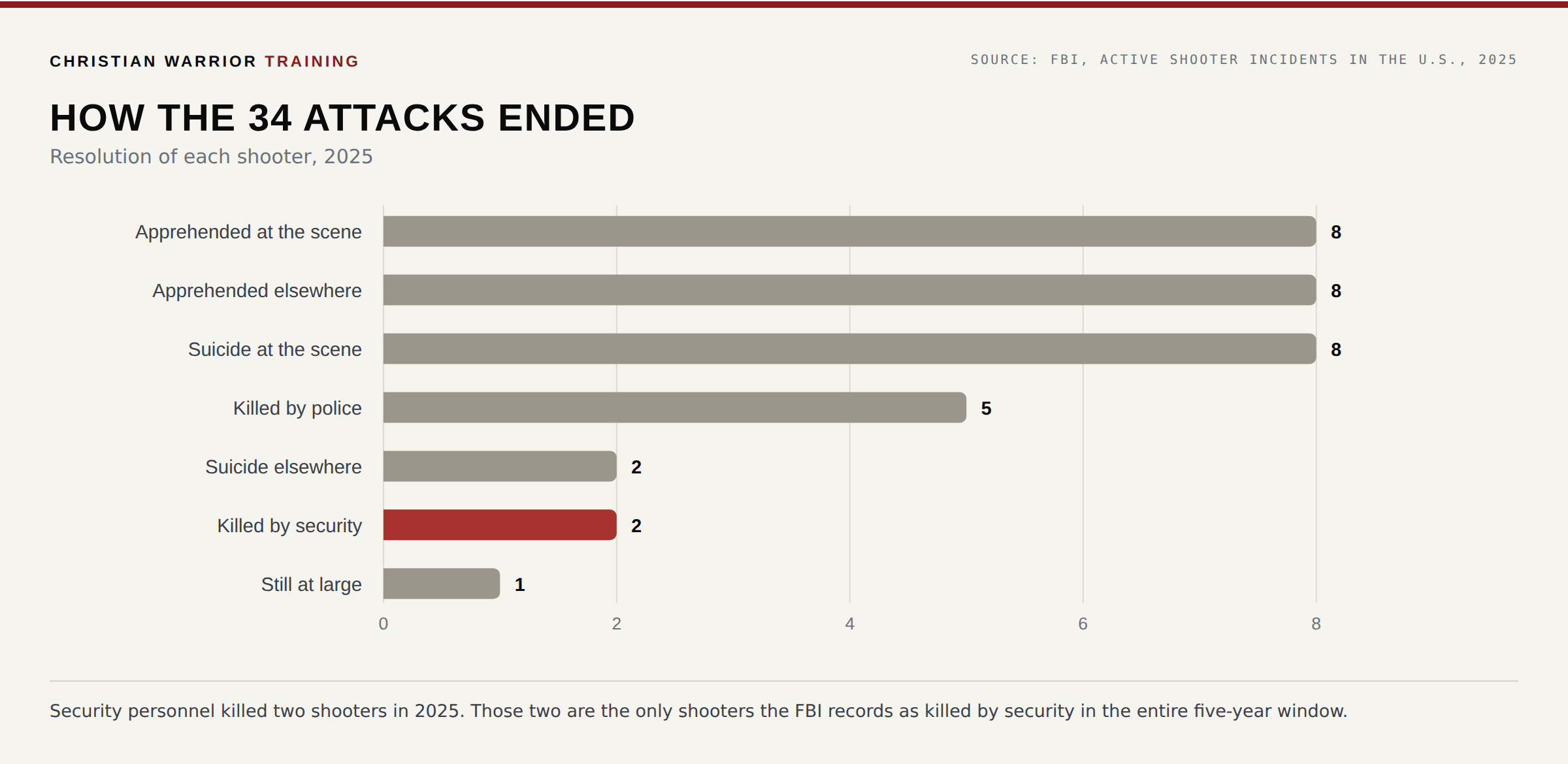
On Sunday, June 22nd, at CrossPointe Community Church in Wayne, Michigan, a 31 year old man with a rifle opened fire outside as the service began. A parishioner watching it happen struck the shooter with his vehicle. Armed church security engaged him and killed him at the scene. One member of that security team was injured. Nobody in the congregation was killed.
On Wednesday, August 27th, at Annunciation Catholic Church in Minneapolis, a 23 year old man barricaded the exit doors from the outside and fired through the windows during a back-to-school Mass. He never entered the building. Two people were killed and twenty-eight were wounded, and the majority of the victims were children in pre-K through eighth grade. He died by suicide before police arrived. Total duration, about two minutes. That was the highest casualty count of any active shooter attack in the United States in 2025, and it happened at a church, on a weekday morning, with the kids there.
On Sunday, September 28th, at the Church of Jesus Christ of Latter-day Saints in Grand Blanc Township, Michigan, a 40 year old man rammed his truck into the building, opened fire on the congregation with a rifle, set the building on fire, and kept shooting. He was carrying improvised explosive devices. A congregant drew his personal weapon and wounded him. Police arrived one minute and fifty-eight seconds after dispatch, which is a fast response by any standard in this country, and killed him. Four dead, eight wounded, three minutes and forty-three seconds from first shot to finish.
One of those three churches had an armed team standing post that morning. That is the church where no member of the congregation was killed.
I am not going to tell you a single case settles an argument, because it does not. But this is the only case we have from 2025 in which an attacker at a church ran into an armed, organized response. That congregation lost nobody. The two that did not have a team lost thirty people shot in one and twelve in the other.
The attack starts outside
Two of the three attacks began outside the building, and one of them never came inside at all.
That should change where you put your people. Most church security plans concentrate everything at the entrance and the back of the sanctuary. The greeters work the door, somebody stands at the rear with eyes on the room, and the whole design assumes the threat walks in through the front where you can see him. At CrossPointe the fight happened in the lot. At Annunciation the attacker worked the exterior wall, blocked the doors so the people inside could not get out, and shot through the glass.
Somebody is going to tell me that a man standing in the parking lot cannot stop a rifle. He is right, and that is not the job. The job is to see a man crossing the lot with a long gun and get that information into the building thirty seconds sooner than it would have arrived otherwise. In thirty seconds your people can be off the pews, behind cover, and the doors can be handled.
So post a man outside during service. Give him a radio, a clear line of sight on the approaches, and permission to walk up to somebody and start a conversation. For most churches reading this, that is the single cheapest change available, and it can be in place this Sunday.
Thirty seconds, not three minutes
Ed Monk is a retired Army lieutenant colonel, a West Point graduate, and a working law enforcement officer who has been researching active shooter attacks since 2007. His book came out in 2025, and it is called First 30 Seconds: The Active Shooter Problem. The number in that title is the most useful figure in this entire subject, and it is far more demanding than anything in the FBI report.
Monk’s finding is that to have a high mathematical probability of holding the victim count in single digits, zero to nine, the attacker has to be stopped inside the first thirty seconds of his attack. His research puts most attackers firing a new shot every three to five seconds. By the thirty-second mark the tenth victim is frequently already down. By the third minute, counts in the twenties and thirties are common.
Now set that against the FBI numbers. Average police response at the three church attacks was two minutes and fifty-nine seconds from dispatch to arrival, and the fastest was one minute fifty-eight at Grand Blanc.
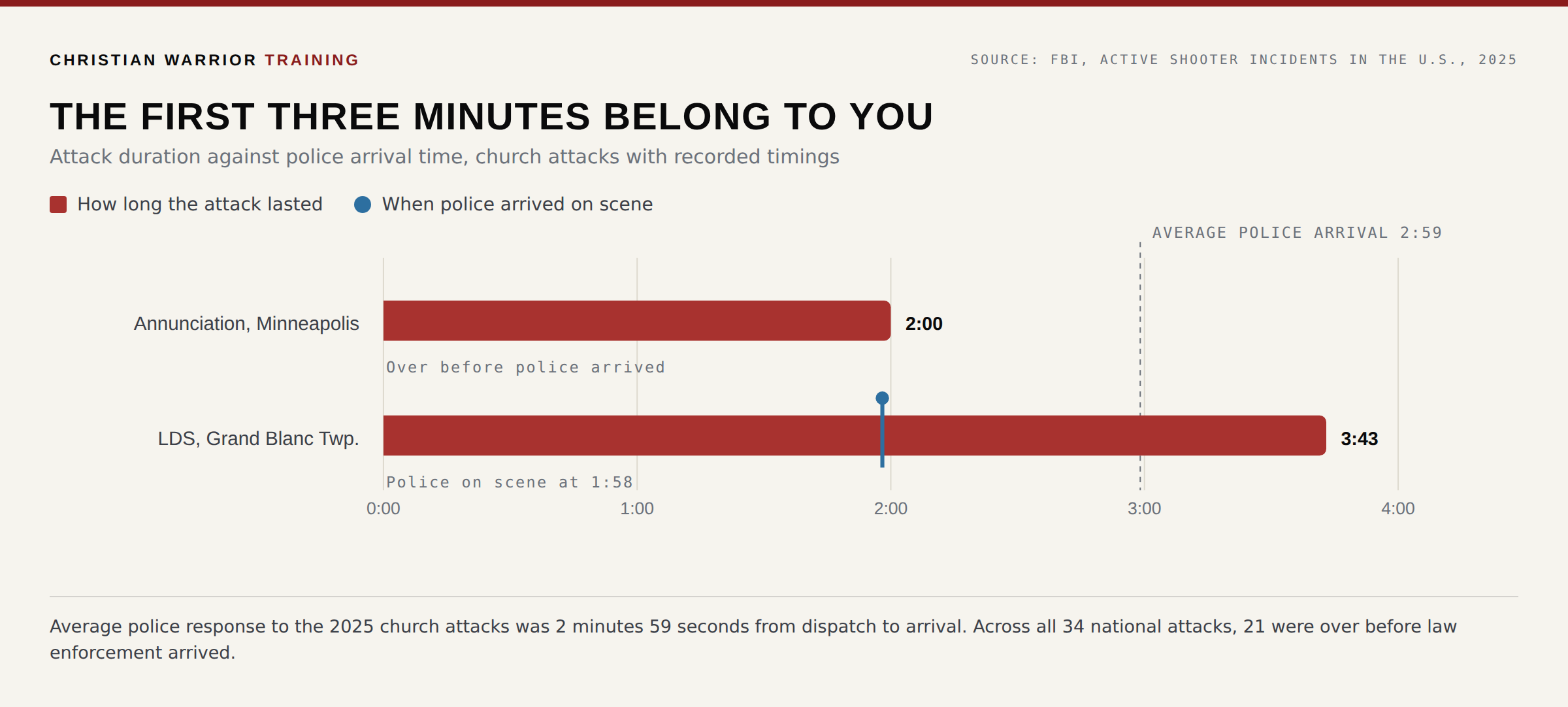
Those are good response times. Those are officers driving hard. They are also about six times longer than Monk’s window.
And 2:59 flatters us. I say us because I spent my career on that end of the call. That clock does not start when the shooting starts, it starts at dispatch. Before dispatch, somebody in your building has to hear it, understand what it is, and get through to a call taker. Arrival on scene is not the end either. Officers still have to make entry, find him, and put him down. The gap your team has to cover is longer than three minutes, not equal to it.
Watch Monk’s math play out in the FBI’s own summaries. Minneapolis ran about two minutes and produced thirty casualties. Grand Blanc ran three minutes and forty-three seconds and produced twelve. At CrossPointe a parishioner hit the attacker with a vehicle and the security team killed him in the opening moments of the attack, and the total came to one injured security member.
The national picture holds up too. Law enforcement intervened in thirteen of the thirty-four attacks while the shooter was still shooting at people. In the other twenty-one it was over before an officer arrived.
So thirty seconds is the standard, and nobody is driving to your address in thirty seconds. That is the whole argument for a trained team on site, and it is why you time your drills. Run the full response and put a real number on each piece. How long to get the exterior doors handled. How long to get the front three rows down and behind something. How long for your team to cross the lot to a man at the far end of it. Write those numbers down and compare them to thirty seconds. A team that knows its own times can plan. A team that has never measured is guessing.
The man in your directory
Two of the three church shooters had ties to the church they attacked, as former members or attendees. They had sat in those rooms. Nationally, fifteen of the thirty-four shooters had some connection to the location or to the victims, and seven of them were classified as insider threats, meaning they had legitimate access at the time of the attack.
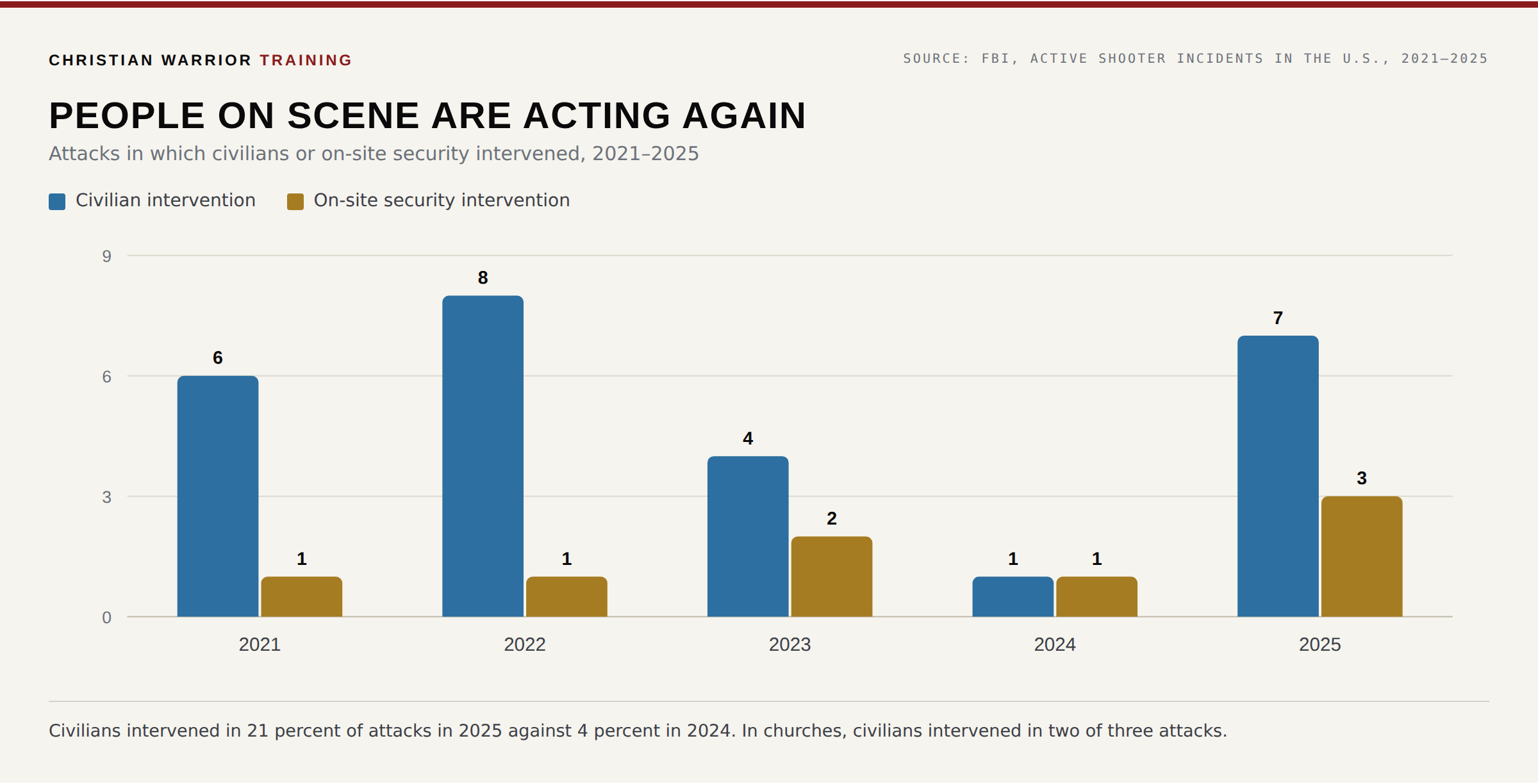
I have been telling you this for years, and here is the federal government’s own data confirming it. Most church security training in this country goes heavy on stranger recognition. Watch the door, watch the unfamiliar face, watch the man who does not fit. That work matters and we teach it. But it is not where these attacks came from. The man who attacked Annunciation and the man who attacked CrossPointe were not strangers to those buildings. They had sat in them.
So the greeter’s job is bigger than spotting a new face. It is noticing the familiar one. The man who left angry two years ago. The one who was removed from a ministry position. The family whose situation came apart inside your church last spring. Your safety team should know those names. That is not gossip, it is a threat assessment, and there is a difference between the two.
And when he does show up, you meet him. You close the distance, get your eyes on him, interrupt his OODA loop, and say something friendly. Hey brother, good to see you, everything all right? If he came to talk to his pastor, he tells you so and you just helped a hurting man. If he came for something else, he now knows he has been seen and identified, and the plan he walked in with does not work anymore. Both of those come out of one friendly conversation.
What actually stops these
Twenty-three of the thirty-four shooters in 2025, sixty-eight percent of them, showed what the FBI calls predatory behavior. That means they considered the attack, planned it, and prepared for it. That figure was fifty-eight percent in 2024, so it is climbing. Those planned attacks caused seventy-six percent of every casualty in the report.
That is good news for your team. A man who plans for six weeks leaves six weeks of evidence lying around, and somebody almost always sees a piece of it. The FBI’s Behavioral Analysis Unit says it flat out on page 74: mass shooters do not just snap.
The back of the report carries an appendix of attacks that were stopped in 2025. Read it and the pattern jumps out. A social media company reported a 16 year old’s post and police found him inside a school in Queens with a handgun and ammunition. A family in Atlanta called after a man livestreamed his plan to attack the airport. Students told their administrators in Schertz, Texas. Students told campus police at the University at Buffalo, and officers seized his firearms the day before he intended to act. Every one of those began with a person saying something out loud to somebody they trusted.
There is one item on the FBI’s list of concerning behaviors that belongs on your team’s briefing sheet this week, and it is this: asking questions about or testing security at a possible target. If a man is walking your building asking which doors stay unlocked, when the offering gets moved, and whether the fellow in the blue polo is carrying, that is your warning sign. Write it down, tell your team leader, and call your local police department.
If you are wrong about a neighbor, you have one awkward conversation and you move on. If you are right and you said nothing, you carry that for the rest of your life.
How worried you should actually be
Not very. A piece like this can leave a man convinced the sky is falling, and the men who have been running your team for ten years will tune out the moment they smell that.
Three attacks in a country with well over three hundred thousand congregations means the odds that your specific church is targeted in a given year are very small. Most churches will exist their entire lives and never see one. Any newsletter that tells you different is trying to sell you a course.
Two things changed this year. When an attack does happen at a church, more people get shot than at the average attack anywhere else, and that has held across five years and seven attacks. It comes from the physical arrangement of a worship service rather than from anything you did wrong. And the direction moved. Church attacks went from one to three. Attacks overall moved out of open spaces, which fell from half of all incidents in 2024 to twenty-one percent in 2025, and into occupied buildings, where commerce attacks more than tripled.
So here is where that leaves you. The odds are low, more people get shot at a church than anywhere else when it happens, and the fixes are cheap. A man posted outside during service. Exit doors that open from the inside. A phone number people can call. None of that takes a budget, and none of it takes anybody walking around your church looking like he is going to war.
Nehemiah prayed and he posted a guard
“And we prayed to our God and set a guard as a protection against them day and night.” — Nehemiah 4:9, ESV
He did both, and the text puts them in the same sentence without treating either one as a substitute for the other. The men rebuilding that wall worked with a tool in one hand and a weapon in the other, and nobody in that account suggested the weapon showed a lack of faith.
Proverbs 22:3 draws the line between the prudent man and the simple one, and it is worth reading slowly. “The prudent sees danger and hides himself, but the simple go on and suffer for it.” The difference between those two men is not courage. It is whether he looked.
The FBI just handed you seventy-six pages of what is coming. Go look at your own building.
Three things this week. Post a man outside during service. Run one drill and write down how long each piece of it actually took. Get your team the names of the people who left your church angry.
Then send this to your pastor and your team leader. The men who need to read it are not the ones who subscribe to a church security newsletter. They are sitting next to you on Sunday and they have never thought about any of it, and you are the one who is going to hand it to them.
Source: Federal Bureau of Investigation, Active Shooter Incidents in the United States, 2025, prepared with the ALERRT Center at Texas State University. Data current as of March 19, 2026.
I just openend facebook, and saw Chris running man on man drills. The page asked i need to join the group to continue to watch. I am a member would like to look at the videos on basic one and two man church clearing. I hope chris gears this
Keith - Excellent coverage of the FBI report. I'm going to order Ed Monk's book soon. I've heard several people reference it recently.
You mentioned that you'd provide a link to download the FBI report. I don't see it. Can you update the article to include it? Thanks brother!