


Facebook | X | Instagram | YouTube | LinkedIn | Threads | TikTok
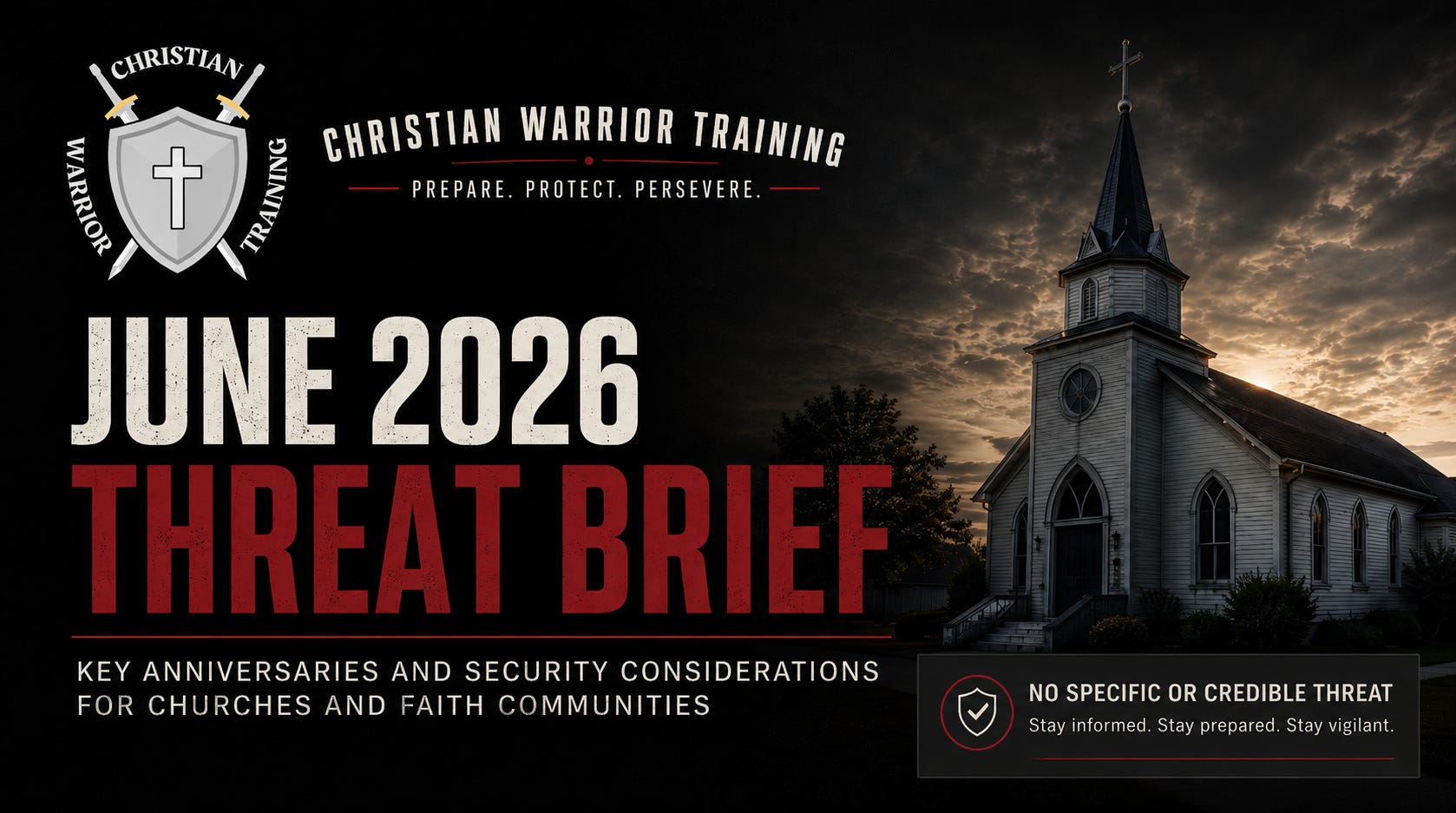
Download for Your Security Room Wall👇

BLUF
There is no specific or credible threat tied to any June 2026 date at this time. June does carry an unusually dense run of anniversaries linked to attacks on worshippers and crowds, and actors seeking maximum psychological impact have historically chosen symbolic dates. Security teams should raise posture across the June 12 through 21 window and on Father’s Day, June 21.
Key Judgments
Highly Likely: No specific or credible threat exists against any listed June date at the time of this writing.
Likely: Any actor seeking maximum psychological effect would favor a date already associated with a prior attack.
Likely: The June 12 through 21 window concentrates the highest operational relevance for churches.
Possible: A lone actor inspired by a previous attack on worshippers could time activity to the June 17 Charleston anniversary.
Possible: High-attendance Father’s Day services present a larger soft-target profile independent of any ideology.
Why Symbolic Dates Draw Threat Actors
Most attacks on churches are not planned around the calendar. They are driven by grievance, opportunity, and access. A smaller number are planned, and planners think about timing. An attacker who wants his act remembered will often attach it to a date that already carries meaning, because the anniversary does part of the work for him. It guarantees coverage, it ties the new act to a prior one, and it signals to anyone watching for it. Open-source reporting and fusion center bulletins track these dates for that reason. The goal is not to predict an attack on a given day. The goal is to know which days carry added weight so your posture reflects it.

The Charleston Anniversary: June 17
On June 17, 2015, a gunman entered Emanuel African Methodist Episcopal Church in Charleston, South Carolina during a Wednesday evening Bible study. He sat with the group for roughly an hour before opening fire, killing nine people. He chose a small midweek gathering, he was welcomed in, and he attacked during a moment when heads were bowed and eyes were closed. That last detail is why this anniversary belongs on every church security calendar. Charleston is the clearest American example of a congregation being targeted specifically because it was a congregation, and the tactics used there remain the tactics most likely to be repeated. Midweek studies and small groups carry the same exposure today that Emanuel AME carried in 2015. If your team has not reviewed the closed-eyes prayer vulnerability, the week of June 17 is the time to do it.
The June 12 Through 21 Window
The middle of June concentrates several dates that draw public attention and, in some cases, past violence. June 12 marks the 2016 Pulse nightclub attack in Orlando, where forty-nine people were killed by an attacker who pledged allegiance to the Islamic State. Pride events run throughout the month, with large gatherings and marches in many cities, and churches near parade routes or hosting related events should plan for traffic, crowds, and the possibility of counter-demonstration friction. June 19 is Juneteenth, a federal holiday that can bring both celebrations and protest activity into public space. The same date marks the 2017 vehicle ramming attack outside Finsbury Park Mosque in London, a reminder that worshippers leaving services have been targeted as a soft, predictable crowd. June 21 is Father’s Day, one of the highest-attendance Sundays of the year. A fuller sanctuary is a larger soft target, and it usually means newer volunteers and visitors your team does not recognize. Plan greeter and parking coverage accordingly.
The Broader June Calendar
The following dates carry historical or situational significance from open-source reporting. None reflects a current threat. They are listed so you can build your own month-at-a-glance.
June 3 — Anniversary of the 2017 London Bridge vehicle ramming and stabbing attack.
June 6 — D-Day remembrance.
June 7 — Corpus Christi Sunday, a high-attendance day for Catholic and some liturgical churches.
June 12 — Anniversary of the 2016 Pulse nightclub attack, Orlando.
June 14 — Flag Day and the U.S. Army’s 251st birthday. Also the anniversary of the 2017 Congressional baseball practice shooting.
June 17 — Anniversary of the 2015 Charleston Emanuel AME church attack.
June 19 — Juneteenth. Also the anniversary of the 2017 Finsbury Park Mosque vehicle attack, London.
June 21 — Father’s Day and the summer solstice.
June 25 to 26 — Yawm Ashura, an Islamic day of commemoration.
June 27 — Anniversary of the 1994 Matsumoto sarin attack and connected to the broader Aum Shinrikyo chemical attacks in Japan.
June 28 — Anniversary of the 2018 Capital Gazette newsroom attack, Annapolis, and the 2016 Istanbul airport attack.
Recommended Actions
Brief your team on the June 12 through 21 window at your next pre-service meeting and assign specific posts for Father’s Day.
Review the Charleston attack and the closed-eyes prayer vulnerability with anyone who covers midweek studies and small groups.
Confirm your greeter, parking, and door coverage holds up on high-attendance Sundays when summer rosters often run thin.
If your church sits near a Pride route, a Juneteenth event, or any public gathering, identify your access points and plan for crowd spillover and traffic.
Reinforce the report-it habit and make sure every volunteer knows how to raise a concern and to whom.
Threat Indicators
Repeat visitors photographing entrances, exits, camera positions, or your security team.
Vehicles positioned to watch arrival and dismissal patterns across multiple services.
Questions about attendance numbers, service times, or where people gather that do not fit a normal visitor.
Online posts referencing a specific date, a prior attack, or your church by name.
Anyone overdressed for the weather or repeatedly adjusting or concealing the same area of the body.
Threat Assessment
The overall threat level for churches in June 2026 is assessed as YELLOW, Elevated. This reflects the density of symbolic dates rather than any specific or credible threat, of which there are none at this time. The primary concern is a lone actor, inspired by a prior attack on worshippers, choosing a small midweek gathering or a full Father’s Day service and timing it to a date that guarantees attention. That is assessed as Possible, not Likely, but the consequences are high enough that posture should not wait for a warning. The secondary concern is friction around public events. Churches near Pride routes, Juneteenth gatherings, or other demonstrations face a Possible risk of crowd spillover, traffic disruption, and confrontation that has nothing to do with the church itself but still arrives at its doors. For the June 12 through 21 window, and for Father’s Day specifically, teams should treat local posture as ORANGE, High, and staff accordingly. The correct response to a month like this is not alarm. It is a calendar, a briefing, and full coverage on the days that carry weight.
Biblical Lens
Matthew 24:43-44 (ESV) “But know this, that if the master of the house had known in what part of the night the thief was coming, he would have stayed awake and would not have let his house be broken into. Therefore you also must be ready, for the Son of Man is coming at an hour you do not expect.”
The point of the passage is timing. The thief succeeds because the owner did not know when he was coming. Jesus uses the image to teach readiness, and the lesson carries straight into security work. The owner who knows the hour stays awake, and the house is not broken into. This brief exists to give you that knowledge for June. You now know which dates carry added weight, so being caught off guard is no longer an excuse. Stay awake on the days that count, and the house holds.
1 Chronicles 12:32 (ESV) “Of Issachar, men who had understanding of the times, to know what Israel ought to do, 200 chiefs, and all their kinsmen under their command.”
The men of Issachar were valued for one thing. They understood the times, and they knew what to do about it. Reading the calendar is not anxiety. It is the work of a leader who sees what season the church is in and adjusts the plan. Knowing the date is only half the job. Knowing what to do is the other half, and that is what separates a security team from a list of names on a roster.
Closing
Pull these dates into your own calendar this week and walk your team through them before the first one arrives. If this brief is useful, leave a comment with how your team handles high-attendance Sundays, and share it with your pastor or security team leader so the whole team is working from the same calendar.
My concern for June is that it's VBS month. Our local PD put it an alert to churches for safety practices during VBS.