


Facebook | X | Instagram | YouTube | LinkedIn | Threads | TikTok
Want to jump ahead? Take the STOP administrator course and download the files to run the program at your church. Just click here.
Most church safety teams have the same onboarding process. A new volunteer shows up on Sunday. Someone walks them around the building, introduces them to the team, and hands them a radio. The following week they are on post.
That is not training. That is hope dressed up as a plan.
The problem is not the people. The problem is the system. Or more accurately, the lack of one. Church safety volunteers show up willing to serve and get placed in a role that may require them to act under pressure with no documented training, no evaluated competency, and no verified understanding of the team’s policies and procedures. If something goes wrong and the response is questioned, the team has no record of what that member was ever taught.
I have been in law enforcement and I have spent years working with church security teams across the country. This gap shows up everywhere. Small churches, large churches, well-funded teams and volunteer-only teams. The problem is not resources. It is structure.
STOP changes that.
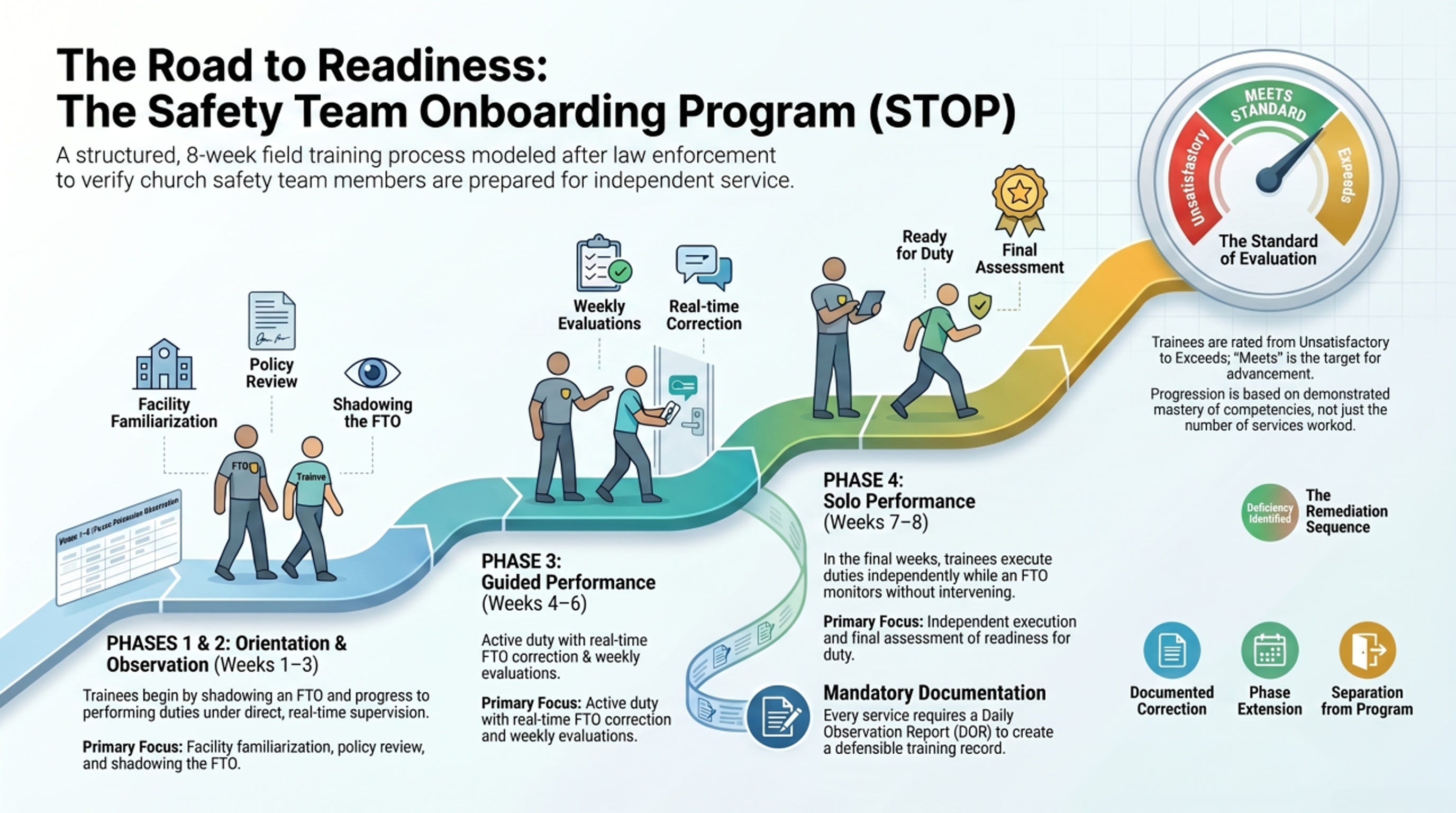
The Safety Team Onboarding Program is a structured, eight-week field training program built on the San Jose Field Training Officer model, adapted specifically for the church environment. The San Jose model is the standard in law enforcement for a reason: it creates a documented, progressive training record that moves a new officer from observation through independent performance with written evaluations at every step. STOP takes that methodology and translates it for a team of safety volunteers serving a local congregation.
The program runs four phases. Phase One is orientation: the trainee learns the facility, meets the team, and reviews all policies and procedures. Phase Two is observation: the trainee shadows their Field Training Officer through every service without taking independent action. Phase Three is guided performance: the trainee works their post while the FTO observes and corrects in real time. Phase Four is solo performance: the trainee operates independently while the FTO watches but does not intervene. At the end of eight weeks, the team leader has a complete, documented record of that member’s development from their first service to their final sign-off.
Two documents run the program. The Daily Observation Report is completed by the FTO after every single service. It documents what the trainee did, what was checked, and how they performed. The Phase Evaluation Rubric is completed at the end of each phase using four descriptive ratings: Exceeds, Meets, Below, and Unsatisfactory. The team leader reviews and signs every rubric before the trainee advances.
This is not overhead. This is the record that demonstrates your member was prepared before you placed them on post.
The biblical foundation for this program is not complicated. Ezekiel 33 makes clear that the watchman who sees the threat coming and does not act bears responsibility for what follows. Luke 14 tells us to count the cost before we build. Proverbs 27:23 says to know well the condition of your flocks. And Nehemiah did not post whoever showed up to the wall. He organized them, equipped them, and placed them where their families were nearby.
Every person on your safety team is someone’s watchman. STOP is how you verify they are ready to stand that post.
The full STOP program includes the Program Guide for team leaders and FTOs, the Daily Observation Report, and the Phase Evaluation Rubric. All three documents are available free of charge for any church that wants to use them. They may be used as-is without modification and without permission. They may not be sold, rebranded, or redistributed for commercial purposes.
If you want to learn how to implement STOP in your church, the STOP School is now available.
The STOP School is an online course that walks team leaders, FTOs, and safety team members through everything in this program: the structure, the documentation, the evaluation process, how to handle a trainee who is not meeting standard, and how to have the separation conversation when necessary. It is designed to give your team everything they need to launch STOP the right way.
If there is sufficient interest, we may bring this training on the road and deliver it live to groups of churches. If that is something your team would benefit from, let us know in the comments.
Head to the Training tab above to access the course.
If you lead a safety team or serve on one, this program was built for you. Take the course, download the documents, and give your congregation the prepared team they deserve.
Take the STOP course and download the files to run the program at your church. Just click here.
Leave a comment below if you have questions or want to share how your team is using STOP. And if this is useful to you, forward it to your pastor or team leader. The congregation sitting in those pews on Sunday morning is counting on someone having done this work.
Thank you Keith. I have enrolled in the class, and I am looking forward to learning how to have a better team. Thanks for all your effort. God bless!
Thank you so much. The STOP approach is much needed.