


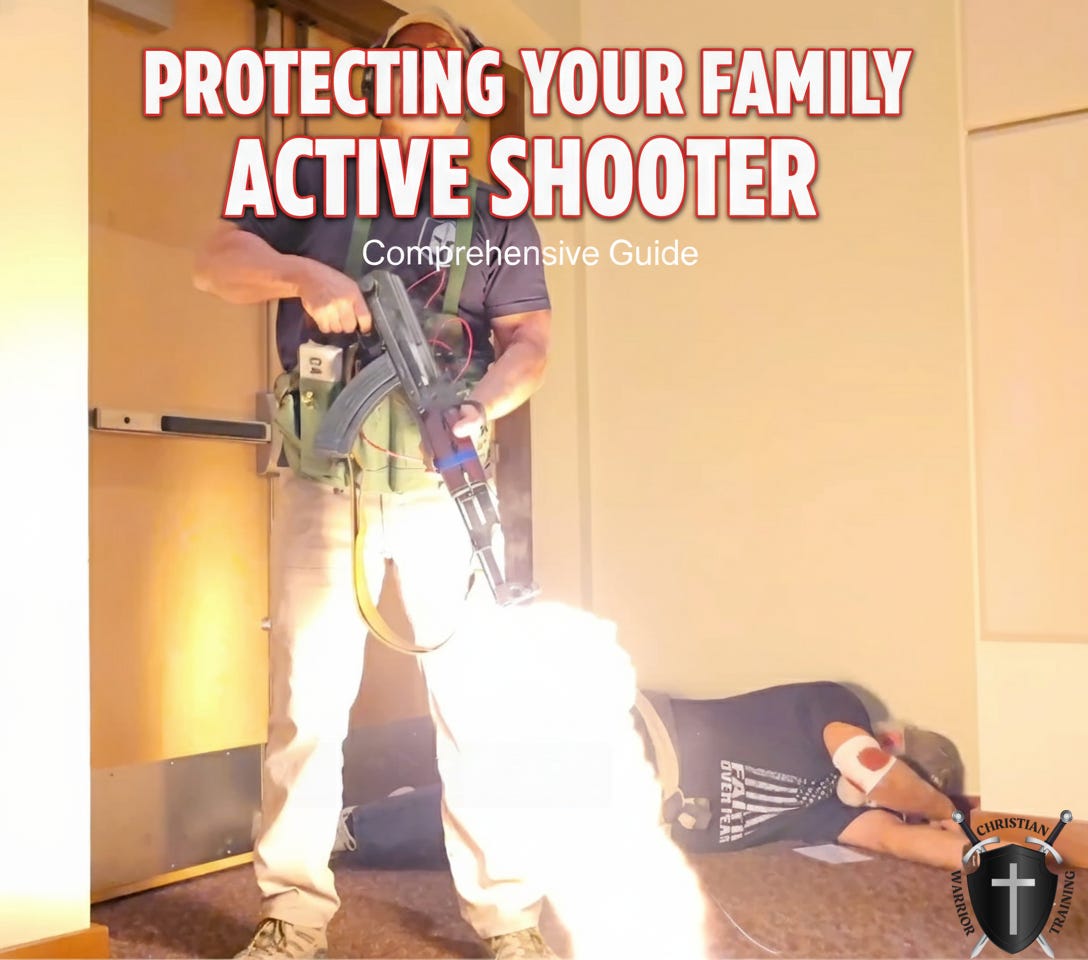
What do you do when there’s an active shooter at your church, and you’re with your family? Do you engage the threat and stop it, or do you protect your loved ones and seek safety?
This is a question that many churchgoers, especially those who carry concealed firearms, grapple with. It’s a decision fraught with moral, tactical, and emotional complexity, and one that requires careful thought and preparation long before such a scenario might unfold.
This article was inspired by a heartfelt question from Seth, who posted the question in the CWT subscriber chat. He shared his concerns about how to respond in such a scenario, balancing his responsibility to protect his daughter with his desire to defend the congregation. His question is one that resonates with many of us, as it highlights the difficult tension between our duties to our families and our obligations to those around us.

By exploring this dilemma, I hope to provide you with practical strategies and biblical wisdom to prepare for such a moment. Together, we’ll examine what it means to protect your loved ones while also considering the greater good, emphasizing the importance of preparation, training, and trust in God’s guidance.
Understanding the Dilemma: Family vs. Congregation
In an active shooter scenario, there are two competing priorities that demand immediate attention: protecting your family and neutralizing the threat to safeguard the congregation. Each of these priorities carries profound implications, both for the individuals involved and for the larger group.

The Tension Between Responsibilities
The presence of family during such a critical incident introduces a unique emotional burden. On one hand, you are responsible for your loved ones’ safety. On the other, you may feel a moral obligation to intervene and stop the threat for the sake of the congregation. The decision you make in those first moments can have life-altering consequences.
Factors to Consider
Proximity to the Threat: Are you close enough to the shooter to engage effectively without putting others at risk? If not, moving your family to safety may be the best course of action.
Safety of Your Family: If the shooter is targeting areas near your loved ones, their immediate safety must take precedence. Ensuring they’re out of harm’s way can free you to act effectively.
Training and Readiness: Your level of preparedness significantly impacts your ability to make split-second decisions. Regular training and mental conditioning can help you remain calm and decisive under pressure.
Coordination with Security Teams: If your church has an established safety team, understanding their roles and capabilities can guide your actions. Trusting trained team members to handle the threat allows you to prioritize your family.
The Weight of the Decision
The reality is that every situation will differ. The proximity of the threat, the layout of the church, and the preparedness of the congregation all factor into the equation. It’s critical to mentally rehearse various scenarios and develop a plan that aligns with your abilities, your role in the church, and your God-given responsibilities as a protector.
Tactical Visualization and Preparation
Preparation begins long before an incident occurs. Tactical visualization is a key component of readiness, allowing you to mentally rehearse possible scenarios and plan your actions in advance.
What is Tactical Visualization?
Tactical visualization is the practice of mentally simulating critical incidents to prepare for effective decision-making under stress. By imagining various scenarios, you can rehearse potential responses, identify challenges, and strengthen your ability to act decisively.
Scenarios to Visualize
Shooter Entering the Sanctuary: Visualize how you would respond if a shooter entered through the main door. Consider cover and concealment options, pathways to engage the threat, and methods to direct your family to safety.
Shooter Already Present: Imagine a scenario where the shooter begins firing from within the congregation. Think about how you would locate the threat, assess the safest approach, and coordinate with others if possible.
Evacuation Under Pressure: Picture yourself leading your family to safety while remaining alert for additional threats. Identify exit routes and strategies for shielding loved ones during an evacuation.
Benefits of Mental Rehearsal
Increased Confidence: Familiarity with potential scenarios reduces hesitation and builds confidence in your ability to respond.
Improved Situational Awareness: Practicing visualization enhances your ability to assess threats and make informed decisions quickly.
Enhanced Coordination: Mental preparation helps you anticipate how others may react, allowing for smoother communication and teamwork.
Anatomy of an Active Shooter: New Zealand Mosque Active Shooter

On March 15, 2019 a man entered a mosque in Christchurch, New Zealand and murdered 51 people. The man, who will not be named here, wore a video camera during the attack and live streamed it as it happened. I have the video and show it in all of my active shooter courses and often in other presentations. I show it because it shows exactly when and where the shooter could have been stopped. However, New Zealand has banned this video and anyone who possesses or views it there faces up to 14 years in prison.
Tactical Responses
Imagine this: You are sitting in your usual spot at church with your family when a commotion breaks out near the entrance. You hear shouting and the unmistakable sound of gunfire. Your heart races, but your training and preparation take over.
Engaging the Threat
You immediately assess the situation. The shooter is advancing toward the sanctuary, firing indiscriminately. Your wife and children are seated beside you, eyes wide with fear. You issue clear, firm instructions to your family: “Get low. Move to the side exit. Now.”
As they scramble to safety, you position yourself behind a sturdy pew for cover. You draw your concealed firearm and take aim, ensuring there’s no one in your line of fire. The shooter moves closer, and you know you have a clear shot. Your training has prepared you for this moment, and you neutralize the threat, minimizing harm to others.
Evacuating with Your Family
Alternatively, the shooter is far from your position, and you decide the best course of action is to prioritize your family’s safety. You guide them quickly but calmly to the nearest exit, using your body to shield them as you move. Along the way, you remain vigilant, scanning for secondary threats or accomplices. Once outside, you lead them to a safe location and call 911, providing detailed information about the situation inside.
Lessons from the Narrative
Assess the Threat Level: The decision to engage or evacuate depends on your proximity to the shooter and the immediate danger to your family.
Prioritize Clear Communication: Giving clear, actionable instructions can save lives and reduce panic.
Trust Your Training: Muscle memory and preparation allow you to act decisively under pressure.
Remain Vigilant: Even after reaching safety, stay alert for additional threats or information to aid law enforcement.
Training Your Family for Emergencies
While the responsibility for responding to an active shooter might primarily rest on your shoulders, it is vital to prepare your family as well. Training them on how to act in emergencies can save precious seconds and reduce panic.
Teaching Basic Emergency Protocols
Recognize Danger: Teach your family how to identify signs of danger, such as loud noises, gunfire, or unusual commotion.
Follow Instructions: Instill the importance of listening and following your guidance without hesitation during an emergency.
Know the Exits: Familiarize them with the church’s layout, including the nearest exits and safe hiding spots.
Role-Playing Scenarios
Conduct drills at home or in controlled environments where your family practices responding to different emergencies. For example:
Evacuation Drills: Practice quickly moving to a designated safe location.
Hiding Drills: Teach them to seek cover and remain quiet if evacuation isn’t possible.
Communication Drills: Rehearse simple signals or phrases to convey instructions swiftly.
Empowering Your Family
Age-Appropriate Training: Tailor the training to each family member’s age and abilities. For younger children, focus on simple instructions, such as “run” or “hide.” For older children or spouses, discuss more complex scenarios and responses.
Reassurance and Confidence: Remind your family that preparation is not about instilling fear but about being ready. Encourage them to trust their instincts and your leadership.

By involving your family in training, you ensure that everyone knows their role and can act decisively. This preparation not only increases their safety but also provides you with peace of mind knowing they are equipped to respond.
Biblical Guidance on Protection and Preparedness
When facing decisions of safety and protection, it is essential to seek wisdom from scripture. God’s Word provides guidance on being prepared, protecting others, and acting courageously while trusting in His sovereignty.
Biblical Responsibility to Protect
Protecting Your Family:
1 Timothy 5:8 – “But if anyone does not provide for his relatives, and especially for members of his household, he has denied the faith and is worse than an unbeliever.”
This verse underscores the importance of prioritizing your family’s safety, recognizing that protecting them is a God-given duty.
Protecting the Vulnerable:
Psalm 82:3-4 – “Give justice to the weak and the fatherless; maintain the right of the afflicted and the destitute. Rescue the weak and the needy; deliver them from the hand of the wicked.”
This calls us to act in defense of those who cannot protect themselves, such as other members of the congregation in danger.
Being Prepared and Ready
Luke 22:36:
Jesus told His disciples, “Let the one who has no sword sell his cloak and buy one.” This directive symbolizes the importance of being prepared to defend oneself and others when necessary.
Proverbs 22:3:
“The prudent sees danger and hides himself, but the simple go on and suffer for it.” This verse highlights the wisdom in recognizing threats and taking proactive steps to ensure safety.
Trusting God Amidst Action
Joshua 1:9 – “Have I not commanded you? Be strong and courageous. Do not be frightened, and do not be dismayed, for the Lord your God is with you wherever you go.”
Acting in defense of others requires courage, which we find through faith in God’s presence and guidance.Proverbs 3:5-6 – “Trust in the Lord with all your heart, and do not lean on your own understanding. In all your ways acknowledge Him, and He will make straight your paths.”
This verse reminds us that even in moments of chaos, trusting God allows us to act with clarity and purpose.
Final Thoughts and Encouragement
The question of how to respond to an active shooter when you are with your family is one of profound complexity. It challenges us to think deeply about our responsibilities, our faith, and our preparedness. By exploring these issues, we can build a mindset that allows us to act with clarity and purpose when faced with the unthinkable.
As you reflect on the strategies and biblical principles outlined here, remember that preparation is both practical and spiritual. Training your mind and body equips you for action, while seeking God’s guidance strengthens your courage and resolve.
If this topic resonates with you, I encourage you to share your thoughts or experiences. Together, we can learn from one another and continue building strong, faith-filled communities that are prepared to face challenges with wisdom and bravery.
Keith, I have been researching an alternative response to an active shooter in a crowded worship service meeting. Because sending lead in this atmosphere is so likely to harm the wrong people, I have decided to carry a pocket size one watt blue laser. It is advertised to permanently blind a bad guy from up to several hundred feet away. This would certainly give other team members time to respond since the culprit could not see them coming. The laser beam is very focused and could be directed without hitting anyone else, starting by aiming at the ceiling and bringing it down to the targeted individual. Permanent retinal damage supposedly only takes milliseconds. There is no special legal requirements to carry or use this as it is not a lethal weapon. I believe it may also be effective at stopping drone photography.
I so appreciate this article. As a trained firearms enthusiast who has taken a dozen plus firearms classes, I am familiar with defensive scenarios and what they MIGHT look like. But, as a husband and a father, I feel my duty to protect is to my immediate family first, then my church family. I admit that I could never commit to a security detail and promise to put my family aside for the greater good. Selfish? Maybe, but I'd be less than honest if I said otherwise. I would never interfere with the security team as they have committed to serve and hopefully train to do so in an effective manner. I'm just going to gather and get my family to safety. If that brings me into contact with the bad guy / gal then whatever happens, happens.