


Why U.S. Churches Must Learn From Attacks Overseas
There is credible intelligence that both Al-Qaeda and ISIS continue to plan attacks on churches in the United States. These groups have not abandoned their desire to strike Christians where they gather, and reports suggest that any future attempt may involve multiple churches targeted at the same time.
For us to prepare, we must look at history. Overseas, churches have been attacked repeatedly, often during major Christian holidays or at times when the sanctuary was full of worshippers. The methods have included suicide bombings, armed assaults, coordinated multi-site operations, and even hostage situations. These events are not random, they reveal a pattern. History is the best predictor of what is to come.
At the same time, churches must resist the temptation to panic or overreact. The right approach is not to turn a place of worship into a bunker. A bunker mentality discourages visitors and changes the very nature of a church. Instead, church safety teams should think of themselves as enhanced greeters. They welcome people into the house of God, but they also carry the responsibility to be watchful and ready to protect. With the right preparation and vigilance, it is possible to keep churches open, inviting, and safe.
Historical Attacks on Churches by Al-Qaeda and ISIS
When we look at the record of Al-Qaeda and ISIS, one thing becomes clear: churches are not random targets, they are chosen deliberately. The goal is always to maximize casualties, strike during times of worship, and spread fear across Christian communities.
Below is a summary of major attacks on churches by Al-Qaeda, ISIS, or their affiliates. The table shows where the attack took place, who carried it out, the method of attack, casualties, and whether the assault coincided with a major Christian holiday.
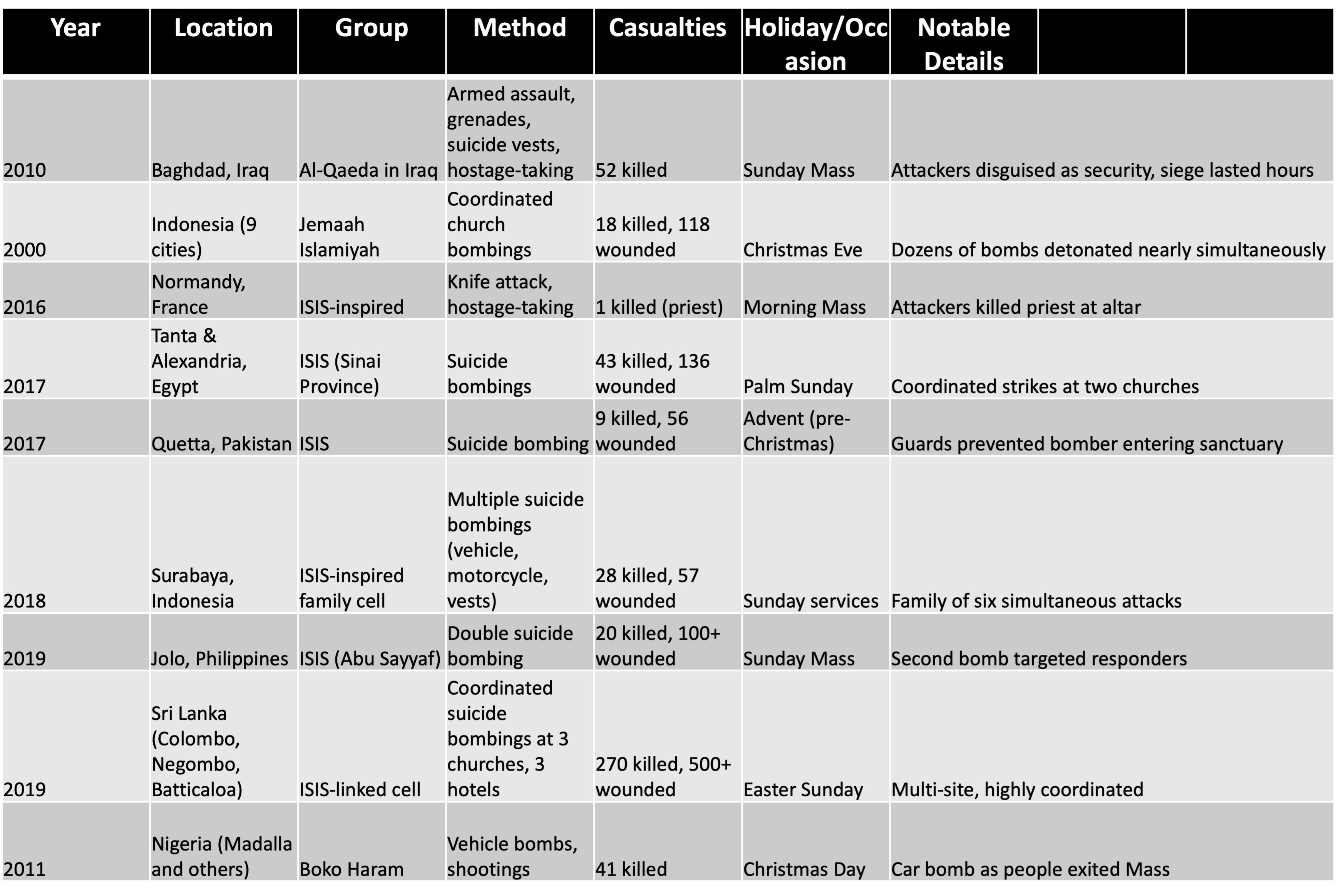
This history reveals several key points:
Major Christian holidays such as Easter, Christmas, and Palm Sunday are favored because churches are full and the symbolism is powerful.
Suicide bombings, whether with vests, vehicles, or coordinated devices, remain the most common tactic.
Multi-site attacks, such as those in Indonesia (2000 and 2018) and Sri Lanka (2019), are designed to overwhelm responders and create widespread panic.
Even smaller-scale attacks, such as Normandy in 2016 where a priest was murdered at the altar, show that attackers are willing to use simple means to achieve symbolic impact.
In several cases, vigilant guards or barriers at the door limited casualties, proving that preparedness matters.
Commonalities and Lessons Learned
When we study these attacks together, the patterns are hard to miss. Terrorists are deliberate in how they plan their assaults on churches. The methods change depending on location and resources, but the objectives remain the same: mass casualties, symbolic impact, and fear that reaches far beyond the immediate victims.
Timing of Attacks
Most of the deadliest incidents happened on major Christian holidays like Christmas, Palm Sunday, and Easter. Terrorists know these are the times when churches are full, and the symbolism of striking on holy days magnifies the shock. Even attacks on ordinary Sundays often coincide with peak worship attendance.
Preferred Methods
Suicide bombings stand out as the most common tactic. Whether using vests, backpacks, motorcycles, or vehicles, the method is effective because it puts the attacker directly inside or at the entrance of a crowded sanctuary. Firearms and hostage situations have also been used, especially in smaller-scale but highly symbolic strikes.
Multi-Site Operations
Several attacks were coordinated across multiple churches at the same time. This stretches first responders thin and creates a broader sense of panic. The Christmas Eve bombings in Indonesia, the Palm Sunday bombings in Egypt, and the Easter bombings in Sri Lanka all show that terrorists favor simultaneous attacks for maximum effect.
Secondary Devices and Lures
Another recurring tactic is the use of secondary devices. After the first bomb detonates, a second follows to target rescuers and fleeing congregants. This was seen in the Jolo Cathedral bombing. Other attacks used diversionary strikes nearby to draw security forces away before hitting the church.
Soft Target Vulnerability
Churches are designed to be welcoming, and this openness is what terrorists exploit. They enter during worship or approach entrances without challenge. However, history also shows that alert security personnel make a difference. In Quetta, guards prevented a bomber from entering the sanctuary, saving countless lives. The lesson is that even simple, vigilant security measures can break an attack chain.
Takeaway for U.S. Churches
What has happened overseas is the most likely picture of what we could face here. These attacks show us what to expect: suicide bombers, coordinated strikes, timing during worship, and possibly multiple churches targeted at once. Recognizing these patterns allows us to prepare, train, and harden our defenses without changing the welcoming mission of the church.
A Fictional Scenario: Terror Strikes Tulsa, Oklahoma
Looking at this history, it isn’t hard to see how these same tactics could be used here. Intelligence suggests that Al-Qaeda and ISIS would not limit themselves to one location, but would plan multi-prong attacks against churches in the United States. To understand what that might look like, consider this fictional example:
It is Christmas Eve in Tulsa, Oklahoma. Families are filling churches across the city for late-night services. At Holy Family Cathedral downtown, the sanctuary is packed, the choir is singing, and ushers are helping late arrivals find seats.
Outside, a man walks calmly through the main doors carrying a backpack. He blends in with the flow of visitors, but hidden inside his bag is a homemade explosive device. As the service begins, he moves toward the center aisle, sets the bag under a pew, and slips back outside. Minutes later, the bomb detonates, killing dozens in the packed sanctuary.
Across town at First Baptist Tulsa, worshippers are just leaving their service when an SUV parked near the main entrance explodes. Shards of glass and shrapnel cut through the crowd. Those who survived inside rush out into the chaos only to find themselves in a second wave of casualties.
At nearly the same time, in a Pentecostal church on the east side of the city, two men armed with rifles force their way inside during a candlelight service. They open fire in the sanctuary and take hostages at the front of the church, intent on prolonging the standoff. Police arrive within minutes, but the damage has already been done.
Within thirty minutes, three Tulsa churches have been struck. Hundreds are dead or wounded. The local emergency system is overwhelmed, and fear grips the entire community.

What Churches Can Do to Prepare
The scenario above is fictional, but it is built on the exact methods terrorists have used overseas. For church leaders and safety ministries in the United States, the question is not if these tactics could be used here, but when. Preparation is not about fear, it is about stewardship and responsibility.
Strengthen the Church Security Team
Every church needs a trained safety team. Team members should think of themselves as enhanced greeters. They welcome with a smile, but remain alert and ready to protect if danger arrives. A visible security presence can deter attackers, while a prepared team can respond quickly if needed.
Harden the Perimeter
Terrorists often attack at entrances or just outside as worshippers leave. Churches can mitigate this by using vehicle barriers where possible, controlling main access points, and ensuring parking areas are monitored. Even simple steps such as keeping cars from parking too close to main entrances can save lives.
Train to Recognize Suspicious Behavior
Attackers almost always show indicators before they act—nervousness, odd clothing for the weather, repeated scanning of exits, or concealing large bags. Training greeters, ushers, and volunteers to notice these behaviors provides another layer of security.
Plan for Medical Response
History shows that attacks often cause mass casualties. Churches should stock trauma kits, identify medical personnel in the congregation, and train safety team members in bleeding control and CPR. Seconds matter in saving lives.
Prepare for Multi-Site and Secondary Incidents
Because intelligence suggests terrorists may strike multiple churches at once, communication is critical. Churches should establish ties with neighboring congregations to share alerts quickly. Teams must also assume that a first explosion could be followed by a second device targeting responders. Responding with caution is essential.
Work With Law Enforcement
Local police and sheriff’s departments should know your security team by name. Invite them to walk through your campus, share your service times, and develop clear communication channels for emergencies. Their awareness of your layout and your preparedness could make the difference in a real crisis.
For a deeper look at these steps and how to build a security plan, see the free training course I created:
👉 Vigilance in God’s House: Enhancing Church Security Efforts Against Terrorism

A Biblical Perspective on Vigilance
The call to prepare is not only practical, it is biblical. God’s Word speaks clearly about the responsibility of watchmen, the need for sober-minded vigilance, and the wisdom of discerning danger before it arrives.
Ezekiel 33:6
“But if the watchman sees the sword coming and does not blow the trumpet to warn the people and the sword comes and takes someone’s life, that person’s life will be taken because of their sin, but I will hold the watchman accountable for their blood.”
Church safety teams are modern-day watchmen. Their role is not to live in fear but to remain alert, to warn, and to act when danger threatens God’s people.
Matthew 26:41
“Watch and pray so that you will not fall into temptation. The spirit is willing, but the flesh is weak.”
Jesus combined prayer with watchfulness. Our security efforts must be bathed in prayer, not simply relying on human strength but asking the Lord to keep us spiritually and physically ready.
Proverbs 27:12
“The prudent see danger and take refuge, but the simple keep going and pay the penalty.”
Preparation is not a lack of faith. It is wisdom. To ignore danger is to invite destruction, but to plan and prepare is to live out prudence.
1 Peter 5:8
“Be sober-minded, be watchful. Your adversary the devil prowls around like a roaring lion, seeking someone to devour.”
Evil comes in many forms, and whether through spiritual attack or physical violence, the adversary seeks to destroy the flock. God’s Word tells us to remain watchful and sober in mind, qualities that every church safety team must embrace.
The lesson from Scripture is not to become hardened or fearful, but to remain vigilant, prayerful, and ready. We do not guard God’s people from a place of panic or from behind a bunker. We stand as protectors who welcome and embrace all who come through the doors, while faithfully keeping watch over the congregation entrusted to our care.
Staying Vigilant Without Fear
The intelligence picture is clear: Al-Qaeda and ISIS have attacked churches overseas repeatedly, and they have expressed intent to do the same in the United States. The history of these attacks shows us how they operate and what to expect. By learning from that history, we can prepare for the future.
Preparation does not mean turning our churches into fortresses. It means training, vigilance, and a commitment to protect the flock while keeping the doors open to all who seek Christ. Security teams should see themselves as watchmen, as enhanced greeters who welcome with one hand and remain ready with the other.
We cannot allow fear to define our worship, but we must not ignore the threats that exist. By being wise, by preparing well, and by trusting the Lord, churches can remain both welcoming and safe.
I would like to hear your thoughts. How does your church prepare for these kinds of threats, and what challenges do you face in balancing hospitality with security? Leave a comment below and let’s learn from one another.
A heavy topic, but so needed. I love how you pair vigilance with hope — and the reminder that preparation is wisdom, not fear. Thank you for the clarity and courage you bring.
One of the ways that we prepare is by having me subscribe to Keith! We are staying informed. We have armed training twice a year that's mandatory and we have armed training with a SWAT instructor which is required for every member if they want to be a part of the team. That course is called Essential Critical Handgun Training. Many of us have taken that class repeatedly because it is good training to repeat. . We have scenario training where we have brought in our local city police force to help run us through scenarios. We have stop the bleed classes, also a course to retake because you don't have muscle memory for this! We have informed our ushers and greeters that they are an extension of our safety team because they are eyes on everyone also. We have hired a professional organization to help us write up a manual on our disaster plans. We are aware of the judicial aftermath. We applied for and received a grant and the first three things we are buying are new cameras with greater outside coverage, the glazing for the glass windows and the manual. We have been called upon by other churches in the area To help them set up A team, because we are the largest team and we have become known as one of the best trained teams. I think one of the critical issues for any team is to be cognizant that you don't know everything. And then until a situation actually occurs you truly don't know how well you have prepared and how well you will handle that situation. Which means, we continually learn and practice and practice and practice what we learn. CB