


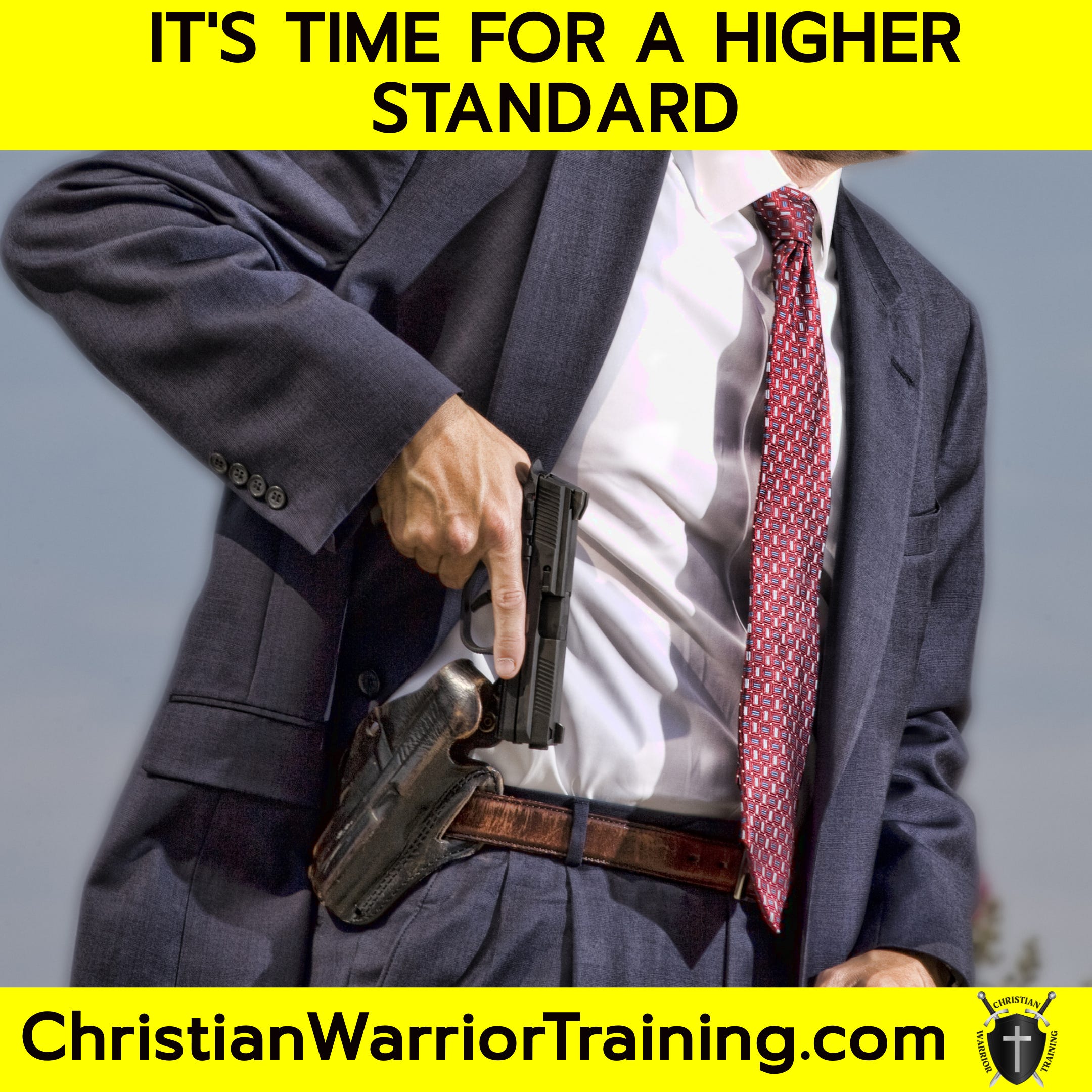
Many people believe that carrying a gun in church is no different than carrying one anywhere else. If you have a concealed carry permit, or if you live in a constitutional carry state, you might think you are already equipped to stand armed on a church security team. But the truth is, serving armed inside the sanctuary is not the same as being a casual concealed carrier. It requires a higher level of commitment. If you are going to carry a weapon to protect God’s people, you need to treat shooting as a professional skill.

Hobby Shooting vs. Professional Responsibility
There are different kinds of shooters. Some enjoy going to the range, buying a gun based on cost or looks, and shooting for fun. There’s nothing wrong with enjoying firearms recreationally, but that mindset is not enough for church security. The responsibility of protecting the flock requires more than occasional practice and casual familiarity with your gun. You need to train as if one day you may face the unthinkable — an armed threat during a service. The odds may be slim, but they are not zero.
Professionalism Means Standards
A true professional is measured by standards. That means armed team members must qualify to a set bar of performance, and that qualification should not be easy. Some won’t pass. Those who fail may have taken the responsibility too lightly, not practiced enough, or perhaps age or injury prevents them from meeting the standard. That is not cruelty — it is honesty. Lives are at stake, and professionalism demands a clear line between those who are prepared and those who are not.

Documenting the Weapon and the Shooter
This qualification should also be properly documented. Unlike the military, where soldiers qualify on a weapons system, a church team must qualify and record the exact firearm carried. That means recording the make, model, and serial number of each weapon, tied directly to the person who qualified with it. If a team member is ever involved in a shooting, there should be no doubt they had trained and qualified with that specific firearm. This record-keeping is not bureaucracy — it is accountability, and it protects both the team member and the church.

The Tradesman Comparison
Think of a mechanic. He doesn’t buy the cheapest tools at the store; he invests in quality Snap-on tools because his livelihood depends on them. He attends courses on new vehicle technology to stay effective. Or consider a plumber who keeps his equipment sharp and up to date because his reputation rides on doing the job right. If skilled tradesmen take their craft that seriously, how much more should church security treat their responsibility with professionalism? In our case, the cost of failure is not a broken pipe or stalled car — it is lives.
Raising the Standard for Church Teams
Professionalism for church security means more than carrying a firearm. It requires training, repetition, standards, and documentation. If you are going to serve armed, you must approach it as a calling to excellence. That means attending training courses, practicing under stress, maintaining quality equipment, and qualifying with your actual weapon. Casual carry may be fine for personal protection, but when you take on the responsibility of protecting the church, you must rise above hobbyist level and serve as a professional.
A Biblical Call to Training and Discipline
Scripture makes it clear that following Christ requires preparation and discipline, not a casual approach. The apostle Paul compared the Christian life to that of an athlete in training:
“Everyone who competes in the games goes into strict training. They do it to get a crown that will not last; but we do it to get a crown that will last forever.” (1 Corinthians 9:25)
Paul’s words apply directly to armed protectors in the church. An athlete cannot win without rigorous training, and a church protector cannot expect to prevail in a crisis without practicing his craft. Carrying a weapon in the house of God demands focus, discipline, and endurance.
Proverbs 21:31 reminds us: “The horse is made ready for the day of battle, but victory rests with the Lord.” Preparation is our responsibility, even while we trust God with the outcome. A firearm, like the battle horse of old, must be cared for, trained with, and mastered long before the fight ever comes.
Ecclesiastes 10:10 adds, “If the ax is dull and its edge unsharpened, more strength is needed, but skill will bring success.” A dull tool is a liability, not an asset. The same is true of an untrained protector. Professionalism means sharpening your skills regularly, refusing to be complacent, and ensuring you are ready when the moment comes.
Finally, Paul exhorts Timothy to embrace the mindset of a soldier: “Share in suffering as a good soldier of Christ Jesus. No one serving as a soldier gets entangled in civilian affairs, but rather tries to please his commanding officer.” (2 Timothy 2:3–4). Soldiers don’t carry their weapons for sport or convenience. They train, they prepare, and they serve with a clear mission in mind.
For those entrusted with church security, the calling is the same. We do not serve armed as hobbyists but as stewards. Professionalism means treating training as a biblical duty, keeping your edge sharp, and preparing faithfully so that God’s people can worship in safety.
Great article. Church's need an aggressive Course of Fire (Skills Test) that armed members must pass. We require bi-annual testing and offer monthly training.
If you are in Oklahoma, check us out at https://oklahomasafetycoalition.com/
Not only is this an excellent article for the security teams to understand why training is important, but it's a Biblically grounded argument for church leadership to understand why they need to approach security properly.