


Facebook | X | Instagram | YouTube | LinkedIn | Threads | TikTok
Watch & Read: Video Below and Graphics-intel Below That
What Happened
On Tuesday evening, April 21, 2026, the FBI Charlotte field office got a tip that an 18-year-old woman in Lexington, North Carolina was planning a mass casualty attack on a Jewish day school near Houston. Within twenty-four hours the FBI Charlotte Joint Terrorism Task Force, working with the Davidson County Sheriff’s Office, had agents at her door.

Angelina Han Hicks was arrested at her Lexington home just after 11 p.m. on Wednesday, April 22. A search of the house produced evidence that Hicks and co-conspirators were planning a vehicle ramming attack on Congregation Beth Israel in Houston. She was charged with felony conspiracy to commit murder and felony conspiracy to commit assault with a deadly weapon with intent to kill. The judge set her bond at $10 million and ordered her held without contact with co-conspirators, writing that the conspiracy was to kill as many Jews as possible by driving through a congregation at a synagogue.
Court documents identified two male co-conspirators only by the first names Angel and Teegan. The next day, Houston Police Major Offenders, FBI Houston, and the Alief Independent School District Police arrested a 16-year-old in Harris County and charged the juvenile with conspiracy to commit capital murder. It is not yet publicly confirmed whether the juvenile is one of the two named co-conspirators.
The target was specific. Congregation Beth Israel is the oldest Jewish congregation in Texas, founded in the 1850s. Sharing the same campus is The Shlenker School, a preschool and elementary school. Both closed Wednesday after Houston police notified them, and both reopened Thursday. The planned method of attack was a vehicle driven through a gathering of worshippers.
These arrests came one month after a Hezbollah-motivated attacker drove a fireworks-laden truck into Temple Israel in suburban Detroit, and on top of a string of arson attacks on synagogues in London since March. The threat against Jewish institutions in this country is elevated, active, and getting more sophisticated.
Lessons for Church Security Teams
Vehicle Ramming Requires Real Physical Barriers, Not Decorative Ones
The plan in this case was not a shooter walking through the lobby. The plan was to drive a vehicle into a crowd. That changes the geometry of your security plan completely. Most church security teams have built their response around the active shooter scenario, with armed greeters at the doors and trained responders inside. A vehicle attack defeats all of that before the attacker ever steps out of the car.
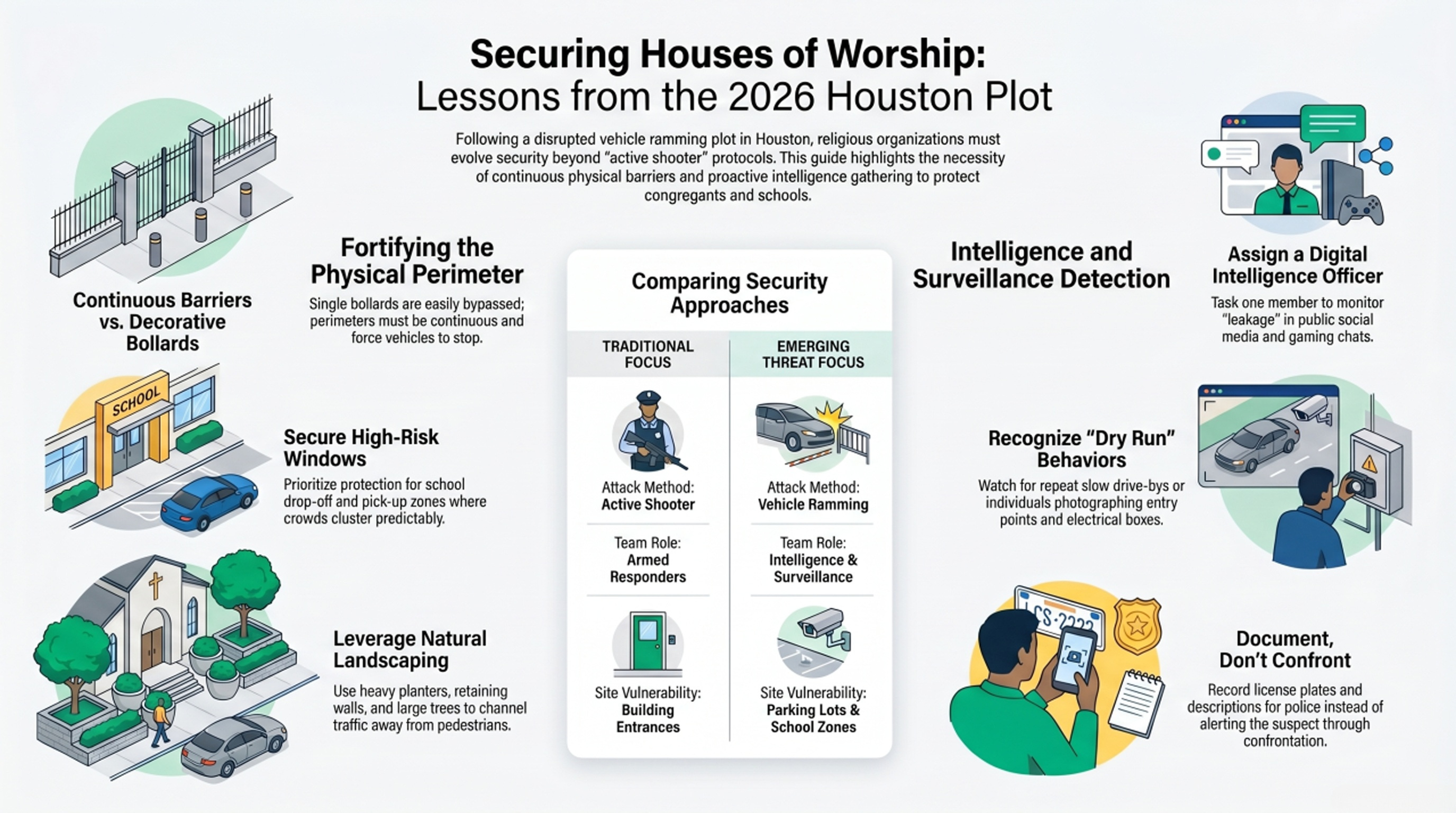
Look at Detroit one month ago. Temple Israel had bollards in front of the main entrance. The attacker drove around them and crashed his truck through the doors. Two bollards in a line are not a perimeter. They are a checkpoint that any driver with two seconds of thought can defeat by going around.
A real vehicle barrier system creates a continuous line of protection that forces any approaching vehicle to slow, turn, or stop before reaching the area where people gather. That means bollards at every approach angle. It means concrete planters heavy enough and close enough that a truck cannot squeeze between them. It means using existing landscape features like retaining walls, large trees, and parking layout to channel traffic away from pedestrians. It means thinking about drop-off and pickup areas, outdoor gatherings, and any spot where ten or more people stand together for more than a few minutes. Walk your campus this week and find every place where a vehicle could leave the road and reach a gathering of people in under ten seconds. Those are your gaps, and they need to be addressed before anything else on your security list.
Build an Intelligence Function Into Your Security Team
The Houston plot did not start in Houston. It started online. Three people in at least two states were communicating, planning, and operationalizing an attack against a specific synagogue and a specific school. Somewhere in those communications was leakage. Leakage is the operational information that surfaces in posts, gaming chat, group messages, and online forums before an attack happens. Most attackers leak. The question is whether anyone is looking.
Your security team needs an intelligence officer. Not another armed responder, not another door watcher. A team member whose assigned job is to watch the open-source environment around your church. That means Google Alerts on your church name, your pastor’s name, and key staff names. It means routinely searching social media for mentions of your church, watching for posts that name your address, your service times, your school, or your leadership in a hostile or surveillance-style way. It means following regional fusion center products if your area publishes them, and building a relationship with your local FBI field office and your local police intelligence unit so when something does not look right, you know who to send it to.
The role does not require law enforcement experience. It requires a careful, observant person who is comfortable on the internet, who can document what they find without speculating, and who understands the line between watching public posts and anything that crosses into investigation. Most days they find nothing. The day they find something, they may save lives.
Learn to Recognize Pre-Attack Surveillance and Dry Runs
Almost every targeted attack on a public gathering follows the same pattern in the weeks before. The attacker visits the target. They time the service. They look at the entrances and exits. They watch the parking lot fill and empty. They identify where security stands and where security does not. They photograph or video the building. They drive the route they plan to use on the day of the attack. This is surveillance, and the test runs are dry runs.
A surveillance behavior is not the same as a casual visitor. Someone who attends a service and asks normal questions is a guest. Someone who sits in their car in the parking lot during service, watches the doors, leaves, and comes back the next week to do the same thing is not a guest. Someone walking the perimeter taking photos of entry points and electrical boxes is not a tourist. Someone driving slowly past the building at the same time on three different Sundays is not lost. Train your team to notice these patterns and to document what they see. License plates, vehicle descriptions, time on scene, behavior, direction of travel when leaving. Every one of those facts is worth more than ten general impressions.
When your team sees this kind of activity, the response is straightforward. Document it, photograph if you can do so safely, get the plate, and report it to local law enforcement the same day. Do not confront the person. Confrontation tells the attacker they have been seen, which only changes the timing and method of the attack. A clean report to law enforcement keeps the investigation alive without alerting the suspect.
Schools on Church Campuses Raise Your Threat Profile
Beth Israel did not get targeted because of the synagogue alone. The Shlenker School, a preschool and elementary school sharing the same campus, was named in the FBI tip. Children draw attackers, and they draw national news coverage, which draws copycats. If your church operates a school, a daycare, or any regular gathering of children on your campus, your threat profile is higher than a church without one.
That does not mean shut down your school. It means your security plan has to account for two populations on the same property with different schedules and different vulnerability windows. Drop-off and pickup are the highest-risk periods on any school campus. They are predictable, public, and they cluster children in a confined space. Walk those windows yourself this week. Time them. Identify where a vehicle could enter and how far it could travel before hitting an obstacle. Then fix what you find. Coordinate with your school administration on lockdown procedures and on who has authority to call a closure. The decision Beth Israel made to close the campus on Wednesday was made fast, communicated clearly, and reversed the next day after consultation with law enforcement. That is the model.
Biblical Perspective
The attack on Beth Israel was an attack on a Jewish congregation. That has weight in Scripture that Christian readers cannot ignore. The people who were targeted in Houston are the people through whom God brought the patriarchs, the prophets, the Scriptures, and the Messiah. When Christian security teams study an attack on a synagogue, they are not studying an attack on a foreign people. They are studying an attack on the root of their own faith.
Genesis 12:1-3 (ESV) — “Now the Lord said to Abram, ‘Go from your country and your kindred and your father’s house to the land that I will show you. And I will make of you a great nation, and I will bless you and make your name great, so that you will be a blessing. I will bless those who bless you, and him who dishonors you I will curse, and in you all the families of the earth shall be blessed.’”
This is the Abrahamic covenant, and it has not been revoked. God promised Abraham that his descendants would be a blessing to every family on earth, that those who blessed Abraham’s line would be blessed by God, and that those who dishonored his line would be cursed by God. The promise is not symbolic. The line of Abraham runs through Isaac and Jacob into the Jewish people, and the most concrete fulfillment of the promise to bless all families of the earth came when Jesus Christ, a Jewish man born in Bethlehem, opened the gate of salvation to the Gentiles. Every Christian alive today is the recipient of a blessing that came through the Jewish people. To stand against the Jewish people is to stand against the line that brought us our Savior.
Romans 11:17-18 (ESV) — “But if some of the branches were broken off, and you, although a wild olive shoot, were grafted in among the others and now share in the nourishing root of the olive tree, do not be arrogant toward the branches. If you are, remember it is not you who support the root, but the root that supports you.”
Paul wrote this directly to Gentile Christians in Rome, and it is the closest thing in the New Testament to a manual for how Christians should relate to the Jewish people. The picture is an olive tree. The natural branches are the Jewish people. The wild branches grafted in are Gentile Christians. Paul is direct with the Gentile believers. Do not be arrogant toward the natural branches. Remember which one of you supports the other. The root is Jewish. The tree is Jewish. The Christian is the late arrival, grafted in by grace, drawing nourishment from a root that was planted long before the church existed.
Paul goes further in Romans 11:28-29, saying that as regards the gospel the Jewish people are enemies for the sake of the Gentiles, but as regards election they are beloved for the sake of their forefathers, because the gifts and the calling of God are irrevocable. The Christian who reads that passage carefully cannot be neutral when a synagogue is targeted. The God who promised Abraham still keeps that promise. The Jewish people remain beloved of God for the sake of the covenant He made with their fathers. That covenant places an obligation on every Christian to stand with them when they are under attack.
The practical response is direct. Pray for the peace of Jerusalem, as Psalm 122 commands. Stand with your local Jewish community when they are threatened. If you have a synagogue near your church, meet their security team. Share information. Learn from their threat picture, because their threat picture is real and active. If a Jewish school in your city is under threat, treat it the way you would treat a threat against your own children. The God who blessed us through Abraham’s line expects nothing less.
Final Assessment
This plot was stopped because somebody picked up the phone. That is the headline. A tip came into the FBI on a Tuesday evening and by Wednesday night the lead suspect was in custody and the campus was closed. Two suspects are now charged, at least one more is still being looked for, and a synagogue full of worshippers and a school full of Jewish children went home alive on Wednesday. That is the result of good police work and a citizen who saw something and said something.
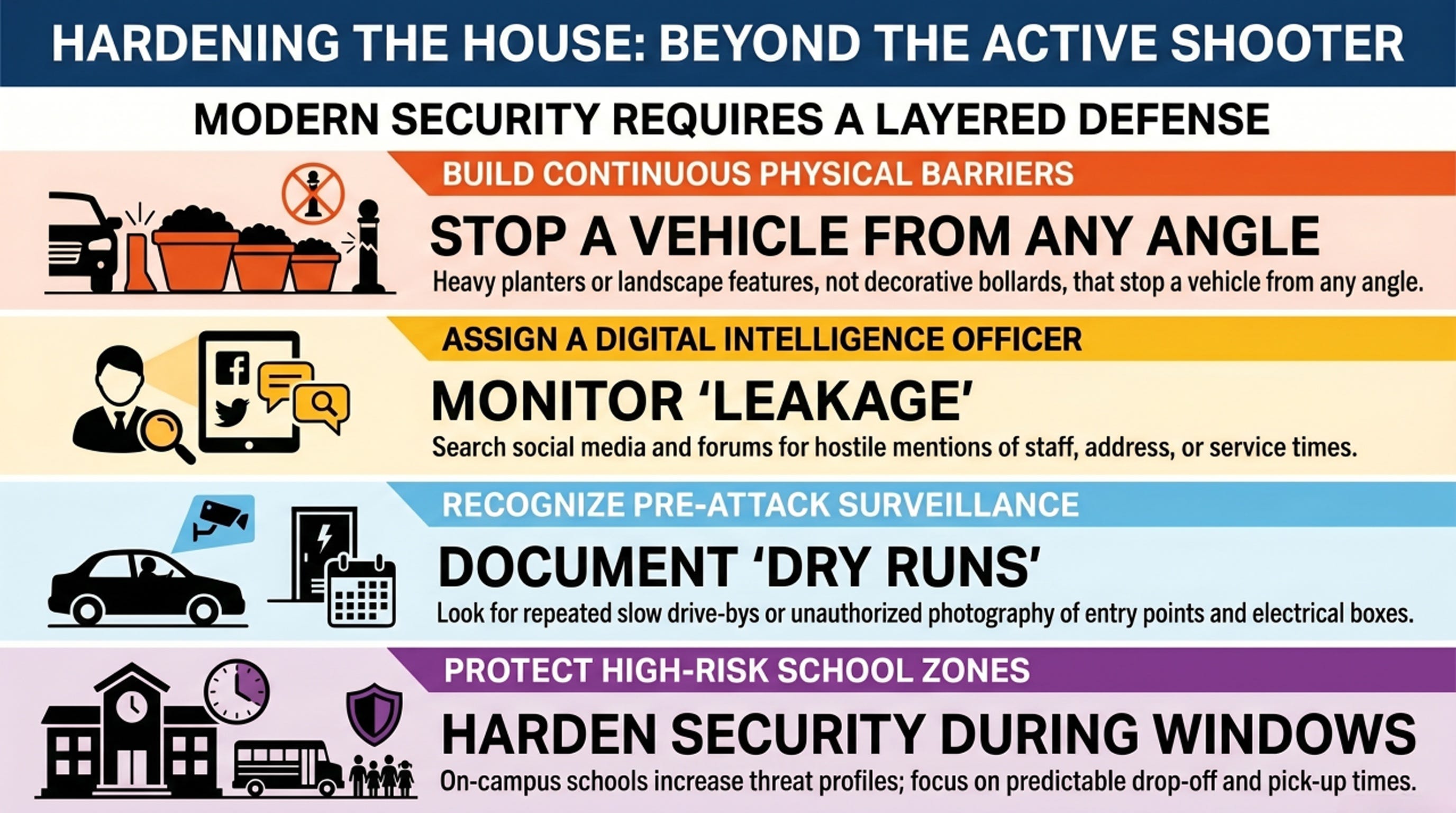
For church security teams the takeaways are concrete. Vehicle ramming is a serious attack method against houses of worship now, and a couple of bollards in front of the door is not a vehicle barrier. Look at Detroit. The attacker drove around them. If you have not walked your campus looking specifically at where a vehicle could leave the road and reach a gathering, you are behind. Get out there this week.
The attackers are online before they ever show up at your church, and your team needs somebody whose job it is to be online too. Not as a hobby. As an assigned role with a clear scope. Pre-attack surveillance and dry runs are the warning signs you can catch in real time, but only if your people are trained to know what they look like. And if your church has a school on campus, your threat profile is higher than the church across town that does not. Plan for it.
For our Jewish friends in Houston and across the country, this is another reminder that the threat is real and active. Christian congregations should stand with them, pray for them, and remember whose root supports whose tree. If there is a synagogue near your church, go meet their security team this month. Share information. Learn from their threat picture, because their threat picture has been operational for a long time.
The attack was stopped. The campus reopened. The work continues.
Call to Action
Leave a comment below and tell us how your team handles online intelligence gathering and surveillance detection. Share this article with your pastor and your team leader, and pass it along to any church near you that operates a school. The next attack stopped before it starts will be stopped by people who saw what others missed.
As always, a very clear analysis of a complex set of interactions. I was reminded of “If you see something, say something.”
"Salvation is from the Jews." (John 4:22)