


They thought it would never happen there. Most of the 415 churches hit by acts of hostility in 2024 probably believed they were too small, too rural, or too far from the headlines to be a target. But according to the latest Family Research Council report, 415 churches were vandalized, burned, threatened, or attacked last year — and gun-related incidents more than doubled from the year before.
As someone who has spoken with countless crime victims over the years — and experienced violent attacks personally — I can tell you this: the belief that “it won’t happen here” is one of the most dangerous lies a church can tell itself.
Reports like this aren’t just a collection of statistics. They’re a wake-up call. They reveal where threats are increasing, what types of attacks are most common, and what trends we must prepare for now. Reading and acting on this kind of information is part of being a good steward of the safety of your church.
Who Produced the Report
The Family Research Council is a Christian advocacy organization based in Washington, D.C., that tracks religious freedom issues, promotes biblical values, and publishes annual reports on hostility toward churches. They pull their information from open-source data — news reports, police statements, and other public records.
For their 2024 report, they analyzed incidents under five main categories: vandalism, arson, gun-related incidents, bomb threats, and other forms of aggression. These findings give us an honest look at the climate churches are operating in today.
The 2024 Numbers
Here’s what the report found for last year:
Total incidents: 415
Average per month: 35
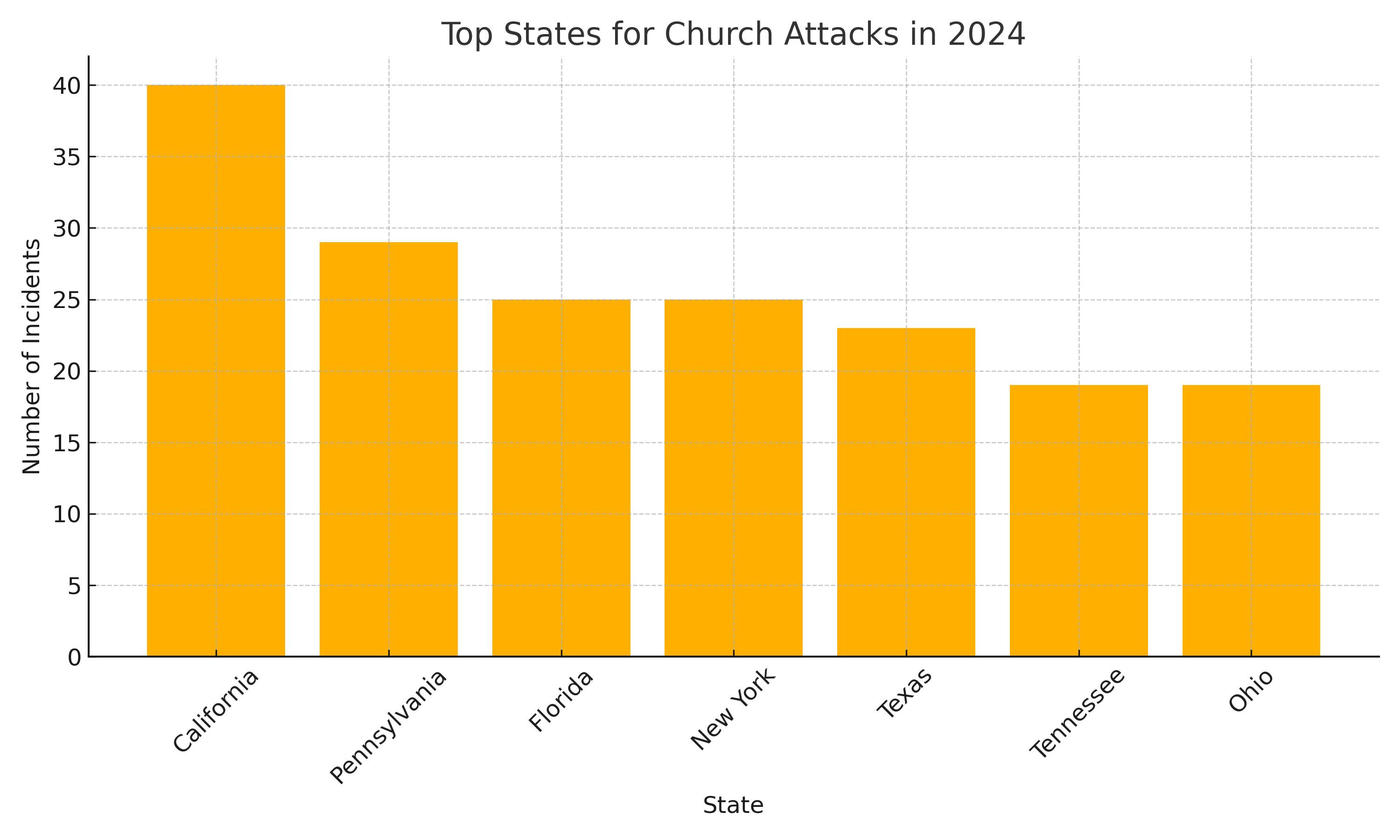
Top states: California (40), Pennsylvania (29), Florida and New York (25 each), Texas (23), Tennessee and Ohio (19 each)
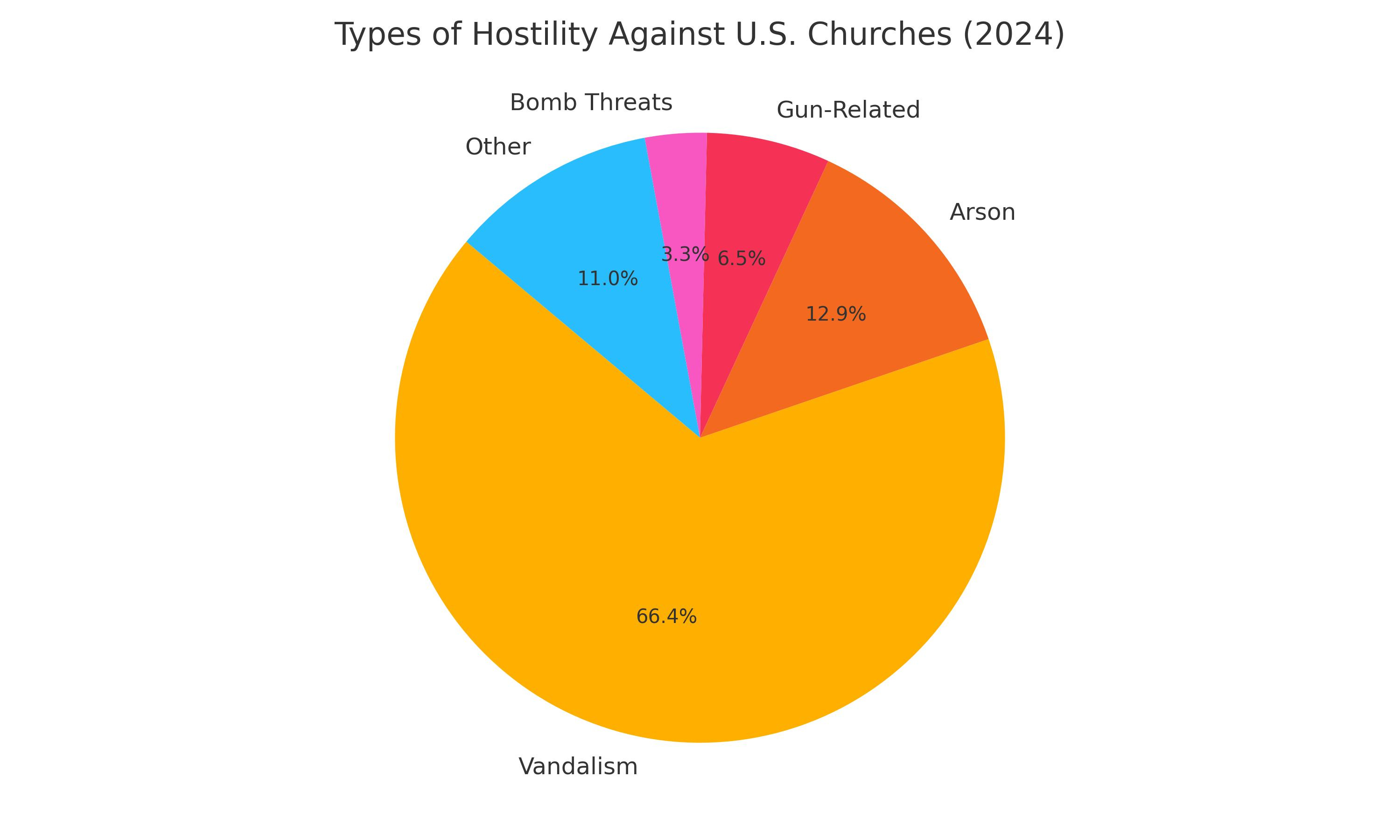
Most common category: Vandalism (284 incidents)
Notable spike: Gun-related incidents more than doubled, from 12 in 2023 to 28 in 2024.
Even with a slight drop from the 2023 record high, this is still almost the same number of incidents FRC documented in their first report — and that one covered nearly five years’ worth of data.
What the Attacks Look Like
Vandalism
Vandalism continues to be the biggest threat, making up more than two-thirds of all hostile acts. Some cases are politically motivated, others seem random, and some appear to be thefts that turn destructive.
In Portland, Oregon, a small church of mostly older congregants faced repeated vandalism, from rocks through windows to chemical damage from fire extinguishers.
In Texas, First Christian Church in Brenham had just completed a restoration project when vandals smashed more than 15 windows with rocks and bricks.
In California, thieves ripped copper pipes from a church organ, causing $10,000 in damage.
Arson
There were 55 incidents of arson or attempted arson in 2024. In some cases, entire church buildings were destroyed.
In Athens, Tennessee, an arsonist set fire to St. Mark AME Zion Church after killing the church secretary. The fire burned through the roof and destroyed much of the interior.
In Ohio, four churches in two counties were burned within four months — investigators believe one person may be responsible.
Gun-Related Incidents
This is the category that saw the sharpest increase.
Near Pittsburgh, Pennsylvania, a man walked into Jesus’ Dwelling Place Church and pointed a gun at the pastor in the middle of his sermon. A deacon tackled him before shots were fired.
At Lakewood Church in Houston, Texas, a woman with a long gun opened fire during a service, injuring two before being stopped by police.
Bomb Threats
While most of the 14 reported bomb threats in 2024 turned out to be hoaxes, they still forced evacuations and disrupted services.
In Cocoa, Florida, two churches received packages claiming to contain bombs, accompanied by politically charged notes.
Other Hostile Acts
These include assaults, service disruptions, and threatening intrusions.
In Hudson, New York, a masked man in a cloak interrupted Mass shouting “All hail” and holding a bottle over his head.
In Louisville, Kentucky, a man broke into a church and attacked a staff member with a hammer.
Why This Is Happening
While motives aren’t always clear, the report shows a few patterns:
Pro-abortion–motivated incidents dropped to just two last year, down from 59 in 2022.
Satanic-themed incidents dropped from 12 in 2023 to one in 2024.
Anti-LGBT–motivated incidents stayed relatively high at 33.
But the biggest driver may be cultural — fewer Americans attend church, fewer identify with any faith, and Christianity is increasingly mocked in popular culture. That loss of shared respect means fewer societal barriers to attacking churches.
Implications for Church Security Teams
This data should shape how we train and prepare.
Vandalism prevention: Improve lighting, install surveillance, reinforce vulnerable entry points, and work with neighbors to watch the property.
Arson prevention: Secure trash bins, lock access to flammable materials, and have fire extinguishers accessible.
Active shooter preparedness: Conduct regular drills, improve armed response capabilities, and assign clear roles during a crisis.
Bomb threat response: Have a plan for evacuation, communication with law enforcement, and checking the premises safely.
De-escalation training: Many “other” incidents involve unstable individuals — the right approach can prevent violence.
A Biblical Perspective
Nehemiah 4:9 says, “But we prayed to our God and posted a guard day and night to meet this threat.”
The early church faced open persecution. They did not give up meeting together, but they also took steps to protect themselves. Our call today is no different. Preparation is not a sign of fear or lack of faith — it’s stewardship. God has entrusted us with His people, and we have a duty to guard the flock so they can worship freely.

Action Steps for You and Your Team
Review your church’s security plan in light of these incident categories.
Update contact lists and response protocols for law enforcement.
Train in both physical security measures and soft skills like verbal de-escalation.
Conduct a full building security walk-through.
Share this report with your leadership team so they understand the reality of the threat.
Final Thoughts
Hostility toward churches isn’t a theory — it’s happening in towns and cities across America, every single week. Whether the threat is vandalism, arson, gun violence, or disruptive intrusions, the mission remains the same: protect the congregation so the gospel can be preached without fear.
This is not a time to grow complacent because one year’s numbers dipped slightly. The attacks are still far above where they were five years ago, and the cultural climate suggests they won’t fade anytime soon.
Train your team. Strengthen your security. And most importantly, keep your eyes on Christ. Our ultimate confidence is in Him, but our responsibility is to be watchmen on the wall.
Thank you. I will not go into great detail, but my church approached me over a decade ago about training those who were willing and able to start a church security detail. I did.
I was fortunate enough to be given the opportunity to speak to the congregation about this. Within the 1st year, my church put up the money to harden the building. We now keep the doors locked during (aside from the front entrance) church. We created a rotating team of those who met my personal requirements with pistols (I’m just an average citizen raised and trained by Vets/many courses and classes since).
Myself or another who is willing and able guard the front door and others stand guard at all locked doors. We have someone inside monitoring surveillance cameras live. We rotate every week so everyone only misses 1 morning and evening sermon every 6 weeks now.
We have over 198 CCW carriers weekly. Not unusual given my location. That’s over half of our congregation. We have people at the entrances to the sanctuary during church. All concealed carry.
That small plan that started with 12 of us has now grown into a well oiled machine a decade later. Nothing is fail safe. We did the best we could with what we had. And we had more than we ever imagined.
Great video and again, thank you.
Statistics are always very helpful to inspire proactive measures. Thank you for this post!